
MAGIC SCHOOL
Dreamed 1982/2/17 by Chris Wayan
This story is about two schools--and schools of thought. One is Stanford University, where I used to work; I never learned the proper name of the other, since everyone just called it the Magic School.
But to get to the magic, you have to read a rant. Worse yet, it's a rant about a debate on politics and economics. Ugggh! Puts ME off and I wrote it. Yet... as I write this intro, 15 years later, the issues in that debate at Stanford are looking horribly current.
And the Magic School, and its debate? Well, you decide.
THAT DAY
The Equal Rights Amendment banned sex discrimination in America. Public support was overwhelming but key state legislatures shot it down, largely due to the lobbying of one woman, Phyllis Schlafly, who became a celebrity--the woman who didn't want equality for women.
She's speaking tonight at Stanford.
Her opponent is Kathy MacKinnon, a Stanford professor of women's studies with shaky tenure: students and colleagues unanimously backed her, but the administration said her research lacks academic weight. It's on women and prisons.
Do the speakers sound unequal? There's a reason.
Stanford paid Schlafly $3000 to speak, money which went to her campaign to kill the ERA. They wouldn't pay for a speaker from any pro-ERA group. Schlafly is an important public figure, you see; supporters of the ERA aren't. Typical for Stanford, really--pretensions of a free exchange of ideas, masking aid and comfort for reactionaries.
So MacKinnon volunteered to get rhetorically slaughtered by Schlafly, for free.
She shouldn't want to, you know. Without pay, I mean. The Laffer curve, the foundation of Reaganomics, proves it. You know the curve--if taxes are low, government revenues are low. If taxes are moderate, revenues peak. But beyond a certain point, they shrink again: a high tax rate produces little revenue, since no one has any incentive to work. A 100% tax produces zero revenue again--because no one works if the Feds take all your money. People only work for money. Right?
Yes, the Reaganites really claimed no one does ANYTHING except for money. No one does things just because they like to, or because it helps everyone. Greed isn't everything, it's the ONLY thing.
Now now, be charitable. This may be less insane then it sounds: inside their social class, it may well be true.
"Phyllis?"
"Schlafly. I think I'm in love."
"Hm. How's your car running?"
"All right. It still leaks gas fumes a little. You can stick your head out the window."
Brrr. But I'd like to see her--the devil herself, onstage! "It's free? Okay."
I regret saying yes all the way up Palm Drive, nose out in the icy February air, body lost in my huge down coat, trying to keep my core temp up. Arnold's car offers a choice between freezing and poisoning. The stars outside are brilliant though. The Milky Way's a bright squiggly arch, a silver lining without a cloud. So clear, and we're in a city of five million! Amazing. And only Arnold's gas leak made me see the galaxy.
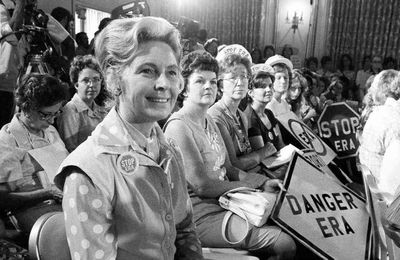
The huge hall is jammed. It's an ugly Sixties box; bare red girders in huge Xs brace against the next quake, making it looks half-finished. Students ignore the firemarshal and fill the aisles, even perch on the slanting girders. And of course they flood the stage itself, leaving only a little clear isle of podiums and mikes at the stage's edge. I'm directly behind them, in fact. My back's against cement, and I squirm, trying to find a comfortable position. People frown at my rustling; the debate's starting.
Schlafly chatters hostile nonsense. The audiences gasps and hisses. Schlafly laughs. I feel time-warped... not to the 60s but to the 1840s and 50s--the pro- and anti-slavery debates. Perhaps it's Phyllis's age. Not physical age but she has the same antique air as Ronald Reagan... and the same ability to get away with murder. Teflon. But why's she unstoppable?
It's not the content of her speech. Nothing new there. Competition, life is hard and unfair, you women are just lazy. The usual. It's her style! I know why the ERA is losing. Schlafly's playing a game she enjoys. She's not out to inform, or even to convince. That's not the point. She enjoys shocking, and angering her audience. She's here to offend 1500 people and get paid for it. Yet she has something in common with Reagan's nice-guy stuff! What?
These students live in a world where women are massively underpaid (and men face early death). Schlafly looks out over this troubled crowd, and cheerfully denies their problems. They should all get married and shut up. Or do as she did and overcome the tilted playing field to become rich and famous like her. Do it alone. Be Wonder Woman.
She's free to be as vicious as she wants, tell any lie. This is entertainment--for her at least. The viciousness of privilege is the privilege to BE vicious.
I've heard all this before from my grandma. Folks born back at the century's turn believe life is tough and unfair, sympathy is nice but impractical, and politics is a game to be played for gain. She imposes values a century dead, values that made sense... when politics couldn't destroy the world. Even enslaving a race or a sex didn't provoke an uprising--upset the board, end the game--for life was hard for most folks, and would stay that way, no matter who was in power. Power was a small game atop a broad table of life. Even if revolution did happen, the table of the world was eternal. No big deal in the end.
Ronald Reagan, killer of poor people, small nations, weak species, possibly of an expendable planet, quoted at his trial in hell: "But I played by the rules," he said. "I won."
It's this same mad certainty, the lack of self-doubt, that gives Schlafly immunity. They don't play fair with us, but we do with them. Why?

So a glib Schlafly or Reagan confuses us. Articulate, yet SURE?
We mistake their casual prenuclear certainty for enlightenment won by living through so many eras, so many social experiments. But these values our elders espouse are not a common denominator or foundation underlying our 20th century roller coaster. They're just beliefs, like all others--but beliefs held by the last generation that never had to question its own heart.
So when an imperious, impervious, oblivious, happy monster comes along--we LOVE it.
We identify with the Reagans--because Reagan and Schlafly are the only generation left who CAN win. They're playing only for points, not to solve problems, not to save our lives. Reagan smirks and we can watch, feed that rebellious little part inside that only wants to win, just once, feel a pleasure guilt-free in their time--but not in ours.
MacKinnon (like most modern reformers) has a grim gray air. It's why reform loses. She's intelligent--and wastes it on logic. That's wise when you're fighting a rival ideology. But she's not. Neo-conservatism's not an idea, it's a feeling: relax, you needn't examine your greed or your prejudices. Hurt whoever you like, it's just a game. The ol' Darwinian game.
Logic will have a use again, when the last of the Certain People is dead... provided they let us live. But now... it's no use to combat glee with more of the agonizing that feeds the glee. MacKinnon's painful plodding logic, the technical terms, suddenly look to me like the skeleton of a high-rise building, each steel floor built on the last, huge, rectilinear, massive--yet penetrated by the random wind, vulnerable at ground level to mad bombers, and even if completed, essentially sterile--uninhabitable. The insecurity of all that steel--versus the prancing chattering maniac who killed equal rights in America in the 80s.
What a smug world it was, in the 1800s, when revolutionary ideologies of the modern sort really got going... Marx, Freud. They erected steel explanations for processes that were complex, alive, even self-aware. These revolutionaries were fighting a steamroller of church, state, custom. Feelings, intuitions, even plain experience that things didn't work were not enough. They had to be respectable in their call for revolution, so they took Newtonian billiard-ball science, clock science, as an ally, and they devised imitation churches, imperial bureaucracies. Salvation armies.

Their ideas had the same assumptions (top-down power and control) that the older systems had about what was important, what was proper. "Revolution is not tidy." says Mao.
But Maoism was.
It's become a cliché that Marxism paralleled the European society it rebelled against: materialism, ruler-worship, linear time, a future apocalypse and a Heaven on Earth, martyrs and saints, and centralized bureaucracy. But feminism as I see it tonight is little different. The catechisms of MacKinnon's religion, like those of Freud or Marx, became more ritualized and sterile when she's under attack. The radicals I know are rather lively people--except under attack. The defense is often to get technical, to squirt gobbledygook (which may still have meaning) the way a squid squirts ink as a decoy. The trouble is, when you're up against a happy killer, a Reagan, or any fundamentalist (for the problem is worldwide), jargon-spouters look like stiff unhappy people you'd be a fool to follow.
Neither ideological defense nor cheery psychosis... what then?
I found my own answer by chance.
A black woman in the audience challenged Phyllis Schlafly's latest assumption. And Schlafly answered "Well, you have to understand that your kind..."
The audience hissed, and rippled like the fur on an angry cat.
I hadn't caught it. Lulled into racism by the voice of my grandmother's clone, I hadn't heard a thing in that phrase.
I repeated "YOUR KIND?", loudly, shocked at my acceptance of that grandmotherly tone--an echo of the voice of my real grandma as she spouted race and class stereotypes with Reaganesque warmth and certainty. I discovered this in a flash, in my skin, like finding a leech crawling on me, and I reacted in horror, flinging it loudly away, reflexively.
A tall white woman near me, a student, turned and hissed at me "Let her speak!"
She was giving Schlafly something Schlafly wouldn't give her--and she knew it. And was proud of her own fairmindedness.
I was embarrassed, sweating: I had been defending my sanity by flinging that horrible, deferring, hypnotized part of myself away. But to her I was out to spoil a debate.
"Let her speak"? But she was--speaking and speaking--how had I stopped her? How could ANYONE?
Yet I felt afraid to laugh anymore, even when Schlafly said laughable things. Unlike Schlafly (who clearly enjoys it) I didn't want to be hissed at by a tall beautiful rich white Stanford girl.
So I shut up and went home and wrote this down.
I didn't write a pro-heckling letter, but I did get to the point where I realized I wanted to. Laughing at lies does not censor them, after all. In the 60s radicals heckled and shook up society by exploiting its rigidity about what was speakable. They argued by showing--blood on draft files, war in the streets. The mainstream, frozen at the time into an arthritic glacier, couldn't cope with freaks. It's a shame, but today the left is on the defensive; the mind guerrillas, to use Lennon's phrase, are the radical right. The Schlafly types don't care about the truth--she's rediscovered it's feelings that matter in American politics. So, spouting emotive nonsense, she zips around the MacKinnons who flounder in their ponderous logical armor.
They both appalled me. My impulse is still to laugh. My real values aren't ideological but experiential. Rhetoric is dead, and so's logic. I trust no conclusion I have not lived.
JUST BEFORE BED
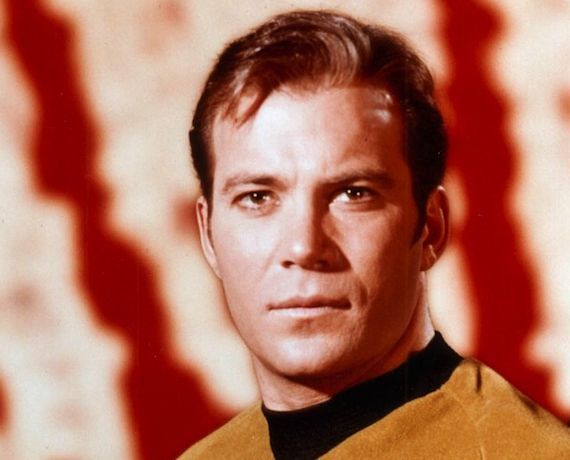
To relax, I turn on the nightly rerun of Star Trek. Captain Kirk is on trial for ejecting a man into space without warning... yet Kirk quite clearly recalls warning the man to get out of the pod, well before he hit the button. Yet the computer log shows he didn't. He's a murderer.
Spock plays chess with the system. And wins, as he should not. The computer must have been altered, by a master. The murdered man was one of the few who might have managed it.
So Spock evacuates the ship, asks the tribunal to convene there. He has the computer monitor the combined heartbeats of everyone on board. And one by one, deletes their hearts.
And the ship has its own beating heart. The dead man's heart. Down the eerie empty corridors of the Enterprise, Kirk tracks the madman through his ship, listening to the tell-tale heart.
To confront, at last, a man driven mad by his failure to win high rank in their competitive world. Driven mad by the social structure Schlafly kept telling us is the only one that can drive men (sic) to excellence.
Tired and sad, I go to bed.
Visions of Laffer curves dance in my head.
THAT NIGHT
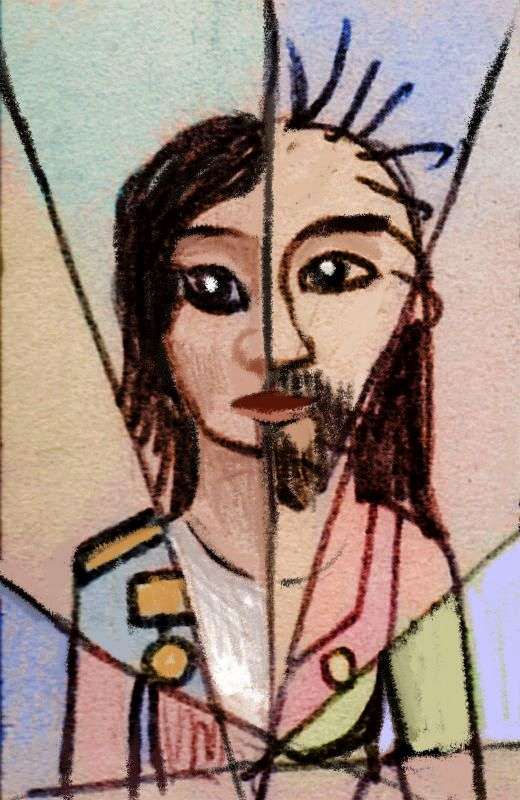
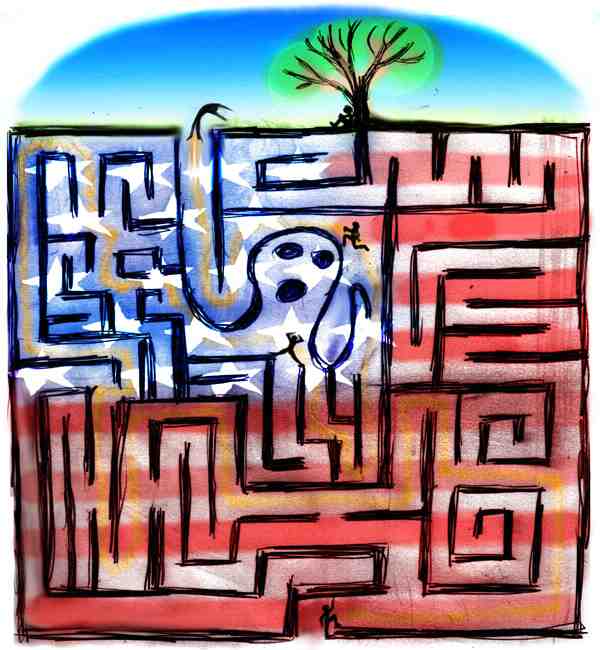
My name is James T. Kirk. I'm a pilgrim. I hike all day, on paths as twisted as lawyers, through steep and convoluted hills. Steep slopes all around, the left below, the right above. Climb up, look ahead. No end in sight.
Near sunset, I reach the camp of a bandit king. Pilgrims carry nothing, so I'm safe enough. It has picnic tables and everything. He's sure of himself, righteous--waiting for the present order to collapse so he can step in. There are other such leaders in these hills. Lots! Each is sure he'll rule.
I meet another pilgrim, my friend Kathy. She's been wrestling with fear of men ever since she was raped--it's her spiritual struggle. She's been traveling in these hills for some time with a group of women. She says "I dread these bandit camps... Their leaders are all the same, with their narrow outlook and male violence."
I go partly lucid, realize it's a dream. Kathy is an independent person, but... these bandit leaders, who I find arrogant too, are parts of ME. Suddenly I see they're INSURANCE. Latent powers, in case my ruling principles fail. Nuclei from which a new ruling consensus will grow, compromising as they ally with disagreeing factions. They're extreme because they're just facets of me--not whole people. Far less dangerous than they look, they needn't worry me--or Kathy.
Next morning, we pilgrims strike camp. There's a bus heading the right way. I tag along with Kathy's women, get on the bus... to the Magic School!
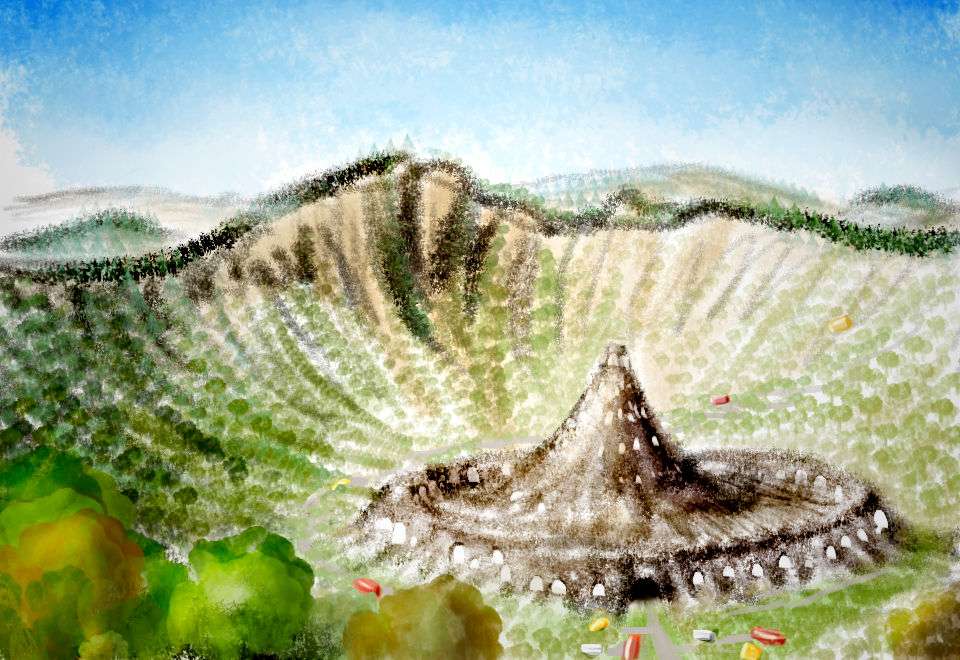
The snaky road squirms out of the hills at last. A flat valley's ahead, maybe ten miles across, ringed by hills, and dominated by a lone castle in the center, like the spike in the eye of an impact crater. Magic School!
The bus stops in the plaza before the gate. I hesitate, looking up at the blank walls. No one comes out... just an open empty gate into an unknown maze.
I'm suspicious of magic, good or evil, real or fake. Even if the powers they teach are real, how will we use them? But if I hike out of here, no longer a pilgrim, I'm fair game for bandits. I fear to be alone in this rough country. Better stay! I walk in the arch, after the others. Into the labyrinth.
I wander the eerie corridors alone. Occasionally I meet another robed pilgrim, but no one knows where to go. We speak very little to each other, suspecting it's a test to be faced alone.
I'm a Leftist, so I turned left when I entered the structure. I've stayed in the outermost corridor. Windows, but no exit. I want out! Because I'm marginal, I see outside. It's still there. That view has a price: less options, less doors than you get if you go straight in. And the only way out seems to be through the core.
I bump into an attractive woman once, and follow her a couple of doors, but we do no better as two. Each must choose a path.
I choose mine.
I turn hard right, into the heart of the structure. A windowless stifling maze. Hunt for the center.
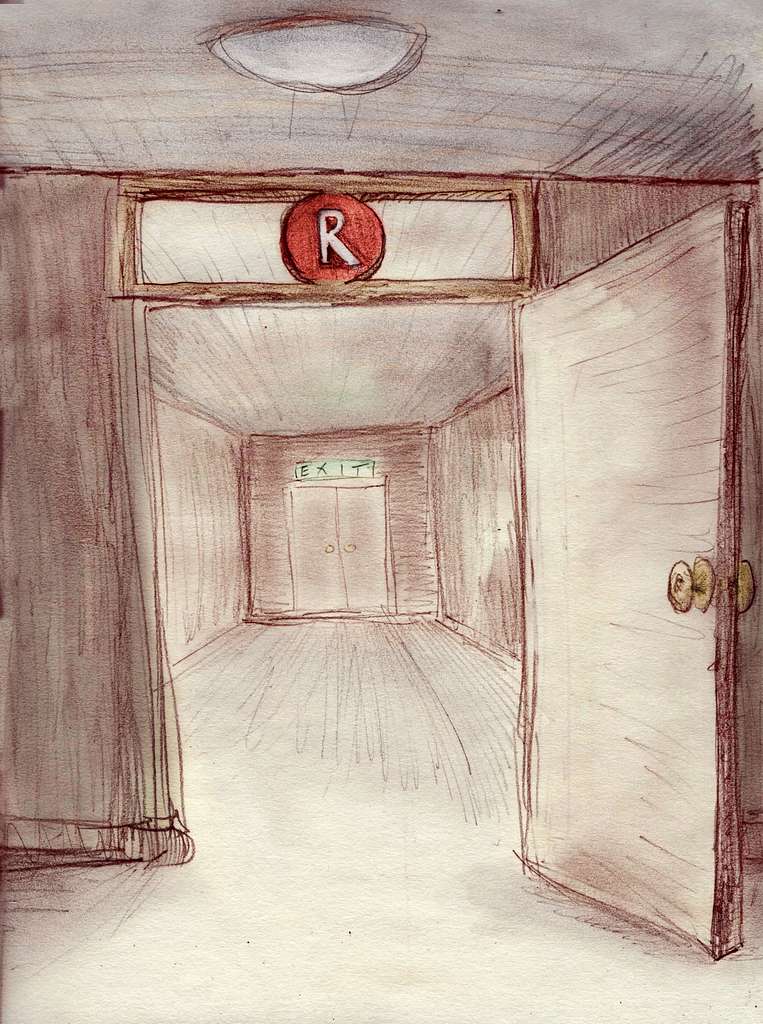
I reach the elevators. Floors here aren't numbered in the normal way... they're like house numbers, in order but not consecutive. The numbers, I've been told, roughly correspond to the level of difficulty of magic taught on that level. I look for a mid-level. The beginning ones are like where I am now, and the high ones will demand I stay in school and do all this research and justification I really don't want to... I just want enough power to get out. Among the numbers, I see one letter: R, which I know somehow is the graduates' door.
I came inward, acting quiet and ordinary, trying to be invisible within my pilgrim's group. But none of them will open this door.
If I go in, I go in alone.
I push the button for R. The door slides open.
No elevator. Just a maintenance room, and on the far side, a second door... opening to the outside world!
I step forward. Carpet. Smell. Not carpet smell. The scent of... old terror. I freeze.
What happens in this room?
I force my attention to the edges of my senses. Notice a high ringing in my ears, the fine spangles of dust. The smell and taste of old, old death. Layers and layers--a rich loam of fear. I hear settling creaks, leafy whispers. Voices! There are spirits in these walls. As soon as I quit insisting their voices are mere noise, I can hear much of what they say.
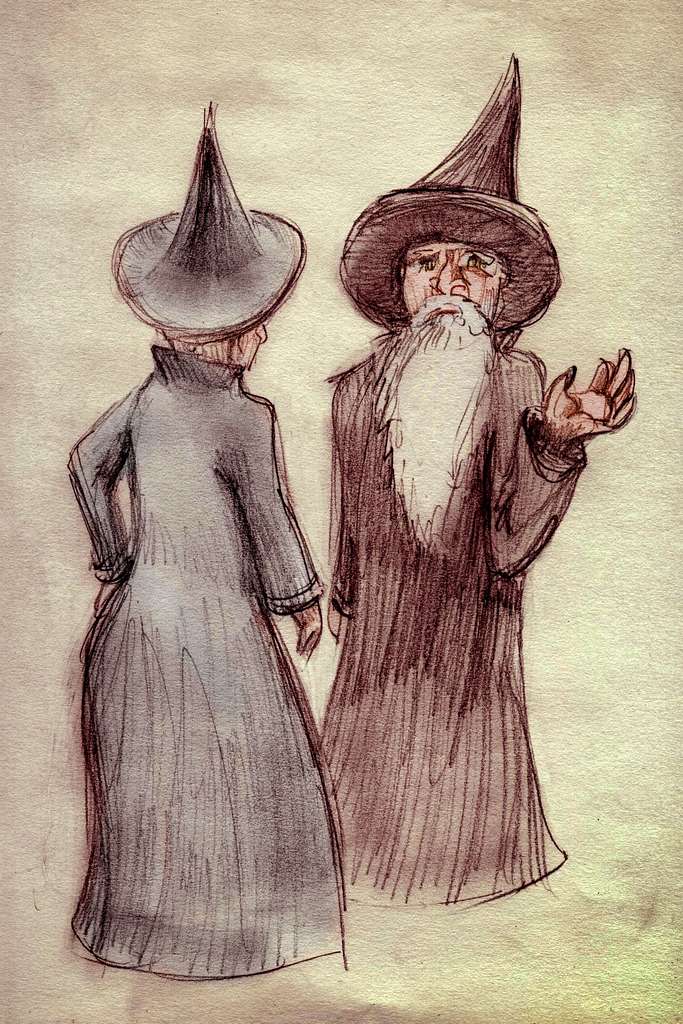
Ancient mages, graduates of the school, recalling their own triumphs here--or deaths. They seem not to realize I hear them. I act oblivious and listen, walking slowly across the carpet, as they speculate on what I'll do. Those who walk through this room are taking their graduate exam by doing so. This is the way out! But they expect me to perform some new feat, worthy of a wizard! If I don't, they'll set me a task themselves. A deadly task. What impossible spell? That's what it takes to graduate: do something no one's ever done. Or die trying.
One mage wonders if I'll change... what? The politics of... "loves"? "laughs"? The Laughter Curve? I may have misheard it. "But that'd take two students working together," he says.
An old witch laughs and says "Not so! I was the first to survive trying it alone at my graduate exam!" She failed to make the change work, but lived through the spell's fatal backlash. And so she entered the pantheon. Pushed the Art one more step toward a unified theory, applicable to any problem--their goal for generations. The Ever-Ready Algorithm, or E.R.A.
I'm astonished by their courage and achievements, and I have to face the fact that the pressure of competition does push Magic forward, it really does. Brilliance under pressure is real.
Yet... I mourn the many talented students who died trying the same solo stunt that this old graduate survived. In a less competitive society, could others have come to the aid of students in danger? Indeed the goal might have been reached sooner, and lives would certainly have been saved. I can't accept this is the only path to progress--this room that reeks of old fear.
Strangely, my thinking and listening seems to protect me somehow--am I invisible to the hovering sages?
I certainly can't attempt to do magic I haven't learned, that'll surely kill me. I don't want to go back either.
I decide to take a chance. I walk straight across the carpet, as if I know what I'm doing, to the exit. And leap through, into the light.
I'm in a courtyard. Weeds. It's a turn-around for pilgrim buses, parked while the drivers hang out in a cafe round the corner. I relax at last. Made it out!
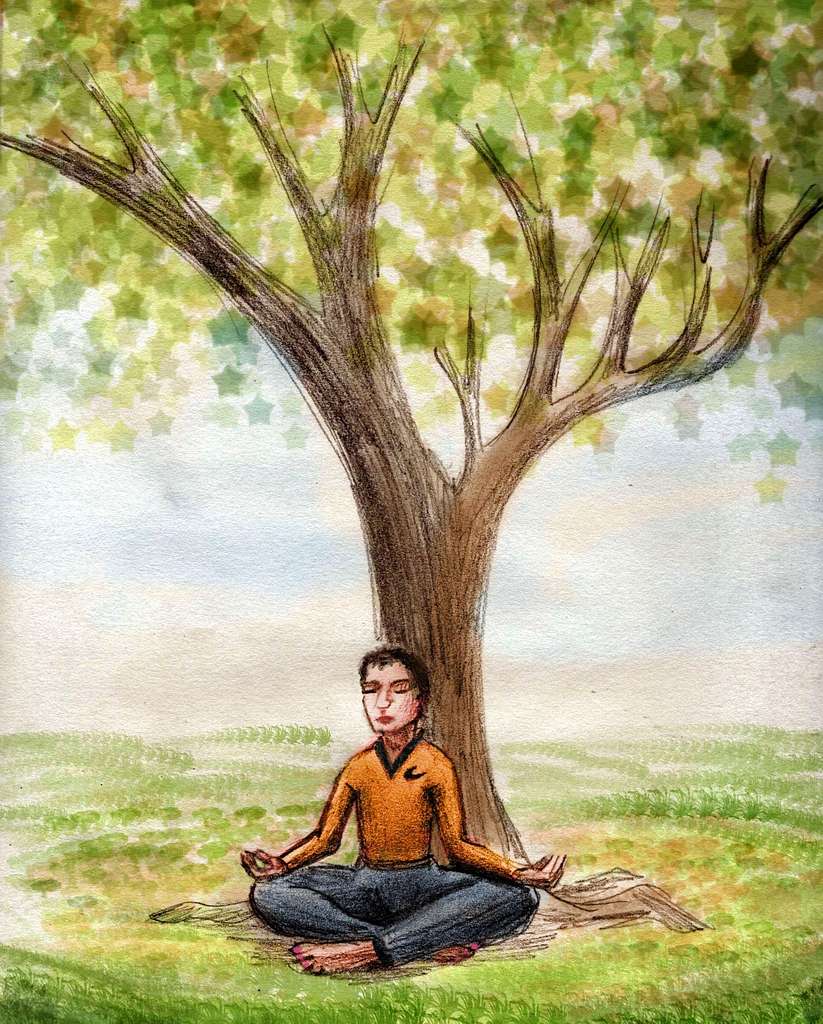
In the center of the yard stands a lone tree. A huge writhing oak. Buff grooved bark. I sit back against its tilted trunk. There's a faint drizzle from the white sky. I look up as the breeze sighs and drops mist on my face. I wonder what I want to do with my life. Others are choosing their careers, inside the structure behind me. But none of their choices felt right.
I look up through the tree. Beautiful. I suddenly see me as the tree. A naive person, who's never seen trees, might think that the motions of a tree, its branches swaying in the wind, are its actions. But a tree's real actions are slow--slow growth inside. And so it is with me! My true actions are invisible, my real motion is slow growth inside. My limbs may thrash, but that means nothing. My real tree-life is not moved by any of the winds of opportunity or challenge at this school.
Huh. I always thought I wanted to do magic! Do I need to?
A man wearing a velour uniform with the colors of a Starfleet crewman walks up to me, and says "Glad to see you made it out, Captain. Starfleet wants you to know if you intend to go back in and lead your crew out too. That's not an order; they assumed you'd know best, having been inside."
"You guessed right." I say. "But how'd you know I wouldn't stay in the school?"
"Nothing is as important to you as your duty to protect your crew."
He's right. I have to play bodhisattva.
So I get up, stretch... and walk back in the terror-door. This time I skulk around the walls of the Final Exam Hall, hiding behind book-boxes. Out into the elevator lobby. Hide in a shadowy nook as a group of acolytes passes, led by a devout robed woman. None of my people.
Drab labyrinth. On and on.
I find Bones at last in a lab filled with alembics, mixing a dark, herbal brew. Crew-women are lying face up in glass cases like coffins. Not dead: IV drips feed the brew into their blood. Mass-produced Snow Whites!
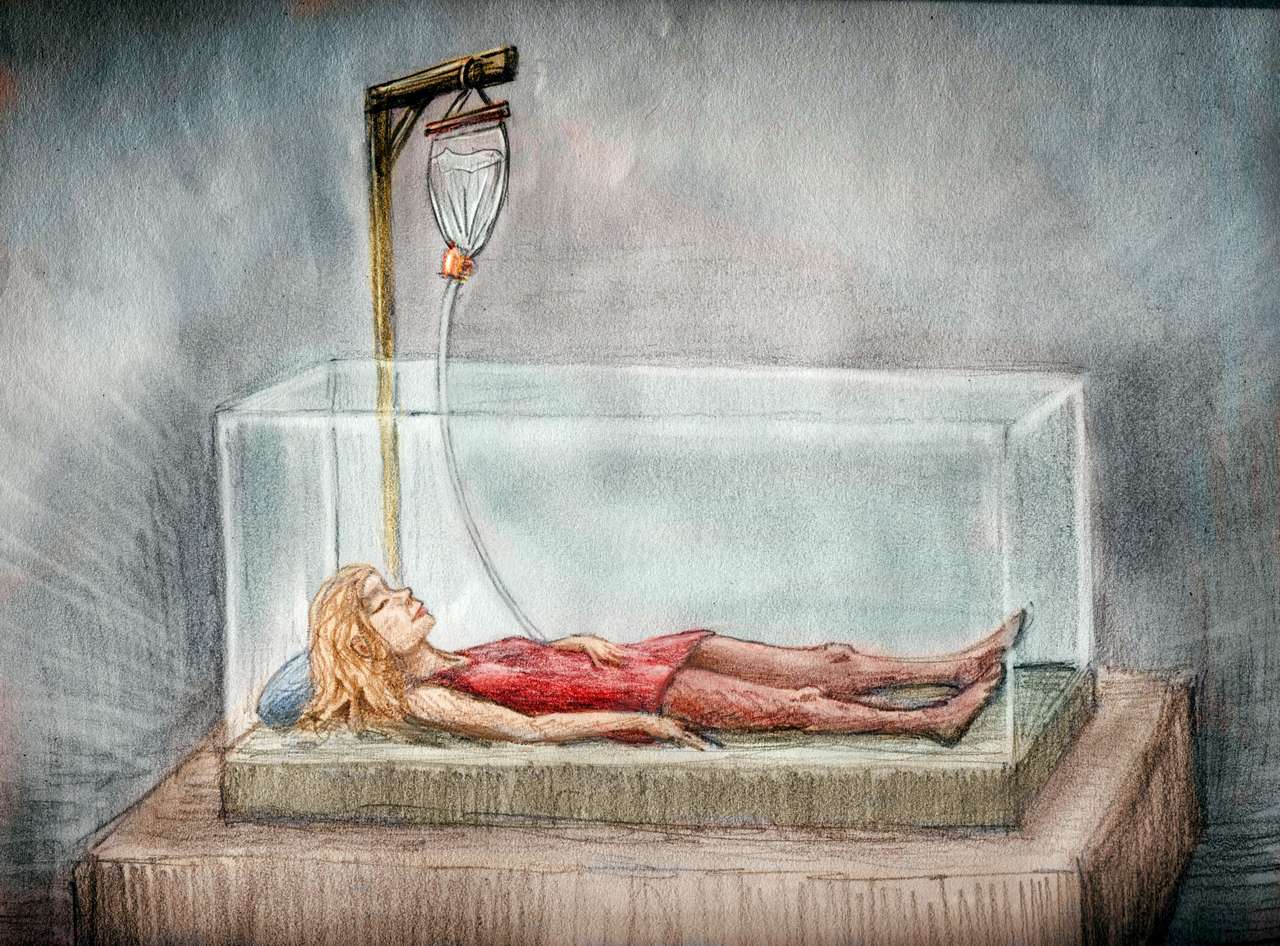
Dr. McCoy beams at me. "Jim, it's wonderful! This potion gives women the Strength of Ten! They're immune to nearly all infection too. I call it Wonder Woman Juice!"
They caught McCoy by his weak spot, his need to do good.
I say "The ten of us here have the strength of ten."
He protests. "But Jim, this may cure all disease! Gimme just a little longer--"
I say "Bones, you're putting them in boxes. All of you, time to get up! Let's go out into the open air. There's a tree I want to show you." Later. Outside. I'm sleepy, under the tree of my life. A woman is massaging me. Feels so good after all the struggles in the structure. The strength of ten fingers heals me. She's singing an ancient folksong, so old it's rumored to be pre-space.
|
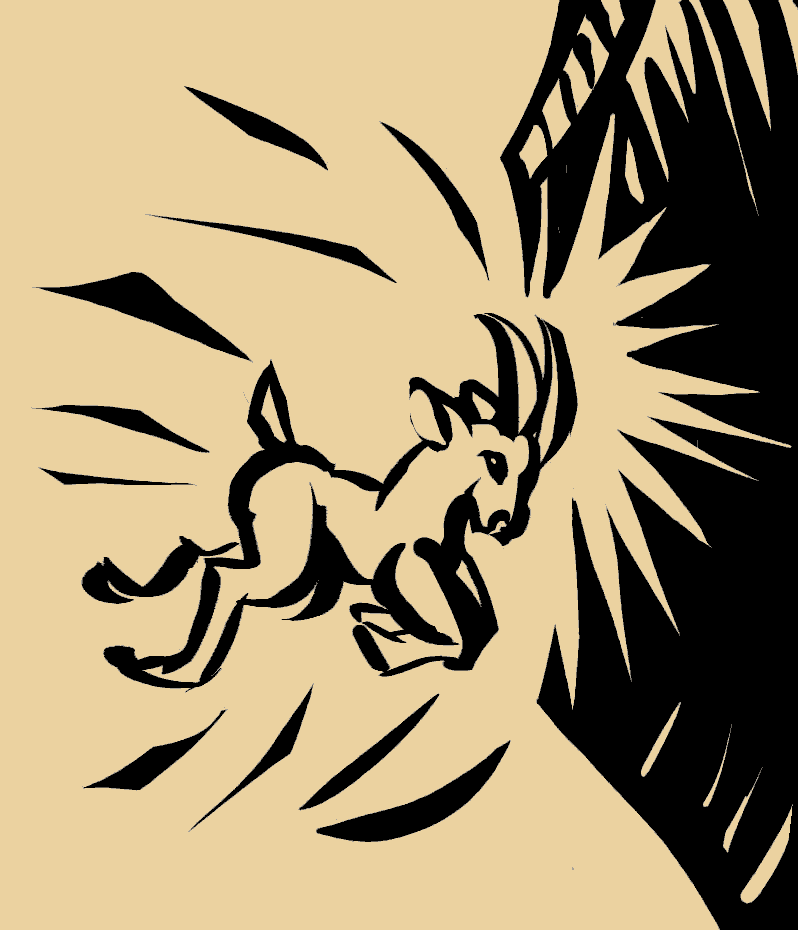
"Once there was a silly old ram Thought he'd move the Bonneville Dam Everyone knows a ram can't Move the Bonneville Dam!
But he had... Hiiiiiigh Hopes,
So when you're tired and gettin' low, |
|
As I fall asleep in the dream world and awake on the other side, I remember thinking:
"Okay, the advice to believe in yourself is good, but was it wise of that ram to knock down a huge dam just to prove he could? Sounds like Magic School thinking again! Ram thinking. Butt the barrier first, and think later. If at all..."
DEDICATED TO THE MEMORY OF...
songwriter Sammy Kahn, flag artist Jasper Johns, Star Trek redshirts, and the legions robbed by Reagan
World Dream Bank homepage - Art gallery - New stuff - Introductory sampler, best dreams, best art - On dreamwork - Books
Indexes: Subject - Author - Date - Names - Places - Art media/styles
Titles: A - B - C - D - E - F - G - H - IJ - KL - M - NO - PQ - R - Sa-Sk - Sl-Sz - T - UV - WXYZ
Email: wdreamb@yahoo.com - Catalog of art, books, CDs - Behind the Curtain: FAQs, bio, site map - Kindred sites