World Dream Bank
home -
add a dream -
newest -
art gallery -
sampler -
dreams by
title,
subject,
author,
date,
places,
names
BEHIND THE CURTAIN
Pay no attention to the small mammal behind the... oh. Too late. In that case...
Hi, I'm Chris Wayan, architect of the World Dream Bank. This is a small personal page with odds and ends not covered in the official pages of the Dreambank. Like:
- a site map
- frequently asked questions
- a mini-biography with (what else?) dreamlinks
- contact information
1: SITE MAP
The World Dream Bank is radial in design: a dozen doors access a pool of several thousand dreams from various angles, sorting for features of interest. The map below is clickable. To view all the dreams with no sorting, use the TITLE list.
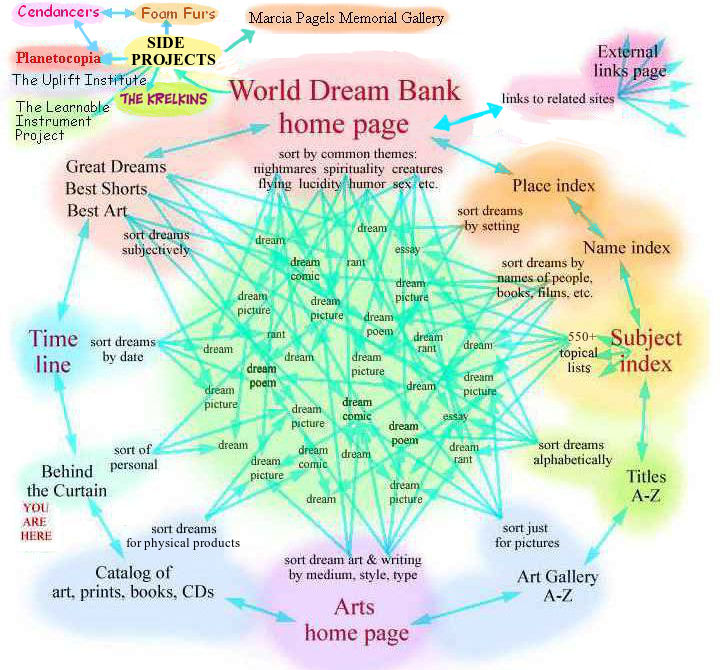
| The World Dream Bank stats as of Feb. 2024
|
| Pages: c.5455
| Images: c.9300
| Dreams: c.4191
| Wayan's dreams: c.2288
| Others' dreams: c.1903
| Dreamers: c.922
| Topics: 700
| Nondream pages: 1330?
| Files: c. 27,000
| Links: c. 500,000
| Main Side Projects
|
| Planetocopia
| The Krelkins
| Marcia Pagels Memorial Gallery
|
| Worlds: 19
| Regional tours: 200
| a surreal/dream band
| Pages: 21
| Paintings: 208
| Pages: c.350
| Images (nonmap) c.1500
| MP3s: 9
| Seeking: lost paintings by Marcia Pagels!
Email me at:
wdreamb@yahoo.com
|
| Maps: c.550
| Seeking: species for Pegasia
| Mixing: 9 more
| | | |
2: FREQUENTLY ASKED QUESTIONS
- Come on, are these real dreams?
- Yes. But I only posted the dreams I thought others might like--about one dream out of 20. But I've been writing my dreams since 1970 and have nearly 40,000 to choose from. They're edited and annotated for clarity--my raw dream-journals are hard to read, since I use lots of shorthand and abbreviations to get it all down fast. Some names have been changed for privacy, and dialog is often paraphrased since I often forget the exact wording of dream speech. But it's as close as I can get--I'm a reporter, not a novelist, and I do try to be honest with you! These are real dreams.
- How can I have dreams like this? How can I remember dreams like this?
- Here's what my dreamwork's taught me.
- Patience. When I get too busy and ignore my dreams, I wake up blank. Takes days of discipline to recover my dreams. Persistence pays off. Keep the notebook there and spend time every morning trying to recall. You'll eventually get snatches, and then more than snatches. If you're starting from scratch it takes time. So does learning a language, or music, or reading. Worth the effort!
- I sleep at least 8 hours a night--or try. Coherent, deep dreams need uninterrupted REM periods, and those mostly happen late in a night's sleep after your body's had a few hours of repair time. So an extra hour can double or triple your dreams. You can't dream much if you're sleep-starved, and many people are without knowing it.
- I don't write a dream-journal--I write a journal. I write the day's events and the night's events even-handedly. I don't know that one set's realer than the other. Writing them side by side helps me see connections. Don't segregate your dreams.
- On waking, I write an outline first--just ONE WORD per scene, and try to recall as many scenes as I can. (Don't write out the first scene you remember--or that'll be all you remember!) Once I have this bare outline of my whole night's dreaming, THEN I go back and write each one. THEN I try to put them in order. ONLY THEN do I try to figure out what it all means.
- Peace and quiet help. A loud, busy sleeping environment can convince your body to suppress REM to a bare minimum, so you can wake instantly. REM sleep paralyzes most muscles--dangerous in an emergency.
- Nutrition helps. Mineral shortages disturb the sleep cycle, especially calcium and magnesium (1-2 g calcium, at least half that of magnesium). Vitamin D (2000+ units) helps mineral absorption (also suppresses cancers). Lecithin improves memory and cognition (a spoonful of granular lecithin a day helps my dream recall). I haven't experimented with melatonin yet. Sleep medications mostly suppress REM.
- Exercise? None makes you fidgety. Restless sleep leads to incoherent dreams. On the other hand, exhaustion after heavy work forces your body to spend all night repairing damage; you'll have short dreams, if any. Sleepy but not exhausted is best.
- I rarely push to have lucid dreams, flying dreams, etc. I let the dreaming mind decide. Bossing and nagging is a poor way to make friends, even with your own brain.
- Can I add dreams, or dream art?
- Yes! Here's how.
- Is the art for sale?
- Not really. The site is noncommercial in intent. There used to be a catalog of printed comics and small-press dreambooks, but it's utterly out of date; I'm adding print-quality images (A-C, D-G, H-L, M-R, S-T, U-Z) so you can download all the dream art free.
- What the hell is this site for?
- I built it to mean several things at once--just like its subject matter. Trying to reduce a dream, or a mega-site, to a single simple point... misses the point. Dreaming's inherently complex, and so's a dreamsite. It's a...
- Personal zine (not quite a blog) for the few readers who share my eccentric tastes: the gifted, the battered, psychics, queers, furries, radicals, anorexics, nerds, witches, fantasy & science fiction fans, web-savvy animals, AIs, aliens, and so on. Hi, y'all.
- A tutorial for dreamworkers--by example. Theory bores me. I learn from experience. The intros to the many dream-lists have advice both on basic issues (like amnesia/recall and nightmares) and advanced ones (like lucidity, ESP, spirituality), all of it first-hand.
- An online reference tool for dream researchers, psychologists, parapsychologists, and skeptics about exotic and advanced dream types: lucid, nested, self-interpreting, reality-bending, shared, epic, psychic, or cledonic dreams. I've recently (Nov. 2023 - June 2024) added a lot of dreams from historical sources and various dreamworkers and dream researchers over the centuries. Again, not much theory; emphasis on examples.
- A library of dreams exciting enough to lure others into the joys of dreamwork. It ain't all earnest therapy. Dreams are fun.
- A portfolio of my dream art and (increasingly) a gallery for others' dream art.
- And of my writing, and increasingly, of others'. Dream poetry, dream stories, dream songs...
- Mmmm, what else? The site also hosts a few non-dream projects of mine:
- Planetocopia, a series of imaginary worlds that are ecologically plausible, non-preachily utopian, and still sexy.
- The Krelkins, my band. We do a lot of dream songs, so we're really not off-topic.
- The Marcia Pagels Memorial Gallery, a tribute to my late mom's ecological/landscape art (definitely the roots of Planetocopia).
- Sites for artist friends of mine: Jenny Badger Sultan's dream art, Nic Griffin's trashion (surrealist fashion of recycled materials), and Henry Sultan's mandalas.
- The Learnable Instrument Project. Dormant now that chromatic keyboards are starting to be commercially available.
- The Uplift Institute, a proposed project on animal intelligence and animal rights
- The Cendancers, a set of dozens of Barbie sculptures of centauroid alien dancers native to a world called Kakalea. A queasy blend of fetish art, humor, Utopianism, exobiology and Barbie's fabulous dorkiness.
- Foam, Furs, Dreams, a project of five lifesize dream-figures done as giant furry sex toys after years of prompting and direction from dreams. Explores the interaction of autism, giftedness, sexual orientation (furry), second sight, and the power of art to heal chronic illness (Lyme, in my case).
- It's also just for fun. I post a lot of dreams bearing heavy insights, but I like comedy, sex, magic, dreams come true... Why not? Why can't databases cheer you up, why can't porn offer spiritual hope, why can't psychology get a sense of humor, why can't scientific research (and this is--see Trefil for a scathing exposé on how we're taught we can't do original science)... be fun, huh? Huh?
- Will you build my website? Can I afford you?
- Sorry. My plate is full just with the Dreambank, Planetocopia and a few friends' sites.
- How did you build the site, what software did you use, what is the site's architecture, etc... all of which really boils down to
Are there lessons here about building my own site?
- Yes, there ARE lessons. Here's what I did and why.
- THE TEXT: Dreams from the last few years were already text files, because I typed them up when I woke. Those dreams merely needed editing, but older handwritten dreams had to be keyed in. Where my handwriting was good enough to read aloud without too many pauses, I transcribed using 'Dragon Naturally Speaking'. An error-prone program, but editing is easier than typing, and at least it's a change--saved me from carpal tunnel syndrome. Such transcriptions were livelier, too. I recommend oral storytelling. Things ring when read aloud (and if they don't, you better rewrite!) I'm gonna re-emphasize that. Far better to have a site built using crappy code and no effects and READABLE TEXT. Spend time writing. Weak writing is the Web's great flaw. Stand out.
- THE PICTURES vary. Many already existed, but they had to be scanned or photographed and heavily color-corrected. Tedious, but I did a few a day. Over a few years, that adds up. I drew hundreds more especially for the site, of course, but that was different. That was my reward, getting to do a digital image every day, if I did enough code or cleanup or editing.
I'd guess 40% of the pictures are pure digital, 40% are pencil or ink drawings tinted shaded and tweaked digitally, and 20% are pure nondigital--acrylic paint, crayon, charcoal, sculpture.
I used an old simple version of Photoshop for much digital work. I like the free program Irfan View for renaming, resizing, and batch work. It also sharpens better than Photoshop without increasing file size, and handles low-quality JPEG images well (most images on the Dreambank are only 60-80% JPEG quality; this tremendously speeds loading). As of 2014, my old computer fried itself and the new one won't run antique versions of Photoshop, so I'm using GIMP, the Open Source alternative. A bit clunky but it gets the job done.
Your paint/photo program will have a histogram. Learn to read it. Maximize contrast without losing pale and dark details. This GREATLY increases the punch of illustrations!
For small images especially, heighten reds a bit--JPEG compression dulls red (especially details) more than other colors. (Not sure about PNG format. GIF colors are true.)
-
THE LINKS were of course the hardest part--100,000 of anything will wear you down. I mass-produced them as follows:
- At the end of each page I typed up, I made a list of themes and topics. In my dream-journals, these already existed in crude form. When typing, I consistently misspelled each topic and stuck a 2 in front of each code-word. So a dream about anorexic talking pigs had "2anorx 2critr 2pig" at the end. I wanted combinations that'd never occur naturally in the text.
- Once all the pages were annotated like this, I used Cold Fusion to globally change all instances of 2ANORX into <a href="2ANOREX.HTM">anorexia</a> which is a working link to my page listing anorexia-related dreams. You don't need Cold Fusion for that; any program that'll search and replace a text string in lots of files at once will work. Just be careful!
- I did it again, for 2critrs, for 2pigs... I'm up to over 700 such search-and-destroys, oops I mean search-and-replaces. Obviously such broad changes were risky, but my little codes were so unnatural I had almost no unwanted alterations, and 99 per cent of the links went where I wanted without tweaking. It was much faster than using a web editor to insert all those links one by one, or learning a powerful site-management program that'd generate them all at once, and checking 100,000 results. Use familiar tools! Starting with your own brain. Don't let software think for you. Bad precedent.
-
DATABASE VS NOT: When you click on, say, "assertiveness", there is no search engine looking for "assert" on the pages and assembling a list for you. I wrote the lists, all of them, consciously judging which dreams fit. This was tedious but had advantages: no search engine could find subtle, abstract things like dreams of assertiveness, Jungian shadows, or dreams about dreaming. And for dream-pictures, by their nature out of the range of normal photos, machines really only understand the "alt" description--totally inadequate. A good site needs a real editor.
I didn't actually WRITE 720 lists of course--I wrote one monster list with blurbs describing every dream on the site. Then, for each topic, I cloned my master list and just cut out all the off-topic blurbs! Faster to carve 99 per cent off an existing list than to paste together a new list. It took time, of course, but it would've taken even longer to annotate every entry so heavily that a machine could search it properly, learn a database program that could handle it, and correct the results. (Also, database-driven pages display slower on the Web, they take too much processing time. Handwritten ones load fast). I update the lists the same way: manually. Tedious? I guess. But I'm making editorial decisions a machine really shouldn't.
-
TOOLS: none, really. I limit myself to around a dozen HTML commands and just write the code myself. I tried three different HTML editors that well-meaning friends pushed on me, but I found typing it was faster, simpler, cleaner and more concise. Microsoft Word wrote the worst code, but all software added unneeded, hidden code bloating pages and making it hard to read if someone else has to fix it later. You can use Word--as long as your page starts with a little plain text, Word will think your code is just text with angle brackets, and changes nothing. So I use Word in the early stages, to add blocks of code for illustrations and tables. I wrote a few extra spelling corrections into Word's "autocorrect" function, so typing "hrf" would "correct" itself into <a href=".HTM"> </a> -- which, with the blanks filled in, is a working link. "Imacen" expands to
<Center>
<IMG SRC=".JPG" width=800 height=600 ALT="" vspace=20>
</center>
which I then fill in with a picture's name, real size and description, getting me a centered image. (Guess what "imalef" and "imarit" get me.) The dimensions usually needed correcting of course, but the dummy ones are often half right. Saves typing. Way faster than an HTML editor for me, because my Word writing-habits didn't need adjusting. I can write HTML nearly as fast as English!
I save the navbar for last; Word decides if a page is HTML or not by the first lines, so I leave them plain text till the last moment, then paste in the navbar from a separate little text file, add the page's title, save it all as plain text, and change the name from "blahblah.txt" to "blahblah.htm". And suddenly it is.
Techies will notice that my Luddite approach is parallel with RISC (Reduced Instruction Set Computing). Simple code runs way faster; simple HTML pages, with everything spelled out and nothing for a poor old overworked timesharing server to hunt for or assemble or fill in, load like lightning. If things go wrong, they're easy to fix--an amateur can read the code.
The roots of my sitebuilding style weren't RISC, but something older: Volkswagens. I grew up driving a hippie bus. It got 28 mpg when the average was like 15, and it ran forever. You could fix it with pipe cleaners and duct tape. This site is a hippie bus--antique, underpowered, but simple, cheap and functional.
To display HTML pages, I just kept a web browser on and hit "update" a lot. Oooh, go buy an expensive program to do that! You really neeeeeeeed it!
-
THE FILE STRUCTURE is simple. I started with no divisions at all--text, pictures, techie files and thumbnails all in one giant folder. I was happy, but some display programs had trouble with so many files in one list, so in the end, I alphabetized them to please the machine gods. Now files starting with "A" go in a folder called "A", and so on to Z. Indexes and such (like the art gallery, the catalog, this page, etc) are in a folder called 01, and the subject lists are in a folder called 2 (shouldn't that be 02? So much for consistency.) That's all the architecture there is. Ain't no more. So if I keel over tomorrow, a kid could figure out where things are and how to expand and update the site.
-
NAMES: The real secret of building and managing a big massively interlinked site isn't in the file structure or the code (and certainly not in having an expensive program to manage those!) but in the names. My filenames are all short, closely resemble their human titles, and alphabetize about the same, so I don't have to hunt or puzzle over them. Also, all filenames are unique--even if a file gets accidentally moved, it can't be confused for another or saved on top of another. And the names describe the content--Newpic.jpg is never, ever, ever a good name. Ever. Shoot yourself now and save time.
Hmm, what else will drive you mad? Oh--even a few dozen files named things like 7_3sq15b.jpg... what the hell is that? No doubt it means something, but it takes you tremendous energy and concentration to decode alphabet soup. Your brain has to go into low gear and read it letter by letter. The meaning is concentrated the way distilled alcohol is. And causes a similar hangover! Whereas your brain understands PICKLEFACE.JPG in one big gulp. Keep your names as transparent as your code!
There are no other secrets. Simple tools plus readable naming equals happy site. Of any size. End of rant, and I do apologize. But I see so many people paying in both money AND LEARNING TIME for massive, ludicrous overkill.
3: ABOUT YOUR EDITOR
Wayan is the common field name for a shy, herbivorous mammal endemic to the warmer hill slopes of the San Francisco Peninsula. This graceful but timid creature is little seen, though it nests even in urban areas. Whether the species is native or a feral offshoot of the common western shaman is still uncertain.
Treated gently it makes a loyal, intelligent pet, but should be left to forage for itself, as it is ill-adapted to digest human foods. Its diet in the wild primarily consists of fresh-picked flowers, leaves, and seeds. The species is believed to spend two-thirds of its life sleeping, dreaming, drawing, and writing.
Someday I'll tell you of my nine lives and the issues that dominated each. For now, go to...
- My life as a canary:
- Environmental illness.
- My life as a cheetah:
- Anorexia.
- My life as a dolphin:
- Genius and child prodigies.
- My life as a robot:
- Autism.
- My life as a wolf:
- Furriness.
- My life as a moss-Green slacker sloth, among you diligent Demoblican donkeys and Repucrat elephants:
- Red diaper babies.
- My life as a straight queer fairy:
- butch and femme.
- My life as a spirit:
- Dreamer and shaman
- My life as a unicorn:
- growing up with ESP.
Hmmm. What else? An Interview with Wayan goes into my dreamwork. Creating/worldbuilding? The Planetocopia Interview!
4: CONTACT
I'm best reached at wdreamb@yahoo.com Response time: slow. But at least I read it.
Facebook? LinkedIn? I'm findable on them, but I NEVER check. Email me instead.
Last resort: snailmail!
Chris Wayan
242A Prentiss St.
San Francisco, CA
USA 94110
World Dream Bank homepage - Art gallery - New stuff - Introductory sampler, best dreams, best art - On dreamwork - Books
Indexes: Subject - Author - Date - Names - Places - Art media/styles
Titles: A - B - C - D - E - F - G - H - IJ - KL - M - NO - PQ - R - Sa-Sk - Sl-Sz - T - UV - WXYZ
Email: wdreamb@yahoo.com - Catalog of art, books, CDs - Behind the Curtain: FAQs, bio, site map - Kindred sites