MARS: ELYSIUM
by Chris Wayan, 2003
Mars Reborn: homepage -- Index: Martian place names -- Planetocopia: more world-models
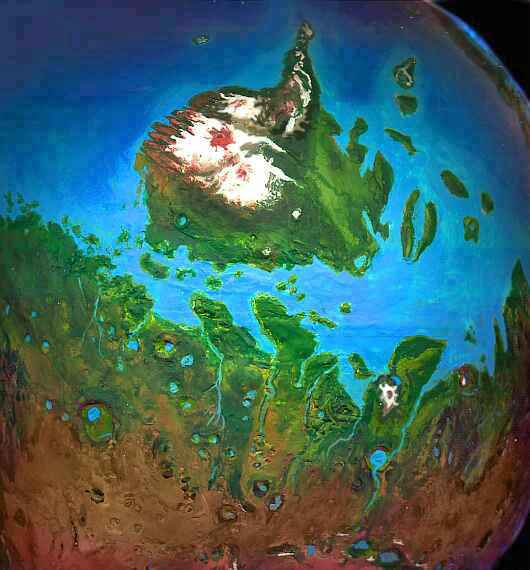
The equatorial Nepenthe and Aeolian coasts (lower half of orbital photo) are lush. Equatorial rains and low gravity combine to coax Terran tree species into gigantism. Some species in favorable bottomland top 140m (460').
The canopy, suffering no cold or dry season, offers a wealth of fruit, shoots, buds, berries, leaves and seeds; low gravity and copious food lure arboreal and flying species into gigantism, too. Parrots and ravens have wingspans of 4m (13') or more--and more to the point, are quite as intelligent as most of my readers. Down in Earth's merciless gravity well, flight has a terrible cost--size limitation. Yet even our sad little birds have tried hard to soar; they rival great apes, with brains just three percent as heavy.
Mars has freed these species' super-efficient brains to expand to their real potential.
Aeolia's life-friendly strip is broad. Even well inland, the desert one expects behind a Martian seacoast simply hides over the horizon. Beyond Lake Herschel, sunk in its great crater, a rolling grassland called Hesperia sprawls. It's like the Sahel, dry in winter (the orbital photo shows it at its brownest; still, it's not that Martian red) but with a weak monsoon feeding grass and scattered trees--and seasonal streams. It's higher, its air thinner, but vast.
A nomadic species of people will do well here--whether humans, Martian elephants, prezebras (hybrids of zebras and Przewalski's horse), or llamas, or all of them, I can't say--but I can predict they'll be as leggy and tall as fashion models--and again, quite possibly smarter. Martian gigantism isn't restricted to rainforest birds.
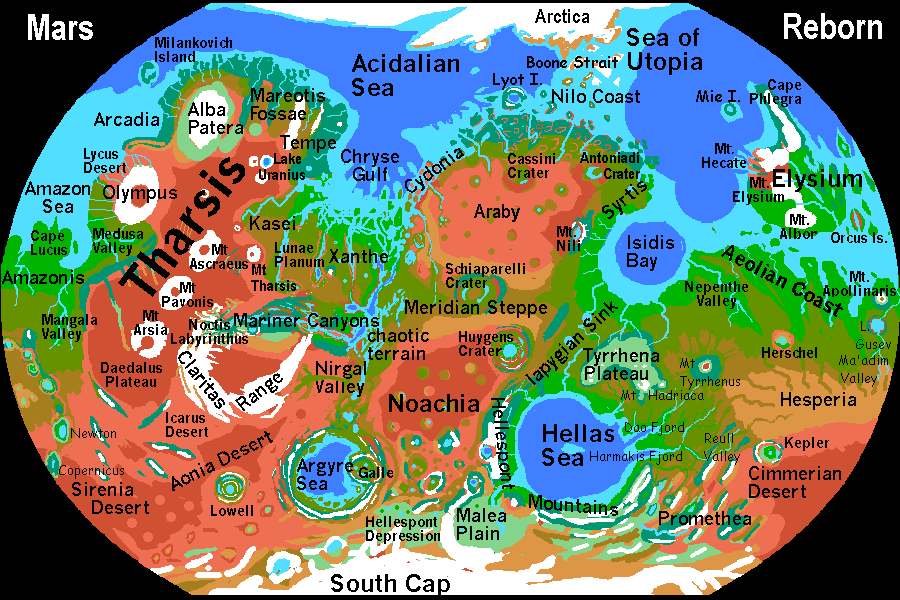
At the east end of the Aeolian coast, marking the border with Amazonis, stands Mt. Apollinaris, an Everest-size volcano whose glaciers make it visible for 200 km all around. From its jungled sea-level feet to icy top, this is one of the steepest, most spectacular peaks on Mars.
Due south of Apollinaris is a crater-lake famous in Areological history--the ancient Ma'adim River breached a crater wall to form round Lake Gusev. Its dry bed was evidence for the wet-Mars theory. Now, refilled, it's one of the larger lakes on Mars. Its warm water and sunny beaches will be wildly popular with tourists from the cool highlands of the southern hemisphere.
The sea here, too, is warm and shallow, a maze of reefs and islands. The coastline shown here is guesswork, for two reasons: relief here is low, so slight changes in sea level make a big difference, and also, a new Mars flyby hints that many of these hills are really as much as 85% ice, under a cover of dust. Once Mars thaws, capes and islands may merely melt into the shallow sea. Certainly some will survive (Apollinaris is no ice-floe!) but details are uncertain.
At the Aeolian Straits--wherever, exactly, they are--a series of bridges will hop north, from isle to isle... all the way to Elysium.
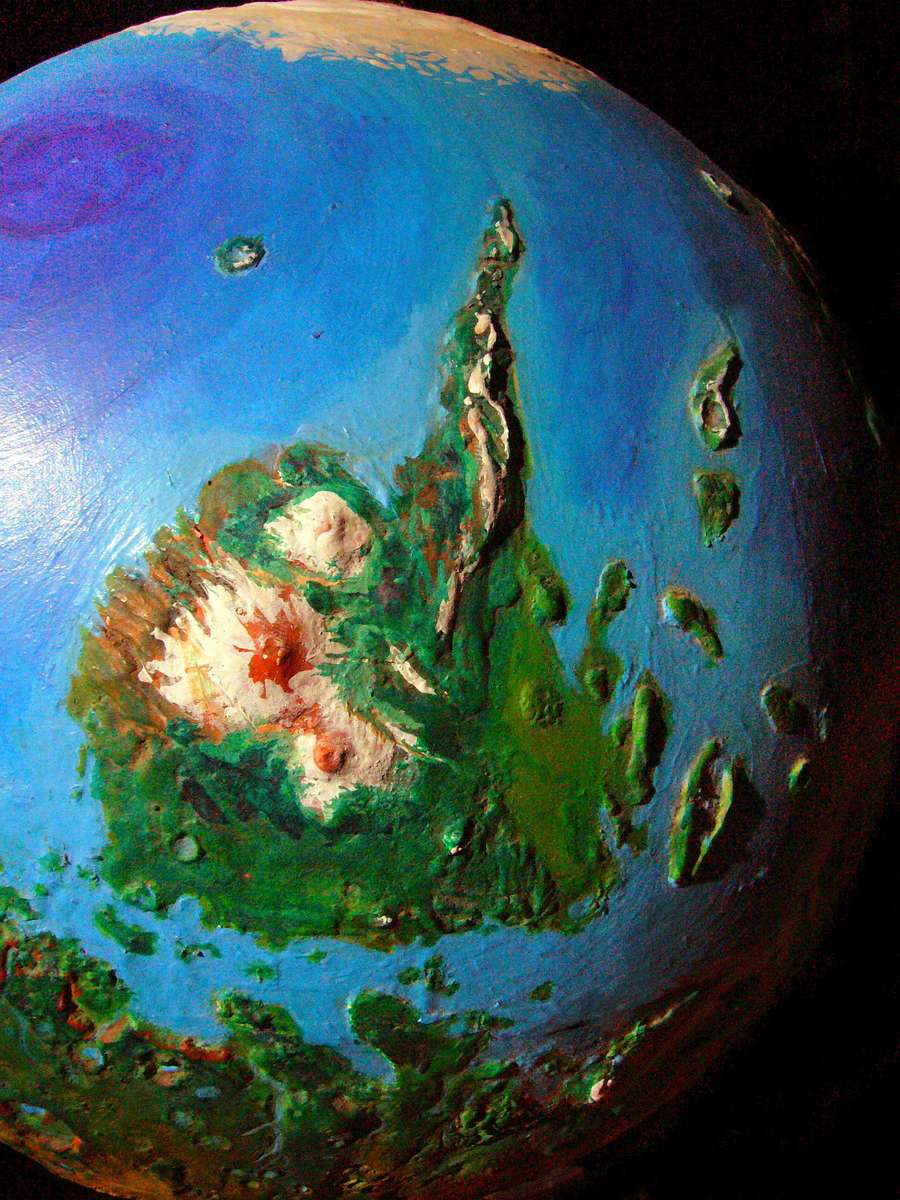
The only true continent on Mars, Elysium's fully surrounded by sea--if just barely. It's a fascinating place--Mars in miniature. In the north, rugged Cape Phlegra stretches 1000 km toward the Arctic. Kim Stanley Robinson projected a cool rainy west coast and a narrow rainshadow desert on the east coast, but I disagree. Both Phlegra coasts will get heavy storms off the North Sea. I predict dense temperate rainforest--redwood or cedar.
As along the Aeolian coast, gigantism will rule--sheltered riverbottoms may have trees up to 150m (500'). This is, by the way, a very cautious estimate; on Earth, before clearcuts, trees came close to their theoretical maximum, the limit of osmosis (drawing water up from the roots). It's dependent on air pressure and gravity; for Earth, it's only about 130m (400'). Redwoods nearly reached that. On Mars, somewhat lower air pressure and much lower gravity push the theoretical maximum to well over 200m (near 700'). I don't expect that; storms regularly lopped the tops of redwoods as it is. But knowing 120-meter trees lived on Earth before the chainsaw holocaust, 150m seems quite modest.
Of course, that maximum will take a while. Redwood generations are slow; we're only a thousand years past pre-Space Earth... the Dark Ages. Now in ten thousand years, we'll see some real trees.
The lonely ring-isle of Mie to the west, created by an ancient impact, will be equally cool and rainy. And tree-ish.
Robinson's rainshadow exists, but well to the south, on Elysium's west coast, where a series of great desert canyons drop into the sea, forming red-walled fjords. The canyon floors are green, irrigated with snowmelt from the glaciers upstream, where Mt Elysium nearly rivals the Big Four--the highest peak on Mars outside Tharsis. Elysium's little sisters, Hecate to the north and Albor to the south, are still immense peaks by Terran standards, and heavily glaciated. Rivers radiate from the central massif all over Elysium, enriched and tinted by glacial silt--not Terran turquoise, but a varied palette of jades, from bluegreen to gold to red.
East of the central mountains lies the wide fertile plain of Trivium Charontis, where milky rivers wind between scattered north-south ridges. On the east coast, these ridges create gulfs and peninsulas in the Amazonis Sea, and then islands--not the typical Martian coast-hugging mesas, but great green sloping whalebacks, 2-300 km long, randomly rising from the shallow Amazonis Sea halfway to Olympus. The Elysian Islands range from subtropical to cool-temperate, but all of them are green--some of the rainiest land on Mars.
Two of the biggest islands, the Orcus Twins, look like Thera on Earth --the Greek isle that exploded, flooding Crete and creating the myth of Atlantis. They're the broken east and west walls of a huge oval caldera, each with a gentle outer slope ending in a jagged dark cliff inland, above a deep sound where hotsprings still bubble.
On Elysium's southeast coast, fossae (straight cracks formed by shrinkage, not water) cut through the Cerberus Hills. Occasional volcanoes (merely Earth-sized) punctuate the rainforests along the south coast, along the Aeolian Strait, creating cool ecological islands of boreal forest, alps and even a few glaciers floating above the jungle.
|
|
World Dream Bank homepage - Art gallery - New stuff - Introductory sampler, best dreams, best art - On dreamwork - Books
Indexes: Subject - Author - Date - Names - Places - Art media/styles
Titles: A - B - C - D - E - F - G - H - IJ - KL - M - NO - PQ - R - Sa-Sk - Sl-Sz - T - UV - WXYZ
Email: wdreamb@yahoo.com - Catalog of art, books, CDs - Behind the Curtain: FAQs, bio, site map - Kindred sites