World Dream Bank
home -
add a dream -
newest -
art gallery -
sampler -
dreams by
title,
subject,
author,
date,
places,
names
HESPERIA
by Chris Wayan, 2003
Mars Reborn: homepage -- Index: Martian place names -- Planetocopia: more world-models
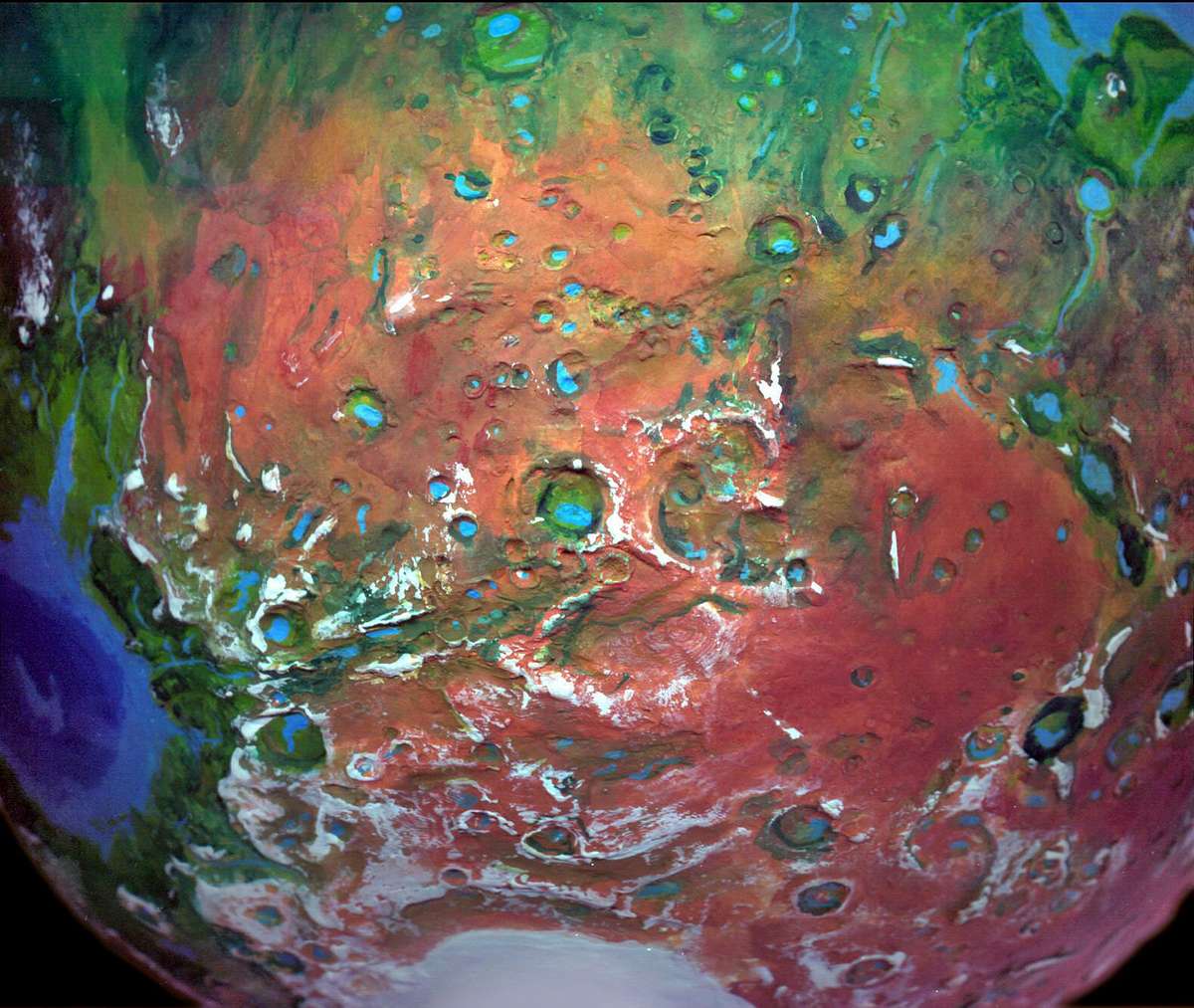
This vast stretch of the Southern Highlands looks at first glance like the biggest unbroken desert left on Mars. But let's look closer.
In the southeast is red, flat Cimmeria. Aside from a few craters and ejecta, , it's a monotonous dry plain (so smooth that I'm suspicious about Cimmeria's history. A basaltic lava flow hiding all the land's ancient scars like concrete poured over a washboard road?)
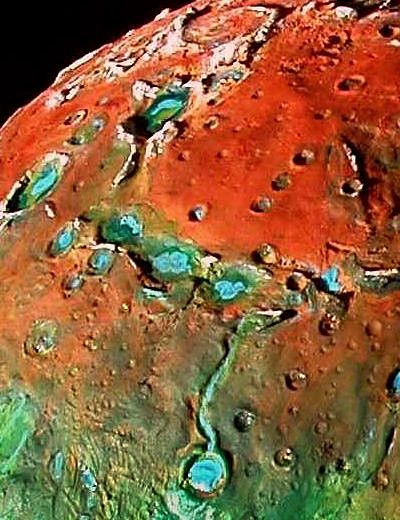
The only major oases in Cimmeria are along its northeast edge, where a chain of deep craters with denser, damper, warmer air cup marshes and brackish lakes. To the right is low-angle orbital shot showing the complex (but remember, we're deep in the southern hemisphere--the south pole's near the top!) The green zone at the bottom is the shore of the Amazonian Sea; the crater lake is Lake Gusev, fed by the Ma'adim River. Its source, the Ariadne Hills, snag most of the equatorial rain and send it back down the Ma'adim; but some gets over this low range. Very low indeed on the back side--I'm not sure if this chain of craters (called a catena) is so much deeper than the surrounding desert because they hit especially hard, or if it was a trench or slump even before the impacts.
The more isolated southernmost two of these craters, Newton (left) and Copernicus (right) lie in a cooler, snowier zone, and sustain dark conifer woods. Newton in particular is so deep that even in our own era its air could almost sustain liquid water; after terraforming, it's quite fertile despite lying well over 45° south, entirely due to its low altitude and dense mild air. Even Earth tourists are comfortable there.
Still, this chain is about the only inhabited (or habitable) part of Cimmeria.
But desert is a fuzzy word. The photo below is centered on Promethea, a much ruggeder land than Cimmeria, and lying downwind of the Hellas Sea. While its average rainfall still qualifies it as desert, Promethea's as full of snowy mountains as central Nevada, supporting conifer woods on their slopes. Even the desert valleys below have woods in sheltered canyons, and short fertile valleys whose rivers feed brackish lakes, or even (with rare luck) winding their way west to the Hellas Sea.
Crater-oases like Kepler (dead center) aren't as deep as Newton, but they retain warmth and moisture, and they add up--Kepler alone is as big as a European nation. Promethea's a sort of archipelago--not of islands, but of oases scattered in a sea of red tumbled stone--mountains flung out of Hellas in that great impact.
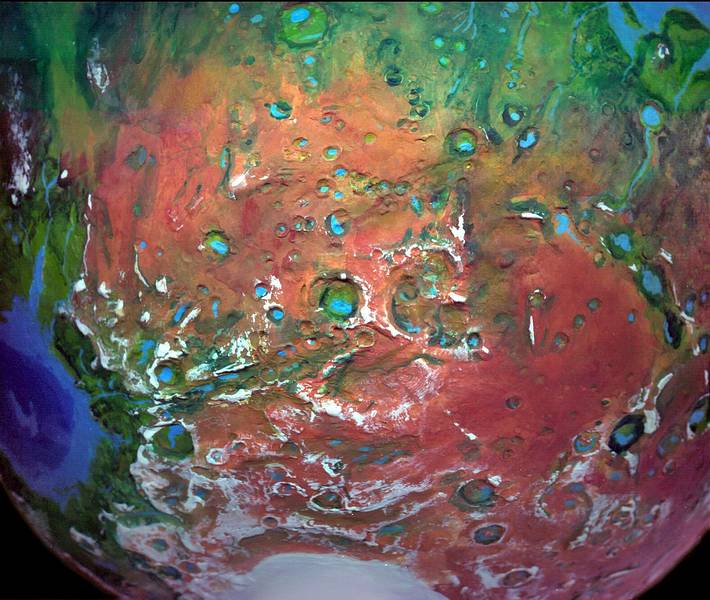
To the north and east (upper left & top) is a third terrain, again relatively mountain-and crater-free: Hesperia, the region that convinced most scientists that Mars had once been wet, for ancient stream channels wrinkle this plateau. True, the Hesperian Age may have been too brief for life to settle the land--it took billions of years on Earth after all.
But now, with terraforming, the streams are back, even if they're intermittent and too small to see from high orbit. But even sparse rains have an effect. These days, dry grass and brush anchor the red Martian dust and give much of this prairie a golden tinge visible even from space.
Hesperia's still a dry, windy, often chill prairie, but alive again, after a billion-year sleep--a land of bison, wild horse, and wolf.
North past the huge crater-oasis of Herschel (top center) pioneering trees turn the steppe into savanna; slowly the trees thicken until, near the equator, the Great Escarpment drops us (and quite a few waterfalls) into the rainforests of Aeolia.
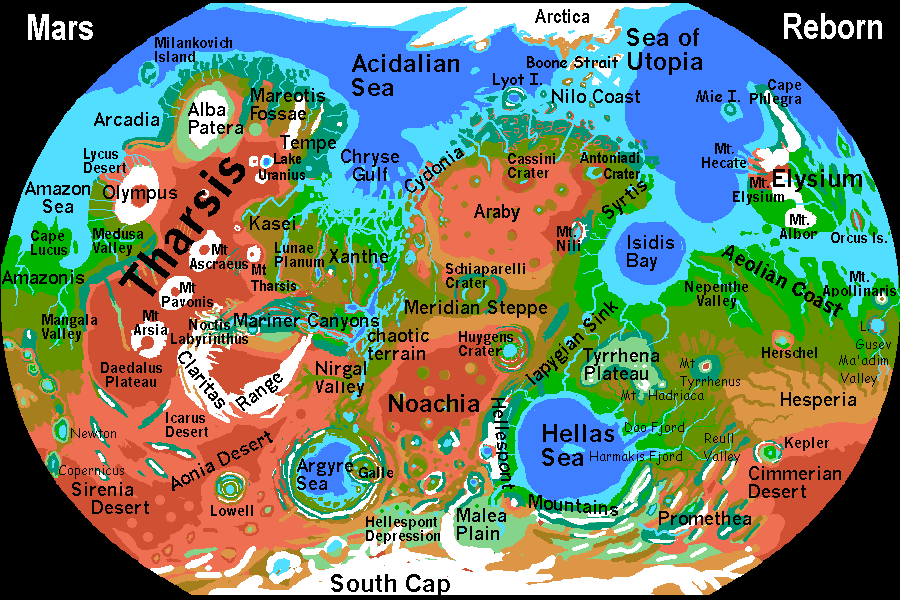
Index of Martian place names. Or for a tour, the following route snakes around Mars, covering all major features:
- AONIA, Red Mars preserved
- ARGYRE SEA, a mammoth basin
- CLARITAS FOSSAE, the unrecognized Andes
- MARINER CANYONS, less certain than you think
- the CHAOTIC TERRAINS, a fractal landscape
- the MARINER DELTA, lenticular heaven
- XANTHE, a channeled plain--warm, but how fertile?
- TEMPE, temperamental is more accurate
- VASTITAS BOREALIS, the northern sea-basin, now refilled
|
- ARABY, Arabia Terra, the great northern desert
- ISIDIS BAY, an old impact basin, now a coral sea
- the HELLAS SEA, a thick-aired basin, now a Terran terrarium
- NOACHIA, impact chaos
- HESPERIA, a steppe revived at last
- ELYSIUM, the one true continent
- AMAZONIS, heart of the Martian rainforest
- THARSIS, a plateau reaching into space
- SOUTH POLE, red and white; was green just a dream?
|
LISTS AND LINKS: Planetocopia, a series of world-models - dreams of other worlds - dreams and waking thoughts on global warming and climatology - Dreams and essays on time: futurology, the deep past, time travel, and parallel worlds - random rants and essays
World Dream Bank homepage - Art gallery - New stuff - Introductory sampler, best dreams, best art - On dreamwork - Books
Indexes: Subject - Author - Date - Names - Places - Art media/styles
Titles: A - B - C - D - E - F - G - H - IJ - KL - M - NO - PQ - R - Sa-Sk - Sl-Sz - T - UV - WXYZ
Email: wdreamb@yahoo.com - Catalog of art, books, CDs - Behind the Curtain: FAQs, bio, site map - Kindred sites