World Dream Bank
home -
add a dream -
newest -
art gallery -
sampler -
dreams by
title,
subject,
author,
date,
places,
names
XANADU
by Chris Wayan, 2006
STILL UNDER CONSTRUCTION
to Joan Vinge, for "Eyes of Amber", a tale set on a living Titan
down to map and regional tours - (don't click yet) peoples of Xanadu - (don't click yet) Xanadu's evolution - more worlds: Planetocopia
Introduction
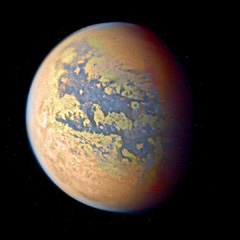
Xanadu's a memorial to a dead dream. Well, not dead--in cold storage. You see, for decades exobiologists have quietly hoped that life on cold worlds (large moons as well as planets) might use solvents other than water: ammonia, methane, ethane. Titan was the local test case--the most promising example in our solar system.
So Titan was the first time in history that many of us prayed our lander would fail on impact. We were hoping it'd drown! What a disappointment when Huygens landed firmly on that dark flat plain of... well, whatever it is. Not even tarry mud, it seems. Today, it looks like Titan has some ethane lakes, and intermittent rivers; but not extensive seas, or more than occasional rain. Those channels and beds may fill less often than the Los Angeles River.
And yet... Titan's dark riverbottoms and seabeds are so suggestive! The landscape's so heavily and obviously shaped by liquid. Could it be Huygens landed in a worldwide dry season? Or is this an Ice Age? Maybe we just need to wait fifteen years. Or a million...
But dry season or ice age or dead world, Titan's a disappointment. Though it's still quite possible there is profoundly alien life hidden in the cracks, it's clearly not a rich biosphere. It looks now like the poles are the rainiest zones, not the equator; the latest radar scans show dunes in those black seabeds.
With Mars, humanity had centuries to puzzle over its markings, to dream of life there. On Titan, we had barely a year between the first hazy images of surface markings to the clear delineation of riverbeds and apparent seas--to the dashing of our hopes. At least locally! But the Titanic issue--can life be based on solvents other than water?--hasn't died. One dry moon can't kill the dream. There are billions of cold worlds out there!
Xanadu is a model of such a world. Like Titan, but wetter, a little warmer, a little larger, with permanent rivers winding down to ethane seas. For purely sentimental reasons, I've kept the geography and regional names of Titan (Shangri-La, Xanadu, etc): the names (curiously enough) of lost Edens. Think of it as Titan as it should have been; the Titan of our dreams.
State of the Project
Xanadu's on hold while I finish three other half-done worlds. But now that the poles of Titan have been mapped, finishing Xanadu is at least possible. Patience!
 Welcome to Xanadu
- Sun = a class G star like ours, for simplicity's sake. But it doesn't have to be--and that matters. Exobiologists focus on rare sunlike stars, because any Earthlike planet around a red dwarf would have to orbit so close that solar tides would slow its spin till it's locked facing the sun--burning dayside, freezing nightside. But for cold worlds like Xanadu, orbiting far out, tides are no problem--a red dwarf would do fine. And little red stars are as common as dirt! If even a small fraction of the ice-moons out there are life-bearing, such Xanadus may outnumber all the Earths in the universe.
- Orbit = 9.5 AU from its sun; that's 1427 million km--just where Titan orbits. With one difference; Saturn's missing! Little Xanadu is a planet in its own right.
- Total annual insolation = about 1.1% of Earth's. But much of that is scattered; surface light levels vary but rarely exceed 0.5%. Curiously, chlorophyll's quite efficient in light that dim. Of course, plants on Xanadu probably won't use chlorophyll but some cryonic equivalent. Still, chlorophyll's example shows they can photosynthesize. Plants may grow slowly, but they'll grow.
- Axial tilt = 26 degrees, creating slow but distinct seasons. I've borrowed Saturn's/Titan's tilt relative to the sun, here.
- Year = 29 Earth years. Saturn again.
- Day = 18 hours. A second key difference from Titan. Titan's day is very long (16 Earth days) but it's tide-locked, with one side always facing Saturn. Xanadu's a lone planet far from the sun, with little tidal drag to slow its spin.
- Mass = .06 Earths. A third key difference! Xanadu has over twice Titan's mass--though that's still not much; just half Mars.
- Density = 3 gm/ml. A fourth key difference. Titan is 1.88, Mars is 3.95, Earth 5.5. Xanadu is part Martian, part Titanian--about equal parts ice, rock and iron. Denser Xanadus will have more trace minerals and be more likely to evolve life.
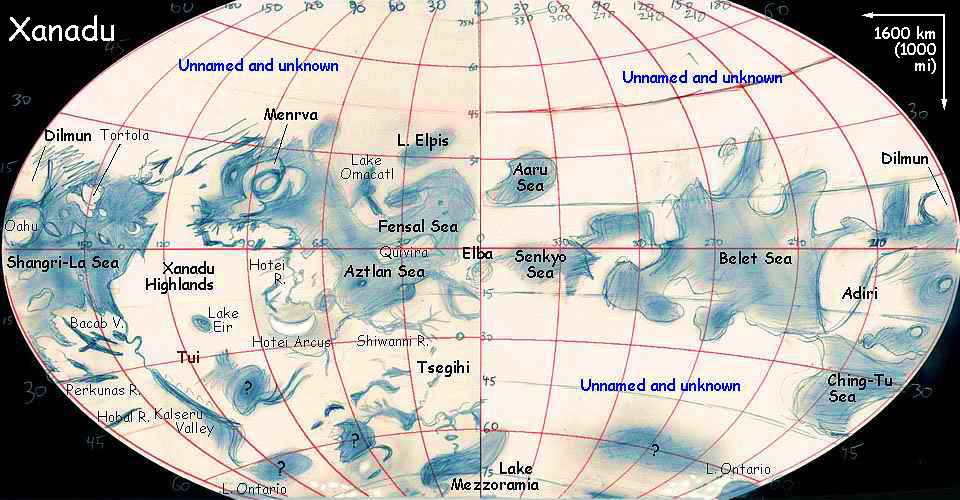
- Diameter = 6120 km (3800 miles): between the size of Mars and Titan. Circumference is 19,200 km (12,000 mi). The map's thirty-degree lines are about 1000 mi apart (1600 km). Convenient!
- Gravity = 0.26 G, only two-thirds that of Mars, and a quarter Earth's. Yet it's enough to hold a dense atmosphere. No surprise--Titan does so with only half this--a surface gravity less than Luna's, in fact. There's a lesson here: down in our hot little ghetto, you need strong gravity to hang onto an atmosphere. Not in the Xanadu zone!
- Surface area = 115 million sq km (45 M sq mi): 22% of Earth's surface.
- Seas (ethane) = 25% of surface area; 28.5 million sq km (11 M sq mi), larger than Africa. All are shallow; about half the area is "coral reef" complexes--larger than Earth's.
- Land = 75% of surface. That's 86 million square km (34 M sq mi), or 57% of Earth's land.
- Geography = Titan's. Same names, same topography. Just a little warmer and a lot wetter.
- Polar caps = none (that is, of methane, ethane or nitrogen snow--dry ice and water ice are everywhere.)
- Age = 4.6 billion years, same as Earth and Titan; but only because we gave it a sun just like ours. Most Xanadus out there will orbit long-lived red dwarfs. That's good: many factors suggest life will be slow to evolve on Xanadus. They can use a few extra billion years.
- Atmosphere = nitrogen over 95%, methane and other hydrocarbons a few per cent--but in quick circulation. How much depends a lot on how life evolves, what the local chemistry of photosynthesis is. It sure won't be like Earth.
- Air pressure at sea level = about 2 Earth atmospheres. On Titan, it's 1.5 or 1.6. As Xanadu's a bit larger, we'll give it a slightly denser but similar atmosphere.
- Temperature = 120 K? (-153 C, -242 F). Distinctly warmer than our Titan (90-100 K). More energy, faster reactions. Methane will boil, but ethane seas will be fine. (Ethane is basically two linked methane molecules. Methane's melting and boiling points are just twenty degrees apart--pretty fussy stuff to base an ecology on! But ethane stays liquid over a ninety-degree range--quite waterlike.)
- Greenhouse gasses = methane and its relatives (it's too cold for CO2). Titan probably has a weaker greenhouse effect than Earth--methane traps heat, but there isn't much TO trap, and the smoggy haze reflects more than it traps. Xanadu has less haze and even more methane and ethane vapor--strong greenhouse gasses. How much? 3%? Certainly more than Titan's 1-2%. But not too much more! We want a reducing atmosphere just strong enough for animals to breathe and "unburn" in some reverse to our oxidation process. But methane's a powerful heat-trap. Too much, and you'll boil the ethane seas. And the stuff's unstable; even weak sunlight will break it down over time. Life (plus cryovulcanism) must maintain it.
- Sky color = variable, hazy. Not as hazy as Titan: life, hungry for useful molecules, has scoured much of the hydrocarbon haze from Xanadu's air. But still the noon sun looks red-orange, when it's visible at all; at lower angles it's often lost in haze. Nights are black and starless.
- Cloud cover = far less than Earth's; the seas have a smaller surface area, and there's far less insolation to evaporate liquid. Most of the year the clouds stick to the tropics and to whichever pole is experiencing summer.
- Albedo (reflectivity) = 20-25%. Despite all the ice, this is lower than Earth's! Our extensive clouds reflect a lot. Xanadu has a cloudy tropical belt, so its albedo is higher than Titan's (20%). But dirt, or a mixture of ice, dirt and tars, just isn't as bright as clouds; and the smoggy haze traps a lot of light.
- Radiation levels = significant. Xanadu isn't shielded by an Earthlike magnetic field. On the other hand, the solar wind at this distance is only 1% what Earth and Luna get. Solar storms can shower Xanadu with particles; the dense atmosphere is only a partial shield.
- Ultraviolet = low. Not only is sunlight dim, the dense atmosphere blocks what does reach Xanadu.
- Internal heat and volcanic potential = modest; some water- and mud-volcanoes. Nothing very hot. Why? The core is lighter than Earth's, so there's little radioactive heating; and tidal stress is lower (unless Xanadu has a large moon)
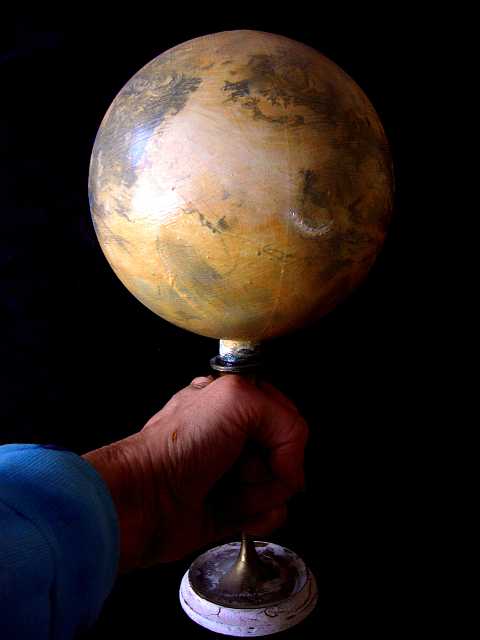
- Tectonics = active, but gentle; surface ice is cold and brittle, but deeper strata are warmer; the ice is so plastic there's little tension and no strong, rigid, Earthlike plates. So convection creates many local bulges and slumps as on Venus, not large plates and long mountain ranges. Mountains up to 2 km high--no Europa, but no Io or Earth or Miranda either. Most obvious surface geological activity is erosional--river canyons.
- Climate belts = three: tropical, temperate, polar. Titan has a pattern of belts echoing the rainfall patterns of Earth--dark (wet?) equator, light (drier?) at thirty degrees, then dark increasing again up to sixty; so (until yesterday's news of dunes in the equatorial regions) I suspected Titan had three (weak) convection cells. The new model implies wet poles, dry equator--quite alien. Probably a one-cell system where each pole gets rain during local summer, and the equator only gets rain briefly around the equinoxes. But then Titan's weather is Saturn-driven, with less influence from solar heating or the (slow) spin. Xanadu's different. Life, hungry for useful molecules, scours much of the hydrocarbon haze from its air; sunlight, though weak, drives Xanadu's weather, and the faster spin creates a more Earthlike two-or three-cell weather system with rainy tropics and cooler, drier high latitudes.
- Habitats = less diverse than Earth's. There's a fair spectrum from wet to dry, but the weak sunlight and dense air mean the temperature gradient from equator to pole is mild; ethane rarely if ever freezes, so there's no equivalent to our tropical, temperate and polar climates.
- Total biomass = about 20% of Earth's.
- Land = 30% of Earth's land biodensity. Land area is smaller, so the total land biomass is even less, one-sixth of Earth's. Mineral shortages may cause relatively sparse land vegetation.
- Sea = Three times our oceanic biodensity; extensive shallow reefs nurture at least half Xanadu's species! However, the seas are small, so total oceanic biomass is only about one-fourth of Earth's.
- Intelligent species = ??? Most intelligent creatures are aquatic ("ethanic"?) reef dwellers. But land life is possible. See Peoples of Xanadu (don't click yet!)
- Technology = generally low. The land's mineral-poor. Xanaduans will likely be stone age. Will metals ever be discovered? Though for some uses ice may take the place of metal! You can melt it, shape it, pour it... and ice this cold is stronger than Earth's slushy stuff. If you can heat it to shape it. How?
- Will fire ever be discovered? Well, the opposite of fire--a reduction (not oxidation) that releases energy from oxygen bound in organic tissue? Even if plants on Xanadu photosynthesize like Earth's, free oxygen is impossible--not with seas of gasoline. Even without volcanoes, lightning bolts, or fire-wielding creatures, every meteor strike will burn hydrocarbons and scrub all but traces of oxygen back out of the air. It'll be a reducing, not an oxidizing mix.
- Energy cycles may run backward! Xanadu's plants, powered by solar energy, pull carbon, oxygen and nitrogen from the atmosphere. There's more methane/ethane in the air than oxygen, so animals probably "unburn" unstable plant matter in some reaction involving reduction, and exhale oxygen, which plants absorb as a vital but trace nutrient. Hmm. Sounds unlikely, huh? On the other hand, consider how insane our cycle would look to someone from Jupiter. Photosynthesis, free oxygen, hemoglobin (almost chlorophyll's twin, yet doing the exact opposite job), oxidation, CO2, photosynthesis again... So the cycles Xanaduan ecology might develop would look equally bizarre to us--with our oxygen bias! Yet if life gets a toehold, it'll find some way to exploit that rich organic stew via solar energy; natural selection guarantees it.
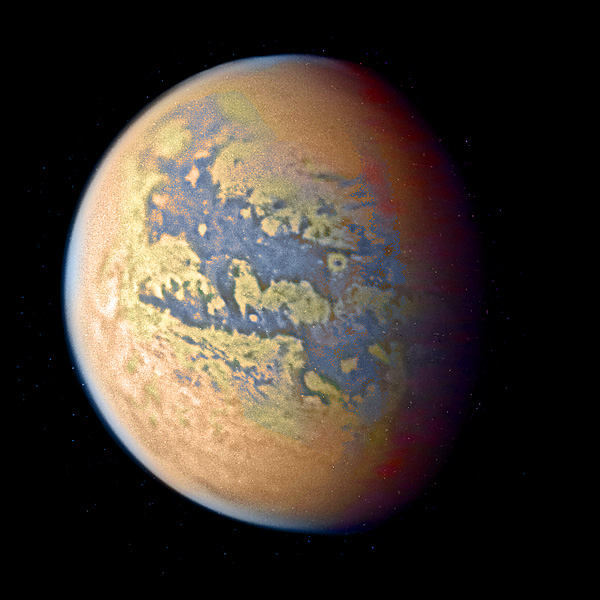
- Coloration: it's hard to know what color vegetation will be, given it'll likely use some opposite of chlorophyll that builds energy-holding sugar-equivalents through a process that absorbs traces of oxygen rather than releases it. In honor of hemoglobin, the closest Terran equivalent, let's declare that this Xanaduan pseudochlorophyll--oh, call it xanophyll, why not?--is the opposite of our green--a dusky purplish red. And let's assume that large bodies of ethane absorb shorter wavelengths much like water does; the deeper you go, the bluer you get. Maps and orbital photos should then be comprehensible if you've seen infrared shots of Earth. What of Xanadu's deserts? The grayish to whitish soils (fewer reddish minerals; less iron, no oxides; ice pebbles) will be tinted by the smog, from pale gold to tans and browns near the horizon, rising to a stratospheric blue in orbital shots. On my previous worlds, I deliberately chose cloudless views for clarity's sake, though it gave a false picture of cloudcover; but on much of Xanadu, much of the year, cloudless is the sad, simple truth. Xanadu is wetter than Titan, but it's still largely a desert world.
- Nomenclature: All names are real, from official Titan nomenclature, with commonsense alterations--"Mare" becomes sea or ocean, "virga" becomes valley or river, "lacis" and "macula" become lake, "facula" becomes island. "Crater" can mean either an impact or volcanic feature; it's hard to tell on Titan, and there's a suspicion that impacts here can trigger cryovulcanism. Is the crust thin? Hard to say. But that fits with the low relief.
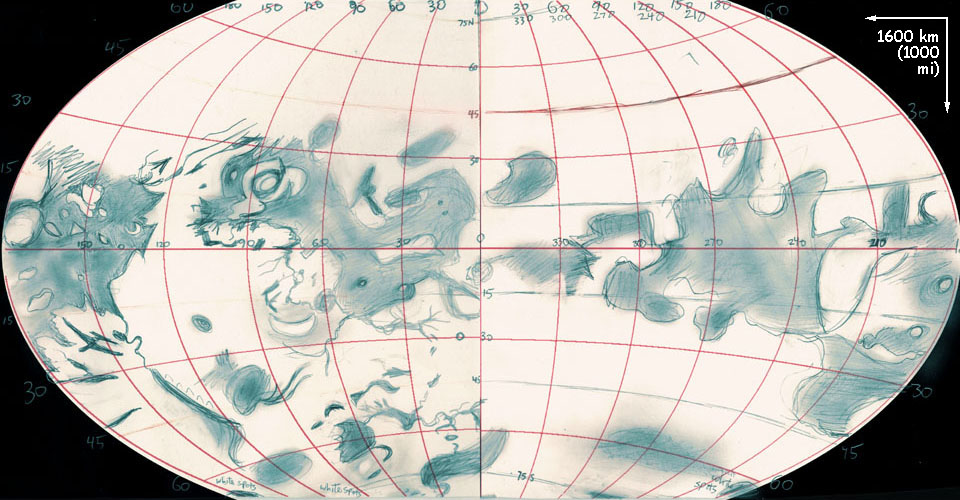 TOURS: the following route snakes around Xanadu, covering all major features
UNDER CONSTRUCTION! Only boldfaced names work yet! Shangri-La Ocean -- Perkunas, Bacab and Hobal Valleys -- Lake Ontario -- Adiri and the Ching-Tu Sea -- Belet Ocean -- Senkyo Sea, Lake Aaru -- Tsegihi and Lake Mezzoramia -- the Fensal & Aztlan Seas -- Menrva Ring -- Xanadu Highland, Lake Eir and the Hotei Arcus -- Tui and Kalseru Valley --
Xanadu's homepage - (don't click yet) peoples of Xanadu - (don't click yet) Xanadu's evolution - (don't click yet) Gazetteer - More worlds: Planetocopia
World Dream Bank homepage - Art gallery - New stuff - Introductory sampler, best dreams, best art - On dreamwork - Books
Indexes: Subject - Author - Date - Names - Places - Art media/styles
Titles: A - B - C - D - E - F - G - H - IJ - KL - M - NO - PQ - R - Sa-Sk - Sl-Sz - T - UV - WXYZ
Email: wdreamb@yahoo.com - Catalog of art, books, CDs - Behind the Curtain: FAQs, bio, site map - Kindred sites