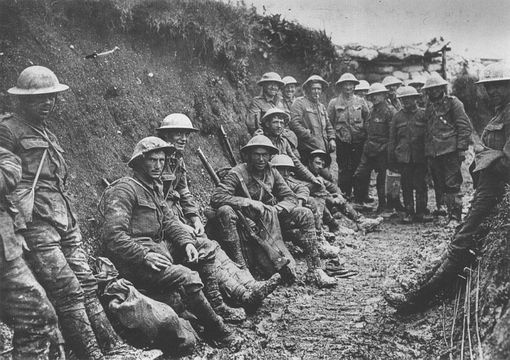
McAndrew
Recurring dreams, 1916-18, by Joan Grant, age 9-11
Mother liked looking after sick people, so there was nothing unusual in having invalids and hospital nurses in the house, although now the patients had been wounded. But I began to have war dreams, which became increasingly detailed and vivid no matter how hard I tried to shut them out.
I used to find myself on a battlefield, grown-up and usually in the uniform of a Red Cross nurse, although occasionally I was a stretcher-bearer. I knew I had reported for duty and received specific orders: either to explain to a man who had just been killed that he was safely dead, or to encourage him to return to a body that was not due to die yet although it had been severely wounded.
At first the memory of the dreams was no more pleasant than it had been to remember going to the man whose feet had been cut off by a subway train, and I tried to remember them more clearly. Very soon I prayed not to remember them at all, but it was too late. I had to get so close to the person I was trying to help that I became part of him; feeling, seeing, fearing as he did, until I could slowly, so very slowly, instil my own faith into him and so free us both from the slough of pain and terror.
I remember crawling through a sea of mud with blood trickling out of my mouth and ears. I remember lying in a shell-hole on top of a putrefying corpse with my arm blown off at the elbow. I remember hanging on rusty barbed-wire and trying to cram the slimy purple snakes of my guts into a hole in my belly.
If I tried to tell anyone about my dreams, it worried or even frightened them. I was an 'imaginative child'. The war must not be mentioned in my presence. I was forbidden to read newpapers... As though I wanted to read about the war!
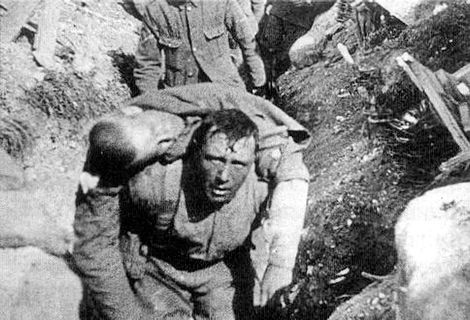
[My sister] Iris tried to comfort me by saying that soldiers who were killed in battle went straight to heaven, and I tried to share her comfortable theory that the casualty lists were made up from people who had been shot neatly through the forehead or blown to bits like [my friend] Billy...
When I was my real self in dreams I was sometimes very afraid, but I could face the fear and fight against it. When I woke up I was only Joan, a child not yet eleven, defenceless against the memory of sights, and fears, and smells. The smells were sometimes so persistent that I had to rush to the lavatory and be sick.
To keep awake I used to pull down my pyjama trousers and sit on the cold strip of parquet in the doorway between the bedroom and the passage carpets, shifting to another cold patch when the first one grew warmer. I tweaked hairs out of my scalp. I pushed matches under my finger-nails. I held my eyelids open until the skin became so stretched that at the age of ten they were as creased as an old woman's. It took me a long time to learn that even when sleep appears to be an enemy it is useless to try to escape from it.
Trying to cut off my dream-life, I behaved as a smug little schoolgirl; for I longed to be safe and ordinary, a unit in a crocodile, a number in a class, a name cut with a penknife in an ink-stained desk. But the longing did not stop me dreaming.
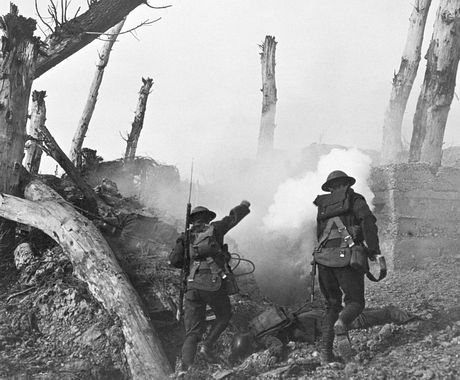
One morning I came down late to breakfast. There was a young man still at the table and no one else in the room. He was just another man in khaki, but the loneliness of keeping my dreams secret was so acute that I said, 'Somehow I know you will not laugh at me. Last night I was with a man called McAndrew when he was killed. I can describe the regimental badge although I cannot remember the name of the regiment, except that it was not an English one. And I can tell you the slang name of his trench.'
The young man did not laugh. Instead, he identified the regiment by my description. It was Canadian. Soon afterwards he wrote to Father, 'For heaven's sake don't laugh at the child. I cannot attempt an explanation, but I have checked what she said. A battalion of that regiment went over the top on a night attack a few hours before she told me it at breakfast. A private called McAndrew was among those killed. She was even correct about the local name of the front-line trench.'
Father did not tell me about the letter until years later. I doubt if it would have helped much if he had.
EDITOR'S NOTE
Grant mentions a death in the Subway after which she eased that suicide's path through death to his loved ones. But she was only seven; she told no one and had no proof it was more than a consolation dream, asserting an afterlife. Freud would argue it was. But... it didn't console. Nor did these. She's right, I think, to say that proof her nightly work was real wouldn't have helped her much. That proof just meant all those horrors were real too. Was proof needed? She and those men had already suffered. Dreams, whether they correlate with waking life or not, are experience; part of your life. Not all of it is good. She really helped others... and she really paid.
--Chris Wayan
SOURCE: Far Memory: the Autobiography of Joan Grant, 1956 (Ariel Press reprint, 1985), pp. 53-56.
PHOTOS: Wikipedia article on World War One's Western Front.
World Dream Bank homepage - Art gallery - New stuff - Introductory sampler, best dreams, best art - On dreamwork - Books
Indexes: Subject - Author - Date - Names - Places - Art media/styles
Titles: A - B - C - D - E - F - G - H - IJ - KL - M - NO - PQ - R - Sa-Sk - Sl-Sz - T - UV - WXYZ
Email: wdreamb@yahoo.com - Catalog of art, books, CDs - Behind the Curtain: FAQs, bio, site map - Kindred sites