Zupashorr, Lake, 0 N, 0 E--- (Source: an arra name)
jump to A - B - C - D - E - F - G - H - I - J - K - L - M - N - O - P - Q - R - S - T - U - V - W - X -Y - Z
LINGUISTIC SOURCES
(names may of course change; only a few have articles as yet.
- FROLCONS: Many of the placenames of southern Continent 6 derive from the gestural language of the frolcons, falconlike people evolved from frogs. The first two letters indicate right/left and fore/mid/rear limb; the rest of the name is a brief description of the primary gesture in the full frolcon name.
- DRIMROL, rich in phonemes, rather human-sounding. Placenames are long and full, with a rolling rhythm you'd expect of people with a bardic tradition; Drimrol burrows are full of spoken and sung tales during the long polar winter.
- PWOKWE: the speech of these small dinos is a long video-arcade chatter of whistles, chirps, gutteral clicks and lip-smacking sounds, interspersed with low booming hoots: pwow-pwow-bwaaom-tok-wok-pwek-chik!
- BUSREHI: these winged insects love compound names built of many short descriptive elements. Busrehi words are rich in plosives but lack an "a" vowel.
- WEKSHEK: a chattering, yapping language. Pseudocanine or psittacine, maybe? Bird dawgs, flying foxes, parrots with something original to say... Or screech.
- TSS: short names, but clearly not from the previous species! What talks like this? Lizards? Insects? Do not annoy these people. Though they also sound like they have a playful side; an appreciation of the sounds. They will have poetry, and dance, and comedians, though not necessarily standup. Will comedians here perch, or hover, or...?
- DWAN: monosyllabic words, like Chinese. But do the sounds suggest a type of creature? A bit dour, maybe. Yet these words sound comic. But... unintentionally so, I think. Do these folks lack a sense of humor? Are they all realtors? There's also a burbling, honking quality that hints at something wet and muddy--semiaquatic dinos or big frogs or hippos with fingers.
- REAMOA: a vowel-rich, slightly Polynesian sound. All those open-mouthed sounds, few gutterals; warm weather, maybe? And they must have leisure time for all those mellifluous syllables... Perhaps an arts-rich culture living in an eternal now. Ooh, vacation!
- OHALLET: hints of the languages of Puget Sound and British Columbia. They sound firm, a people with definite rules and views, but sensitive to rhythm. I'd bet all those very precise consonants mean these are descriptive phrases--compounds.
- NKORE: vaguely African; but what do all these vowels and nasals suggest about this species? They have sinuses and lips... not beaks, then.
- LANTHURA: sounds mammalian, even Indo-European--touches of Persian, Latin and Slavic?
- DILOCHA: I have no idea why I associate this group with mountainous country, but I do. Prove me wrong.
- TSIPEET: They chirp, obviously, but are they birds, small mammals, giant crickets? You tell me.
PRONUNCIATION GUIDE
My intent here was to create a transliteration system for Pegasian names that generates fairly readable, unambiguously pronounced spellings for a broad range of potential alien languages. I did not aim for academic rigor, absolute universality, or conformity to any existing phonetic system. I have discouraged diacritics and special characters, since they're tedious to code and iffy to display on some browsers. There are some exceptions, like ü, which seemed unavoidable.
CONSONANTS
Only ambiguous ones are listed here. B, d, f, h, k, l, m, n, p, t, v, w, y, and z are roughly as in English. Or French. In other words, these correspondences are very loose. Is that p aspirated or not? Is that f bilabial or labiodental? Answer: throw all that out the window! Aim for clarity, not precision or exoticism. A sound marked "t" merely means an unvoiced click much like human "t", not that every Pegasian species says "t" with a humanlike tongue or teeth or palate. Quite the opposite. Pegasian travelers (human or native) will meet creatures with strong accents indeed. Like the tribe that trills "rr" with their elbows. (Who? You tell me!)
- ' = a glottal stop (click in the throat) as in Hawai'i or uh-oh.
- c = ambiguous; only use in the compound ch. For k or s sounds use those letters.
- ch = always church, never chrome (k), loch (kh), or charade (sh).
- dh = always like this, never like adhere (use d-h).
- dl = one sound; may be initial
- dz = one sound; may be initial
- g = always gargle, never George
- gh = a voiced h or hh
- hh = like a gentle Spanish j and some Arabic h sounds; harder than English h.
- kh = a strong gutteral, like German or Hebrew ch. For the sound in backhand, use k-h.
- ks = one sound; may be initial
- j = as in jeep. Never a hard h as in Spanish, zh as in French or y as in Balkan languages
- ñ (n with tilde) = doesn't display well on some old browsers; use ny or ni
- ph = ambiguous. Use only as a special sign for a non-Terran sound, as with the Pwokwe. For philosophy, use f; for hophead, use p-h.
- ps = one sound; may be initial
- q = used only for a k sound deep in the throat, as in Arabic and Inuit, not the English kw or the lisping Chinese ch-like q.
- r = varies. A retroflex Mandarin or American r, a short Japanese tongue-flip, a strong trill as in Spanish, or a uvular Parisian gargle.
- s = always sss, never z
- ssh = a long, emphasized or aspirated sh (shsh seemed too cumbersome).
- tch = a long, or emphasized aspirated ch.
- tl = one sound; may be initial
- th = always think, never these (dh) or fathead (t-h).
- ts = one sound; may be initial
- x = ambiguous, avoid!
- zh = voiced sh sound, the consonant in Asia
VOWELS
Most simple and compound vowels are roughly as in Spanish.
- ee = always feet, never fiancee. Always an accented syllable.
- oo = always boot, never foot or cooperate. Always an accented syllable.
- ü (With luck, your browser shows that as a "u" with an umlaut--two dots over it) = as in French, German, or Chinese. Or just say eeeeee, but then shift your lips into a tube as if saying oooo while not moving your tongue into the ooooo position. It's quite distinctive once you've got it.
- y = avoid treating this hard-working consonant as a decorative vowel; use i, ee, ü where appropriate
ACCENT
Accent is most often on the penultimate syllable: LISpo, aGHUri. But doubled vowels like aa or oo, and diphthongs like ai, ao, eo, iu, mark accented syllables. So do doubled consanants after a vowel, like emm, att, orr. Don't use silent letters.
Names without apparent vowels still follow the rules. Just treat continuing sounds like dh, f, gh, h, hh, l, m, n, r, s, sh, th, v, z and zh as vowels, and hard stops like b, d, g, k, p, and t as consonants. Luckily, none of these "vowel-less" languages heavily use glottal stops, or make a (consistent) distinction between k and deeper gutteral stops (as in Arabic q), so we don't face unreadable though quite pronounceable words like tvqgh or 'hhqdh (I hope you're not disappointed). When a vowellike letter is doubled, it often marks an accented syllable, but some are doubled for simple readability, to help you find the pseudovowel, and merely indicate length, not a strong emphasis.
TONES
Some of Pegasia's languages are highly tonal, but tones are not marked (mostly for my own sanity). Length matters too, in some tongues; ii, aa, uu indicate longer vowels, but for elongated e and o (which, if spelled ee and oo, English speakers will probably pronounce like feet and pool) I've instead doubled the following consonant, just as I did to indicate stressed syllables: onn or ell is ambiguous, but will have you saying the right vowel and at least emphasizing the right syllable somehow. You're a tourist; they'll probably cut you some slack.
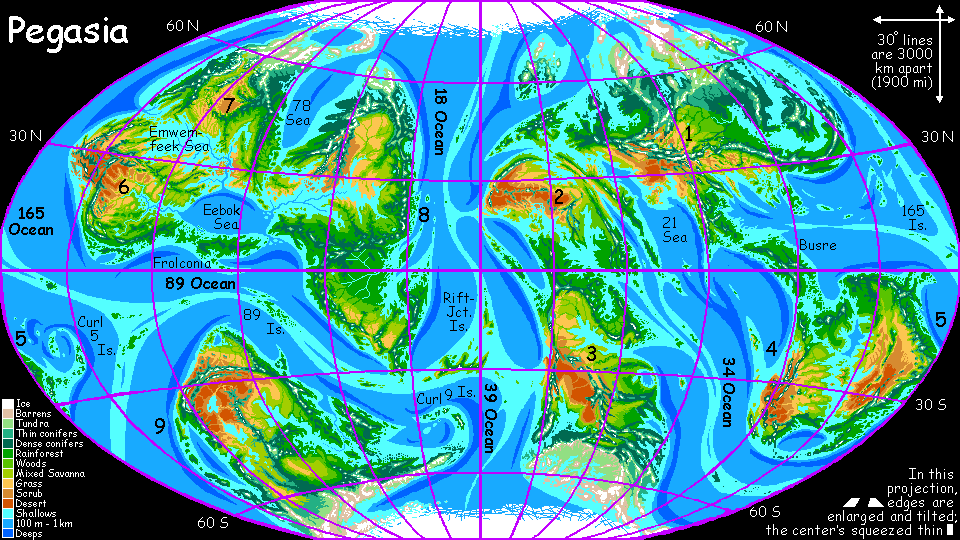 TOUR PEGASIA! Survival tips first, then click on a region (just numbered for now): Continent 1 - 165 Is. - Continent 2 - Continent 3 - Rift-Junction and Curl 9 Is. - 1-4 Is. - Continent 4 - Continent 5 - Curl 5 Is. - Continent 6 - Continent 7 - Continent 8 - 89 Is. - Continent 9
The gazetteer will have a full index of native placenames, with descriptions--once the contests's over and we have natives to name them.
LISTS AND LINKS: Planetocopia - dreams of other worlds - ecology - climate change - evolution - populations and eco-crashes - natural disasters - terraforming - orbital dreams - sculptures and 3D art -
World Dream Bank homepage - Art gallery - New stuff - Introductory sampler, best dreams, best art - On dreamwork - Books
Indexes: Subject - Author - Date - Names - Places - Art media/styles
Titles: A - B - C - D - E - F - G - H - IJ - KL - M - NO - PQ - R - Sa-Sk - Sl-Sz - T - UV - WXYZ
Email: wdreamb@yahoo.com - Catalog of art, books, CDs - Behind the Curtain: FAQs, bio, site map - Kindred sites