Subway
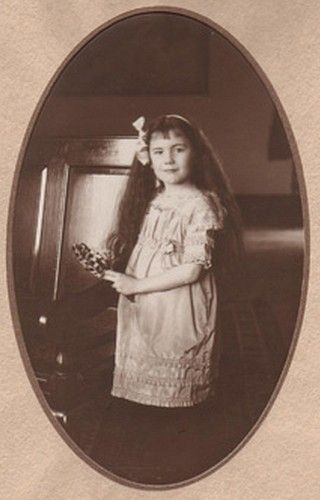
Dreamed September 1914 by Joan Grant, age 7
[Her British family is visiting New York. One morning Joan and her father climb the Statue of Liberty.]
We had lunch in a restaurant, and then Father, who knew I had not enjoyed the morning much, said I could choose what we would do for the rest of the afternoon. "Anything?" I said. I wanted to be quite sure this was not a choice only between things considered suitable-for-children. 'Anything,' he said stoutly. 'You earned it this morning. You looked so green, my Gingerbread Rabbit, that I thought you were going to throw up.'
'We'll go on the Elevated Railway...I'll gargle as soon as we get home if you like and catch any fleas that get on to me before they bite Margery.'
He agreed at once, and we spent a very interesting two hours riding above the streets and seeing into other people's windows when they put the lights on without drawing the curtains. It seemed a pity not to make use of the opportunity to go in the underground railway, too, which would be an important adventure to put in my letter to Diana, so I said, 'Now we will go back by subway.'
'Sure you wouldn't rather do that another day? It will be very crowded now when the offices and the shops are just closing,' he suggested hopefully. But I was firm, and he laughed and said I was a glutton for punishment.
Almost as soon as we had clicked our way through the turn-stiles I began to have doubts, and the and the roar of too many people in a hurry sounded so much like an underground river that was carrying my canoe into a whirlpool that I tried to become an Indian Brave who would not be frightened even in such a dangerous situation. This didn't work properly, because I had only started after Joan got so wrapped up in her feelings that she was too heavy to shift. I was rather feebly pretending to be leading my war-canoes against an enemy tribe who had invaded our hunting-ground when someone shouted, 'Keep back, keep back!,'
But we were swept towards the voice as though we were logs in a beaver dam breaking under ice-floes until we jarred against another dam, men with their arms linked to hold back, the surge of humans. I was squashed against one of the men, but under his arm I saw a small pool on the platform. Someone has spilt a pot of red paint on it, and I was surprised that people made so much fuss at the thought of getting paint on their shoes.
Father tried to pick me up, but there was no room for him to bend down, so I steadied myself by holding on to his legs. 'Don't look! ' he said urgently. I tried to keep my eyes shut but my eyelids refused to obey. It was worse than not being able to hold them open against a nightmare. It was not red paint and an old mackintosh on the platform. It was blood, and there was a dead body under the mackintosh. It was dead or they wouldn't have covered its face. Someone sobbed, 'He jumped right in front of the train. I saw him!'
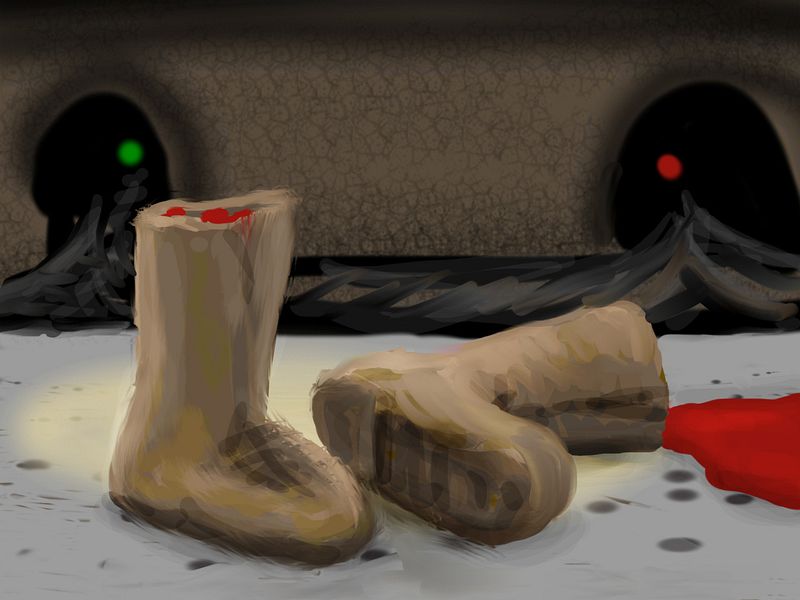
Then I saw the boots, large black boots with leather laces and tags sticking up at the back. The boots were standing neatly side by side next to the rest of the man's body, as though he had taken them off before getting into bed. But the train had taken them off for him. I cannot remember exactly what happened next, except that Father said, 'Help me get this child out of here, damn you! ' And I was lifted over the top of hundreds of heads which felt like flying in a dream, the kind when you are far too heavy to do it safely.
Then Father and I were in the street and my beaver muff was damp and smelt sour, so I knew I had been sick down myself and someone had wiped it off while I was not noticing. 'You feeling all right, old thing?' he asked. When I said I was, he patted me and said, 'Well, I'm not.' And we went into a hotel and he had brandy and I had ginger ale.
'I don't think we'll tell your mother,' he said tentatively. 'Or would you rather we did?'
'She'd only fuss,' I agreed quickly. 'I'll find the loo-lady and get her to wash my coat for me or Mother will think it was too many ice-creams.'
'You are a very competent child,' said Father, and gave me a dollar for the loo-lady, who said 'the English are tough babies' when I told her about the boots. It helped to tell somebody.
I was bustled off to bed as soon as we got back to our hotel, and went to sleep so quickly that I expected to have a nonsense dream about the things I had been thinking deliberately... the dinner with Father and the singing girls dancing in rows with men in very shiny top hats.
But I found myself standing alone on the platform, alone except for the boots and the man whose feet were still inside them. He was lying on his side, his hands clutching his leg stumps. Then he saw me, and at the same moment I saw myself. Instead of being only a child I was grown-up, about eighteen I should think. 'Agnes,' he pleaded, 'Agnes, help me.' He loved Agnes, who had been his daughter, more than anyone else, which is why I looked like her to him. I stood quite still, absorbing into me the love between them so that I could use it to help him. As Agnes I knelt down and put my hand on his forehead. 'Shut your eyes, Pa,' I said soothingly, 'and I'll soon get you fixed up. You've been at the whisky again and you're seeing things.'He closed his eyes obediently, but he was still very frightened. His fear made it difficult for me to keep hold of his affection for Agnes, and at the same time act as the real part of me without becoming clouded by little Joan's terror. My fingers fumbled with the laces of the boots, for the blood on them was black and hard. But at last I peeled off the stiff leather and sat crosslegged with the severed feet in my lap. The toes were misshapen, with broken, dirty nails. So I began to straighten them very gently between my fingers, breathing on the worn skin of the insteps as though I was cleaning the earth from a windfall apple.
When he was ready I turned him on his back. He appeared to be sleeping, and after I had made his clothes disappear I washed him all over very carefully, with water from a jar that someone had set beside him for me to use. His flesh was old and tired even when it was clean again. But when I fitted the bones of his severed feet to the stumps of his legs they began to grow together; and the new life in his feet began to flow up into him, and the skin and the muscles of his body gradually became young again.
He had been a nice-looking young man, clean shaven instead of a grey stubble of beard, and with strong fair hair instead of a few sodden, tattered wisps. I put him into a blue shirt and flannel trousers as he was not yet used to being naked. The platform had changed while he was changing, and now he was lying on spring grass under a willow tree. Between the long leaves I could see tall buildings beyond a lake, buildings which seemed incongruous until I recognised them from a different context. We were in Central Park, and I thought I had not been loving enough to bring him safely into Heaven.
Then he yawned and opened his eyes, stretching his arms luxuriously in the warm, clear light. A girl in a pink dress came running along the path beside the bright water. He scrambled to his feet, laughing with joy, and ran towards her calling, 'Agnes! Agnes, I'm here! I'm here!'
And I was Joan again, a child who was not allowed to roller-skate in Central Park.
EDITOR'S NOTE
I chose this passage for its intensity and fidelity to her viewpoint as a child, reminding me of Katherine Mansfield's Sun and Moon. But a child with double consciousness; both seven, and a much older soul who knows what to do as a shaman.
In a child's body, she lacked the authority to follow up on the suicide to see if he did have a daughter named Agnes. So she had no proof it was more than a consoling dream, in which she imagines she's helping a soul through death trauma. Wishful thinking, Freud would say, so she can deny that death is simple extinction.
But over the next few years, as the casualties of World War One mounted, such dreams became common for her; and in some of those cases she could verify names, regiments, and manner of death, like McAndrew. She was doing war work--every night. Drafted before age ten.
I wonder: in light of the coming horror, was her insistence on taking the subway right then childish, or did her soul sense what waited on the platform? If that aspect of us really is timeless, it may have thought "Given what Joan'll soon face, she needs all the practice she can get." Even if the inoculations hurt.
--Chris Wayan
SOURCE: Far Memory: the Autobiography of Joan Grant, 1956 (Ariel Press reprint, 1985), pp. 37-41
World Dream Bank homepage - Art gallery - New stuff - Introductory sampler, best dreams, best art - On dreamwork - Books
Indexes: Subject - Author - Date - Names - Places - Art media/styles
Titles: A - B - C - D - E - F - G - H - IJ - KL - M - NO - PQ - R - Sa-Sk - Sl-Sz - T - UV - WXYZ
Email: wdreamb@yahoo.com - Catalog of art, books, CDs - Behind the Curtain: FAQs, bio, site map - Kindred sites