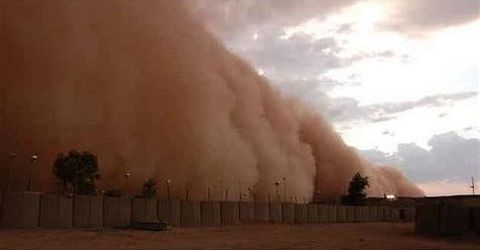
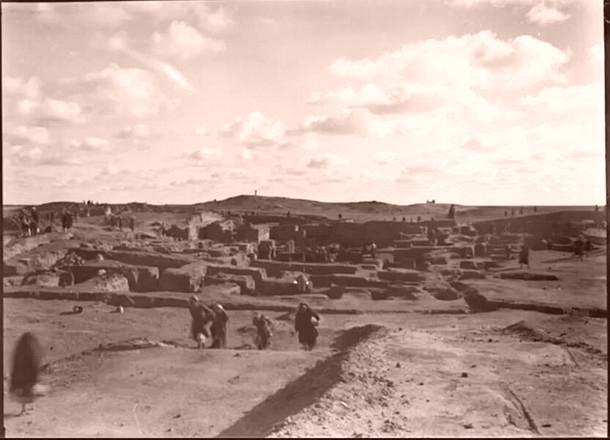
Tel Asmar
A shaman makes rain, late Feb. 1935, by Joan Grant
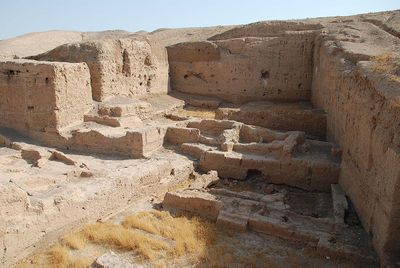
[Grant was at Tell Asmar (modern Iraq, NE of Baghdad) sketching finds from its archeological dig, when a dust-storm hit.]
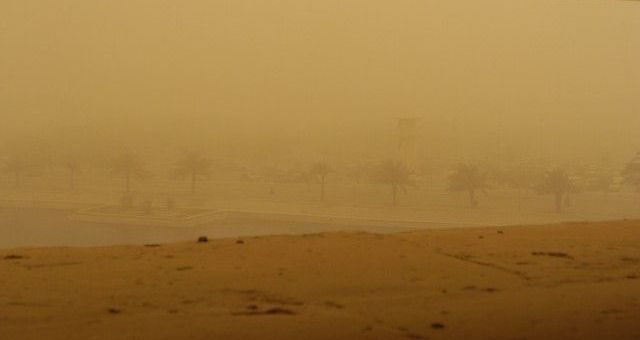
It was early in an afternoon at the end of February and I was working in the umbar [a long narrow workroom] with brilliant sunshine streaming through the windows, when the great dust-storm began. In less than five minutes it was too dark to see what I was drawing so I switched on the lights, a hundred-watt bulb at each end of the room. In another five minutes the light-bulbs were only a pale glow in the darkness, like the nimbus from the top of an old-fashioned lamp-post in the blackest of London fogs.
Leslie came to fetch me and we groped our way back to our room to make sure that the servants had shut the windows. Already everything was filmed with dust, and our feet left clear prints on the layer which covered the floor-tiles. Every window in the house had well-fitting steel frames which normally kept the air indoors relatively clear. By the time we got to the sitting-room the noise of the wind was so loud that we had to shout to each other.
Four hours later we had dinner, a cheerless, gritty meal out of tins opened in the dining-room, as anything not in a sealed container would have been uneatable by the time it was carried across the kitchen courtyard. The women had their hair tied up in scarves and looked like caricatures of females in the middle of spring-cleaning; and everyone's face was blurred and ochre-coloured with the layer of dust which made penthouses of their eyebrows and turned their faces into masks grotesque as clowns'. We hung wet sheets over the windows, stuffed rolled-up rugs under the door, but still the dust filtered in. By midnight our eyes were red and sore.
Tempers were beginning to fray, except Joanne's, who was always at her best in adversity. No one felt inclined to go to bed, for breathing was already sufficiently hard work to make sleep impossible. Rachel took her temperature and found it was over 101°. She was wondering whether she had 'flu or something more drastic when I suggested that, as a perfectly healthy man's temperature often rises to 101° at the end of five sets of real tennis, it was possible that the panting we were doing was producing a similar effect. So we all took our temperatures--at least it was something to do--and discovered that my theory was right. No one was under l00° and most of us were over 102°, which cheered Rachel considerably.
'Dust-storms never last more than six hours, or seven... or eight... or nine,' we told each other as the night crawled slowly past. Only the clock, and Abdullah bringing tea, which he had managed to make on a Primus (all the other servants having long since thrown in their hands) told us that dawn had officially arrived.
As the day, which was still as black as the blackest midnight, crawled on, the wind increased instead of abating. Seton, with a thick woolen abbas over his head, fought his way across the courtyard to a window on the windward side of the house and reported that a dune nearly twenty feet high had developed beyond the outer wall.
Everyone became even more depressed, for a storm as severe as this one meant that thousands of tons of dust would have been deposited in the dig-pit, undoing months of laborious excavation. The season's work would have to close down. As soon as the antikas were divided into the half which was allowed to Chicago University and the other which was claimed by the Baghdad Museum, we would disperse until next year.
This was depressing news as, except for the last twenty-four hours, I had been thoroughly enjoying myself, and I knew that, once it was over, I should enjoy remembering the dust-storm. It was not drab, like money worries and illness, but dramatic; so it came under the heading, 'To-day's adversities are the funny stories of tomorrow,' a private slogan which I have often found comforting.
I was feeling odd. My temperature was now over 103°. But Leslie shouted in my ear that as we had promised Gillian to get home only in time for my birthday we could spend the extra three or four weeks in Egypt--so I was cheerful, even when Hans decided that we had better retreat to the store-cupboard as it had no windows. At the beginning of the season it had been piled high with cases of tins from the Army & Navy Stores and Fortnum & Mason, but now it was nearly empty. The air inside it, though still so thick that we could only breathe through wet cloths which had to be frequently wrung out in buckets of water, was a little clearer. We could at least see each other, although the sight was not very appealing. None of the men had been able to shave, and the women looked even more dilapidated.
I had been too busy being sorry for my own discomforts to worry about the diggers. But as my feelings of claustrophobia increased, I was appalled by the thought of them lying in their sleeping-holes, no better than shallow graves, with only a strip of straw matting to protect them. I was told, repeatedly, that Arabs are used to dust-storms and as a race would never have survived unless they were very well able to look after themselves in storms such as this one which was remarkable only because it had come so early in the year.
'Oh, why won't it rain! ' I said miserably. Nobody answered. Why wait for rain--especially as there had been practically none for four years? I lurched to my feet. 'I shall make rain, ' I declared dramatically, and tottered out of the store-cupboard.
Luckily the sitting-room door was on the lee side of the courtyard and so I opened it without difficulty. But once I was out of the shelter of the wall the wind caught me and sent me sprawling on my face. For a moment I thought I was going to lie there helpless until I was smothered to death. Then the pain of dust scouring my unprotected forehead (I had a towel tied over my nose and mouth) whipped me into action, and I crawled on hands and knees until I reached the haven of my bedroom. It was not much of a haven, for the dust, which is finer than talcum powder, had made drifts over everything; but at least I could stand without being blown over. I unfolded a rug and put it over the bed, on which nearly a foot of dust had collected, and lay down.
Then I began to pray for rain. I prayed until the sweat ran in runnels down my face. Exhausted as I was, I began to feel exultant. I felt the virtue entering into me. My prayers were going to be answered! I began to talk to the rain, as though it were a separate deity. Suddenly I heard my own voice, though it had been inaudible because of the roaring of the wind. The wind was abating! I stripped off my clothes and stood naked, shouting to the rain to come to me. Suddenly I realised that the only sound I was hearing was my own heartbeat. There was no other sound.
Then in the silence I heard an insistent musical sound, a tune played on one note, like a drum-beat and yet metallic. It was the first heavy drops of rain falling on the corrugated iron roof. The separate notes blended into a symphony of rain, surged into the triumphal singing of a torrent. And I found myself standing naked in the courtyard with clear, clean water sluicing down my body, breathing great gulps of fresh, wet air into my lungs.
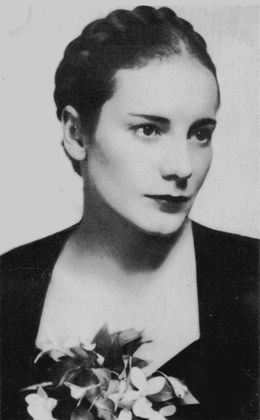
Joan Grant, a bit cleaner in 1937 |
Then I remembered the others: and also to put on some clothes before I went to find them.
It rained for twelve hours in a four-mile circle round the house. No rain fell anywhere else in the district and during the night over a hundred people were smothered to death in the streets of Baghdad. For three days we were marooned. The house, and the ancient mound on which the diggers lived, were islands in the middle of a lake. The dig-pit was full of water, which did far more damage than the dust-storm.
'Next time you make rain you had better specify how much you want,' said Leslie, but he said it fondly. For a few hours the others were grateful and even a little awed. Then it became only an odd coincidence; and they grumbled because the water had damaged their toy.
EDITOR'S NOTE
The World Dream Bank has hundreds of dream & altered-state experiences involving paranormal information--verified predictions, telepathy, clairvoyance or psychometry (reading histories of objects). But dreams or altered states affecting the physical world, even subtly, are rare. There are a few--skewed odds, wildly unlikely outcomes, dreams leaving physical traces, and telekinesis (usually small, and often involuntary or semivoluntary, like poltergeist activity). This is one of the biggest and most impressive--conscious, deliberate, large-scale, and verifiable.
Also... funny. Their dig was then 30 meters deep, and she flooded it. Or, if you insist, wild coincidence flooded it. No rain for four years, naked rain dance, localized deluge. Sure. Chance.
Mind what you wish for.
--Chris Wayan
SOURCE: Far Memory: the Autobiography of Joan Grant, 1956 (Ariel Press reprint, 1985), pp. 219-223.
World Dream Bank homepage - Art gallery - New stuff - Introductory sampler, best dreams, best art - On dreamwork - Books
Indexes: Subject - Author - Date - Names - Places - Art media/styles
Titles: A - B - C - D - E - F - G - H - IJ - KL - M - NO - PQ - R - Sa-Sk - Sl-Sz - T - UV - WXYZ
Email: wdreamb@yahoo.com - Catalog of art, books, CDs - Behind the Curtain: FAQs, bio, site map - Kindred sites