LEBBIRDS
by Chris Wayan, 2004
Map, Tharn's homepage, Peoples of Tharn, Regional tours, Geology and Evolution, gazetteer, terms explained. More worlds? Planetocopia!
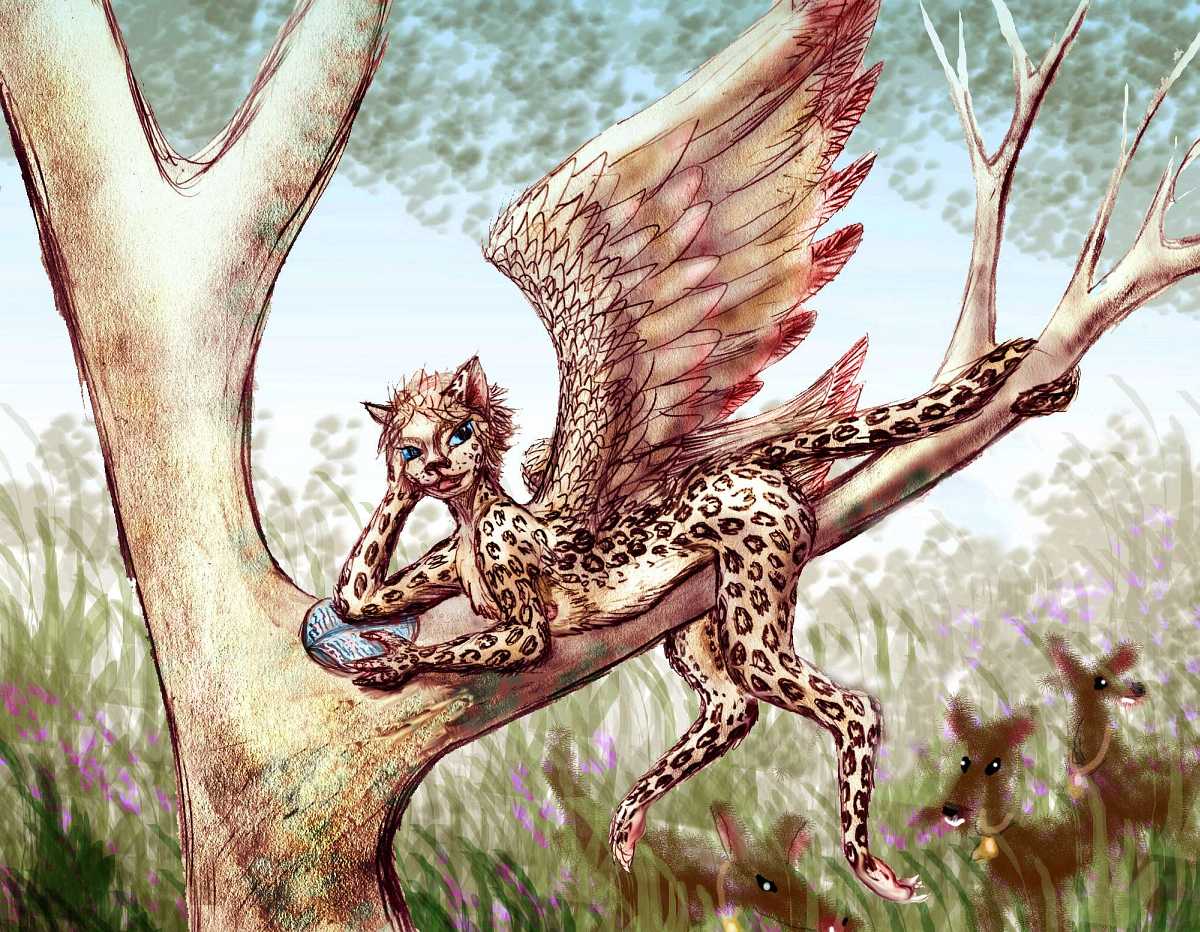
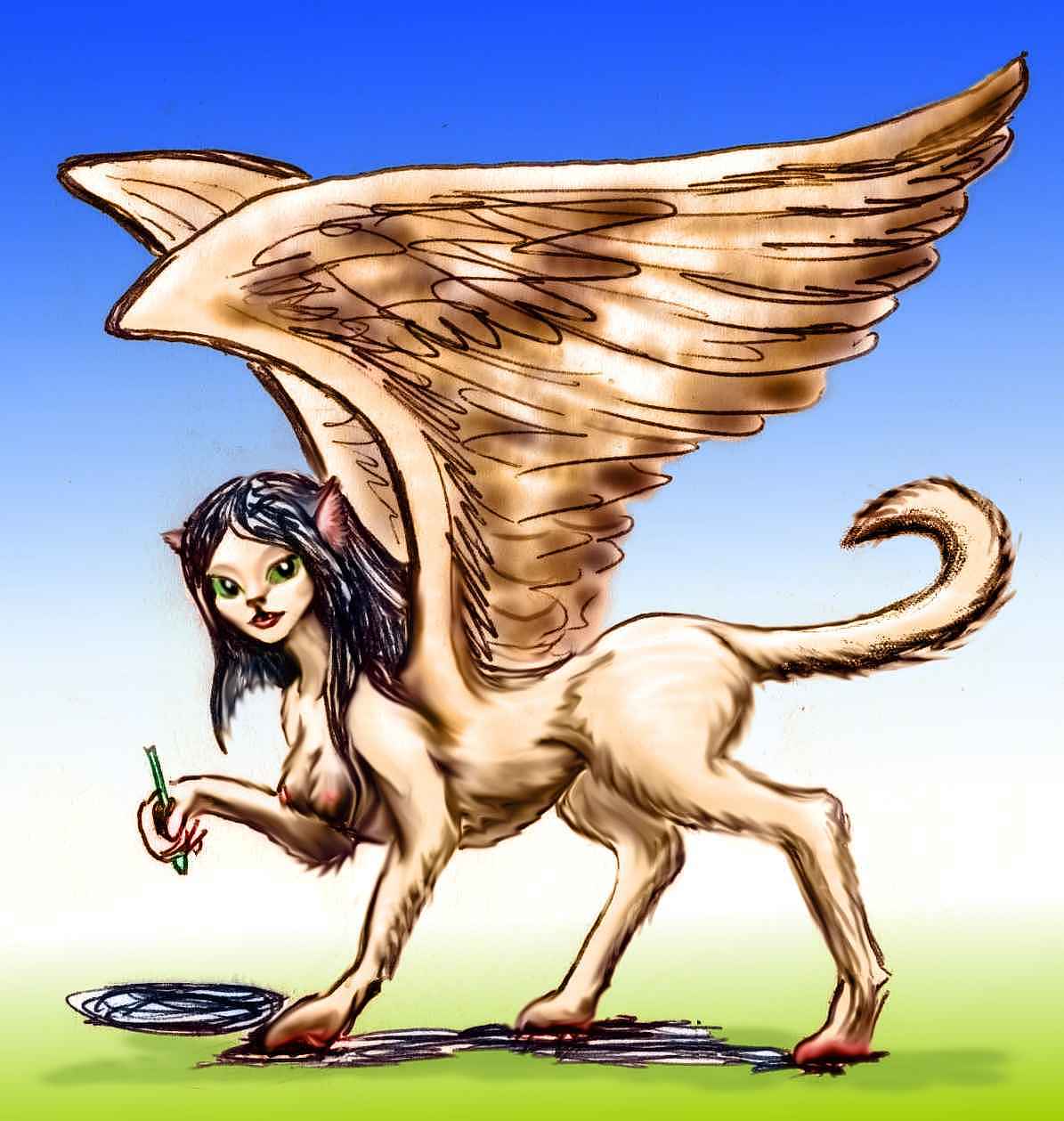
Lebbirds are a winged people of the equatorial trenches, with a leopard-like torso and spots, but handlike forepaws, hawklike wings, a high forehead and eyes nearly as big as a nocturnal creature--Tharn's sun is dim and red enough before it's filtered through the dense canopy of a trench rainforest.
The common feline traits of lebbirds and centahs are mere evolutionary convergence, not a sign of close relationship. Their most recent common ancestor was some six-limbed trench-dweller that likely had no feline features at all. Certainly the two species are closer cousins than either is to, say, lobbras or mamooks, but that could be said of nearly any people on Tharn.
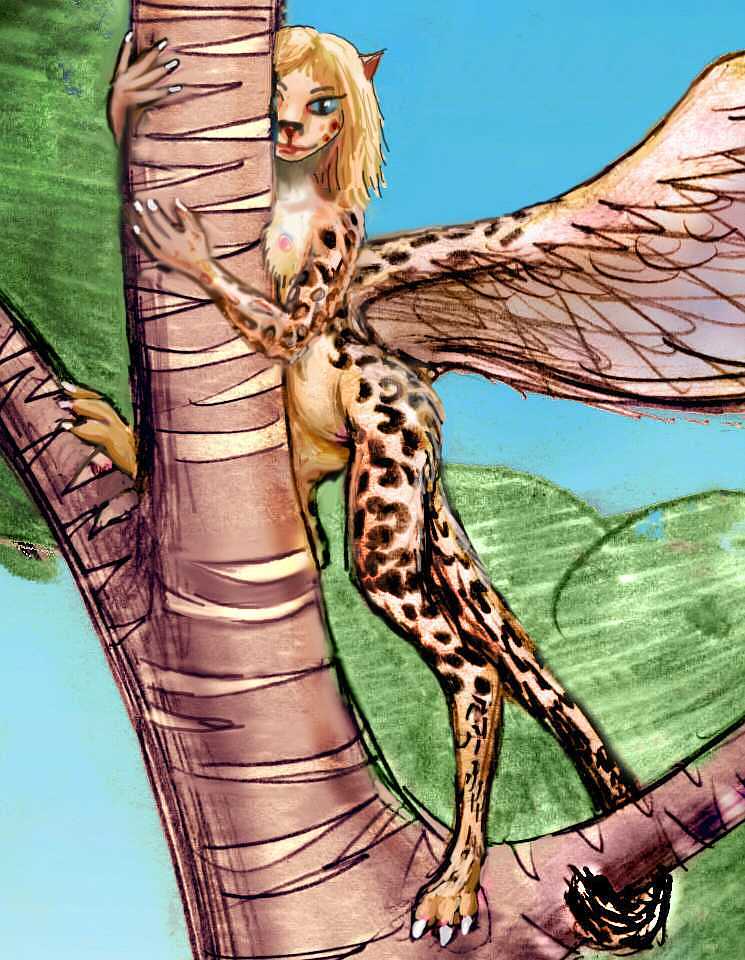
Note the long hind legs; lebbirds can stand and walk upright along branches, balancing with their long tail, or using it as a sort of third leg. Yet they can climb using all four legs, or swing by their arms and prehensile tail, as well as fly. This complex design-compromise means you can find lebbirds in many environments--if it's a lowland, that is. Lebbirds, like arthom live only where the air is dense enough to let them fly.
Though I've dubbed them lebbirds because they look quite feline, these are not Terran cats--the most purely carnivorous creatures on our planet. In contrast, lebbirds were originally omnivorous hunter-gatherers of the jungle canopy, eating a wide variety of fruits, nuts, flowerbuds, bugs, small animals and fish. Fish-mad, in fact--they dive like pelicans from clifftop villages by many trench-lakes. Today, some are ethical vegetarians (high-protein ones, heavy on dairy products from herds of domestic milk-monkeys, plus bird- and lizard-eggs), but then, half them declare fish is a vegetable. What is it about sushi, anyway?
Nearly leopard-sized, lebbirds are far more delicate: hollow-boned! Even so, on Earth a large lebbird might top 25 kg (55 lbs); Tharn's weak gravity effectively halves this, making flight possible in the trenches. But on the plains and uplands, lebbirds are effectively grounded. They describe it as a nightmare of frustration--the terrible effort to rise, only to fall back exhausted in seconds. They can survive the plains, but mere survival's not living.
Of course, lebbirds could selectively breed for a smaller subspecies able to fly in the thin air of the plains--but with the tragedy of the wingbok haunting Tharn, they'd rather not risk their kittens. They'll caravan over the plains to other trenches, but not settle the heights.
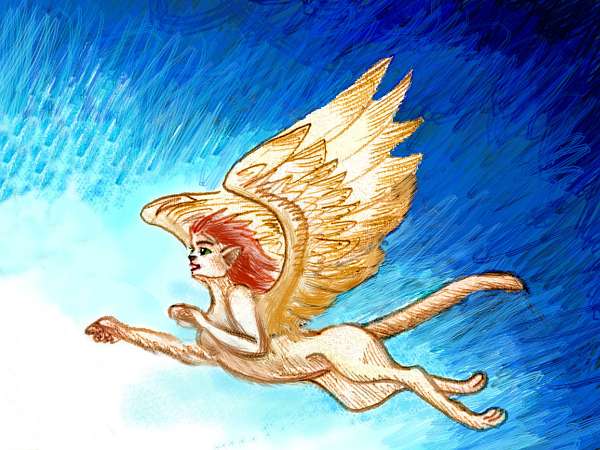
Lebbirds aren't mere gliders, they've achieved true flight. But they're not nearly as specialized as Terran birds--or as good in the air. Ponderous fliers, Tharn's largest, near the weight limit for practical flight. It's an open question whether a lebbird could even get off the ground on Earth. Denser air to grab, but high gravity... Like driving with the brakes on!
BEHAVIOR
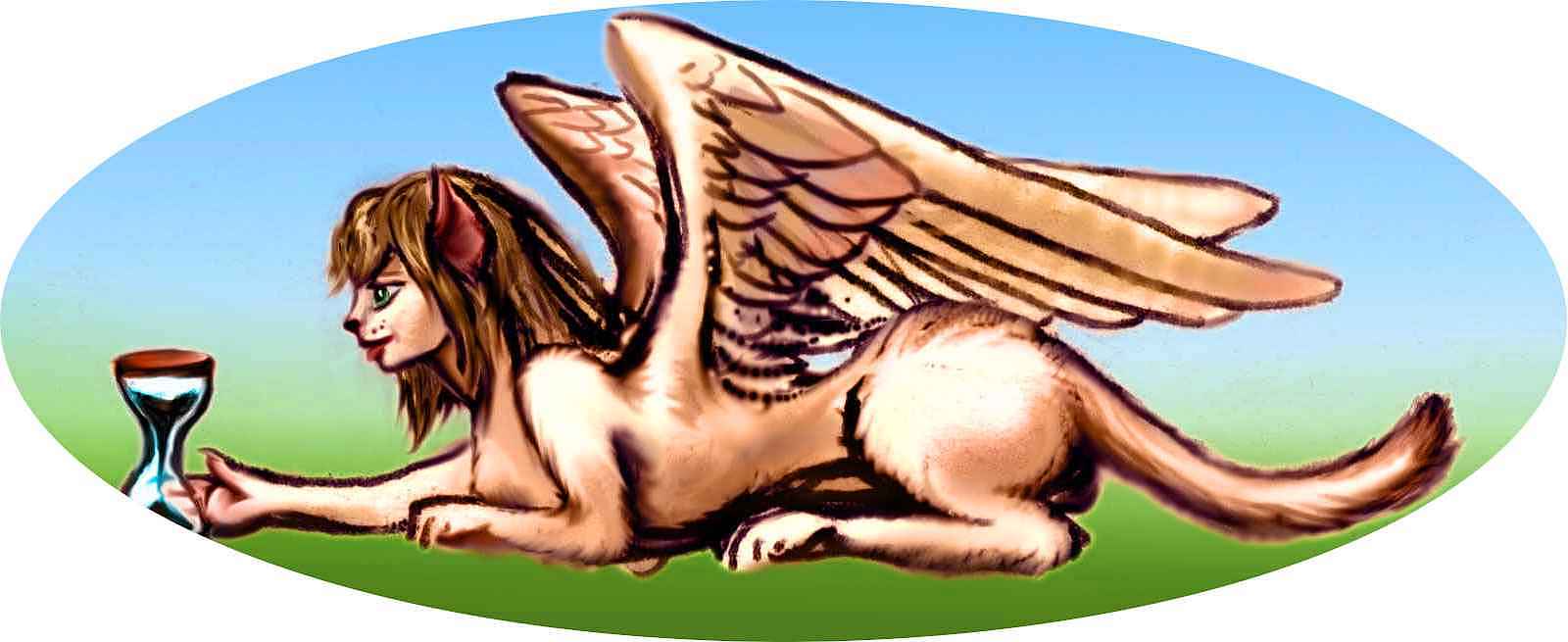
Lebbirds are highly social cats, easy-going, slow to anger, reluctant to fight--possibly due to their light bones and delicate wings. As sensual as leopards, they excel in dance, bodywork, seduction, sex, scents and herbs. Actors, dancers, musicians. Intensely curious, they make good therapists, shamans, and scientists--all fields with complex, multidimensional puzzles, like flying through the canopy they evolved in. With hunter's eyes, visually attuned to motion, they readily visualize changes over time; it was lebbirds who invented Tharnian calculus.
You can guess from place names like Mrr, Worawora, Rree, Mwaa, Au, and L'ree, that lebbirds speak Trade Camaroo (the Tharnian trade tongue, a pidgin based on camaroo speech) with a very strong accent. Whimsical grammar, too. For such bright creatures, they have a fuzzy notion of syntax!
Lebbirds themselves say words and ideas come to them in nonlinear patterned wholes. In Trade Camaroo they use the word "meshes"--but in their own tongue they say rrao-luu: "a mass of interlaced twigs and branches." The difference is revealing. Camaroo evolved in high, treeless alps, but they netted fish; the connotation of "meshes" thus suggests making a thing to catch ideas--choosing to structure your thoughts this way. Lebbirds, however, are arboreal, and read travel-routes through the canopy as a unit, instinctively. Not a choice, but a perception.
Their pattern-sense may twist their grammar, but it gives lebbirds startling flashes of empathy and insight into other species. This, plus their strong sensuality, makes them the Tharnian record-holders for cross-species liaisons (whether casual or the equivalent of Terran marriage).
While all lebbirds are sensual and nonlinear, by no means all are artists or intellectuals. Many have remained quite traditional cliff-fishers and orchardists. Even for urban lebbirds, flying, swimming and especially climbing fill a primal need.
HABITAT
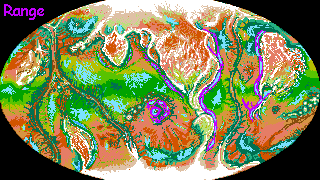
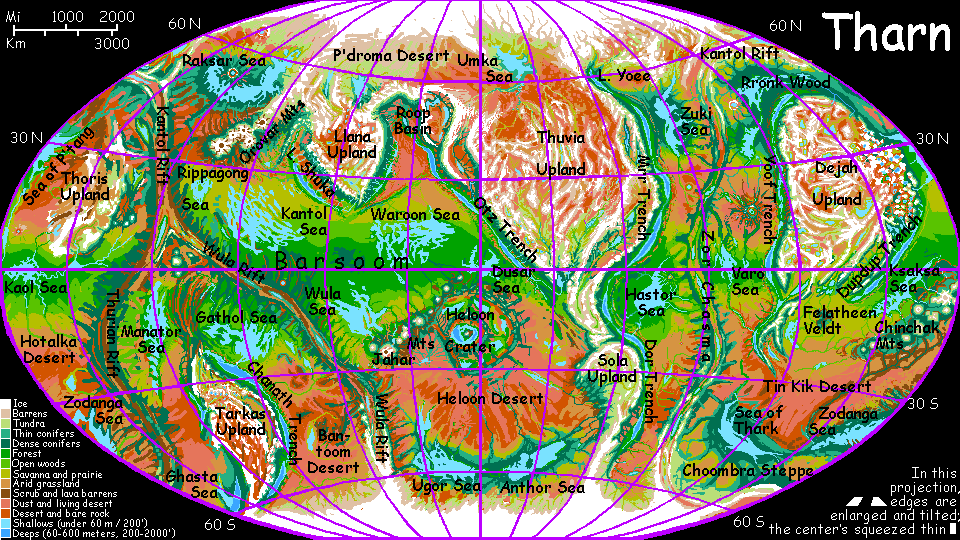
Lebbirds evolved by the shores of equatorial Mrr Trench; today they've spread to Yoof Trench to the east, and more recently over Trunzip Pass to Otz Trench and the huge Heloon impact basin. Most lebbirds live 3-5 km below bedlevel; at less than 2 km down (-6600') flight becomes difficult; at bedlevel it's impossible. Two kilometers up, lebbirds get altitude sickness. High passes can cause brain damage or even kill.
Thus, though their range sprawls halfway around Tharn, the actual area of lebbird settlement is small--under 2% of the surface--and unlikely to expand further. But that 2% is bigger than it seems: Heloon and the trenches are all air oases, the richest biomes on Tharn.
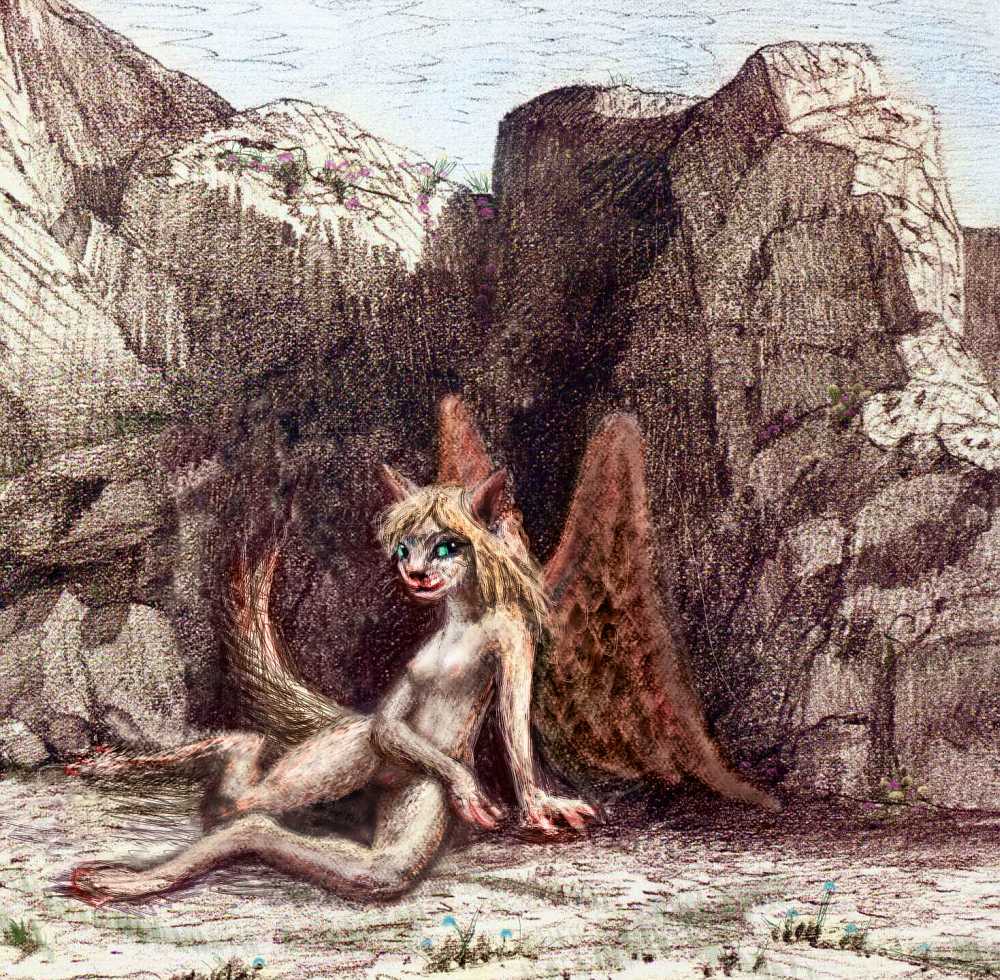
Lebbirds have a love affair with trees--they feel lost in the open without them, and are reluctant to settle a trench too dry for woods, no matter how warm. The two main exceptions are:
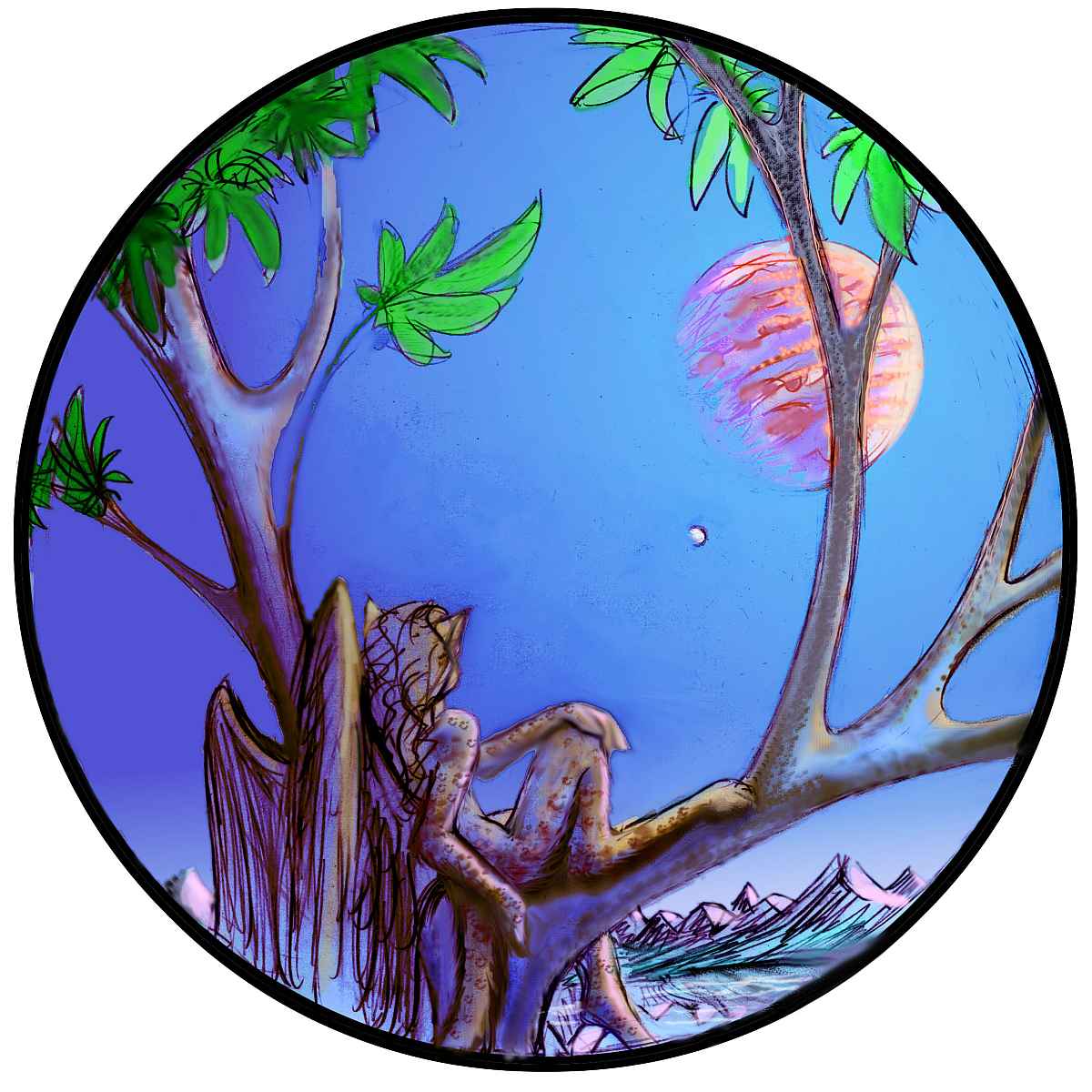
Days in the true rainforests are hot and humid, and lebbirds here sleep while the sun's high. The tree-cities really come alive at night, under the vast golden glow of Zeus, Tharn's primary, a gas giant twice Jupiter's mass. In the sketch below, the small white moon is Pegasia, larger and biologically richer than Tharn--quite Earthlike, in fact, if not quite Earth-sized. Together their brilliant, warm light outshines our dead little moon a thousand times; full color at midnight! The boughs and cafes full of a purring cats are quite magical--like Dunsany, Yeats or Tolkien's visions of Elfland: a luminous twilit world. Just substitute winged leopards for elves.
Many lebbirds still live in treetop- and cliff-villages, but these traditionalists may be a minority today. After all I've said about lebbirds' love affair with trees, their second preferred habitat may seem paradoxical: non-lebbird cities! For lebbirds enjoy being around other species, and gravitate to multi-species towns. Trench cities all over Tharn have enough resident lebbirds to support cafes and restaurants with their distinctive, sweet-spicy cooking (having evolved in the tropical canopy, full of fruit and flowers, lebbirds have a sweet tooth and a taste for resins, florals and aromatic spices). Quite Southeast Asian. Hmm. I'm hungry now...
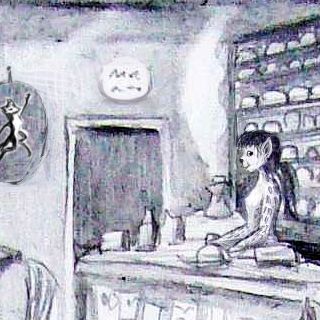
If you get the chance to tour one of Tharn's equatorial trenches, do as the natives do. Fly at dawn and dusk, siesta all day, and go out to treetop cafes all night. Listen to music. Hear a good storyteller.
Try lebbird drama (character motivation may seem peculiar to humans, but the acting will grab you by the scruff of your neck!) Most of all, see some ballet. Air-ballet for certain, and love-ballet if you're not squeamish. Yes, it often involves sex on stage, but as this breaks no taboos for lebbirds, it's somehow innocent. Rather sweet, really.
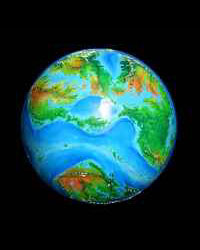
If it's too sweet for you, just act on the lebbird proverb: "There are plenty of trees in the wood." Just glide to the next tree-cafe. You'll find a new circle, snack, fruit drink, band, sculpture jam, storyteller, song-duel, play, dance marathon...
Most Tharnians say that after death our souls fly to Pegasia, that lush blue moon with green lands peeking through veils of cloud...
But lebbirds disagree. Heaven, they insist, is a big crowded cafe.
World Dream Bank homepage - Art gallery - New stuff - Introductory sampler, best dreams, best art - On dreamwork - Books
Indexes: Subject - Author - Date - Names - Places - Art media/styles
Titles: A - B - C - D - E - F - G - H - IJ - KL - M - NO - PQ - R - Sa-Sk - Sl-Sz - T - UV - WXYZ
Email: wdreamb@yahoo.com - Catalog of art, books, CDs - Behind the Curtain: FAQs, bio, site map - Kindred sites