 WELCOME TO INVERSIA
the world turned inside out
by Chris Wayan, 2006-2016
more planets: Planetocopia
Inversia homepage - (not done, don't click:) geography & climate - evolution - peoples - map & tours
WELCOME TO INVERSIA
the world turned inside out
by Chris Wayan, 2006-2016
more planets: Planetocopia
Inversia homepage - (not done, don't click:) geography & climate - evolution - peoples - map & tours
We've all seen Inversia now and then. You look at a map and mistake land for sea, sea for land. It happens most often with those crisp, simplified news maps ("just the facts, ma'am!") showing a place you don't know well. As Orwell said, "ignorance is strength." But Inversia can sneak up on you, too. I once saw a whole antique globe inverted--for the oceans' ink had aged over the years from blue to a strange sepia that I saw it as dirt; and the original brown of the continents had faded to off-white; I saw them as shallow seas.
What if they were? The Sahara Sea, the American Ocean, the Himalayan Trench...
JUDGMENT CALLS
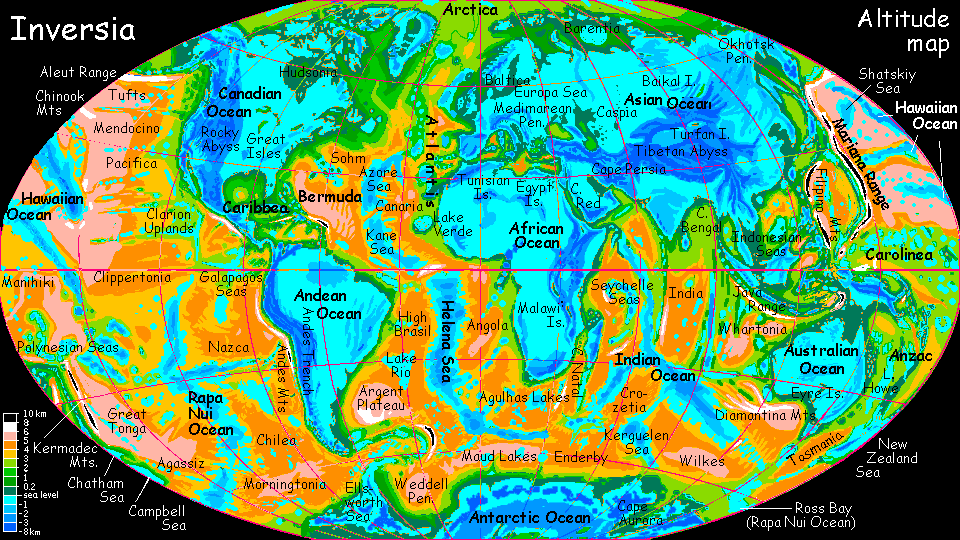
Inversia can't be a simple swap of water and land. Paradoxes rise. Picture a deepsea atoll that barely breaks the surface; inverted, it becomes a deep pit in a highland. Obviously it'll fill and become a lake--but how deep, how big? What are the odds it'll fill to exactly match its flyspeck shoreline on Earth? In rainy regions the lake will grow way beyond that, until it spills over; in a dry zone the lake will be smaller (and salty).
In general, I've stuck to the familiar shorelines of continents and the largest islands--Australia, Greenland, New Guinea. You need some signposts! But I've let smaller islands-become-lakes, like the Hawaiian chain, fill to whatever size and shape seems right for the local rainfall (which of course these inland seas affect! Which came first, the chicken or the egg?)
What of the reverse--Earth lakes? Should they be islands? Well, not all of them. Only where a Terran lakebed dips below sealevel (not easy to determine in many regions, but I've done my best) did I build islands: see Lakes Superior, Baikal, Tanganyika, etc. This makes the shores of the new Baikal Islands consistent with the offshore terrain; if I honored the Earth shoreline above sea level, we'd get huge, geologically senseless cliffs right at the waterline.
What of lakes or seas BELOW sea level? The Inversian island of Caspia is bigger than our Caspian Sea, for that basin is well below Earth's main sea level, the largest such region on Earth; and Caspia's coast follows sea level. The dying Aral Sea makes an equally shrunken Inversian island, but not due to its current drought problems: its bed is shallow, so only the deepest part dips below sea level--making a small island on Inversia.
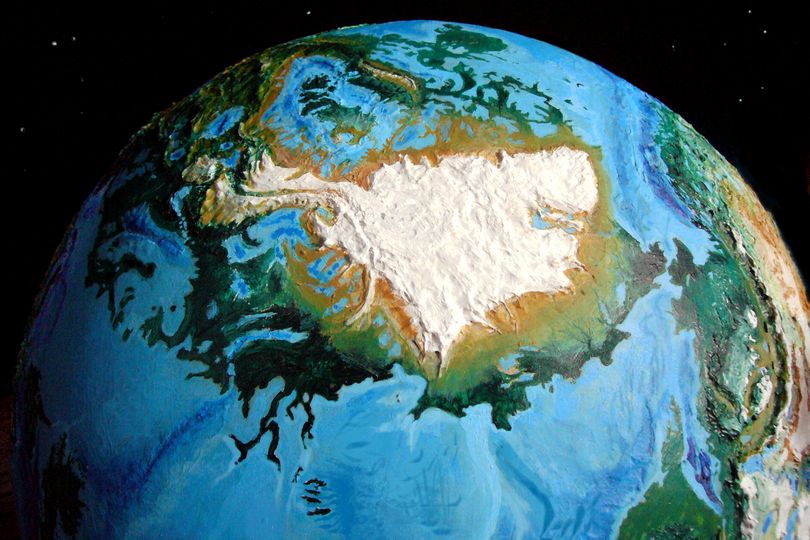
There are a few Inversian islands where Earth has no equivalent lake at all--just a dry valley below sea level, as in Egypt, California, Tunisia, Israel/Jordan, Ethiopia, and Sinkiang. All deserts, of course--elsewhere they'd fill & be lakes. Well, not quite all. I forgot Greenland and Antarctica. On Earth, their hearts are depressed by ice to well below sea level; so Inversia has an Antarctic Ocean with unexpected land at its heart. Similarly, the Greenland Sea is deep where our coastal mountains lie, but it's a mere moat; inside it is a modest but truly green Greenland.
In short, Inversia's a reversal of altitude not water. But even that isn't so simple. I quickly found that supposedly authoritative sources disagreed on even basic seafloor topography! The southeast Pacific was especially hard, for it has not one speck of land; most globes and atlases use it as a place to put their legends and logos; even if they don't, undersea features are sloppily shown. There are plenty of errors on Inversia, but even if your atlas shows me to be wrong... don't trust your atlas too much. Even the detailed maps I finally used (thanks to SF State's map room and the online General Bathymetric Chart of the Oceans, GEBCO) firmly disagreed about names, depths, topography, even reefs--as close to land as the region gets. It was a real cartography lesson: wherever they figure no one will look closely or care, even modern maps get sloppy.
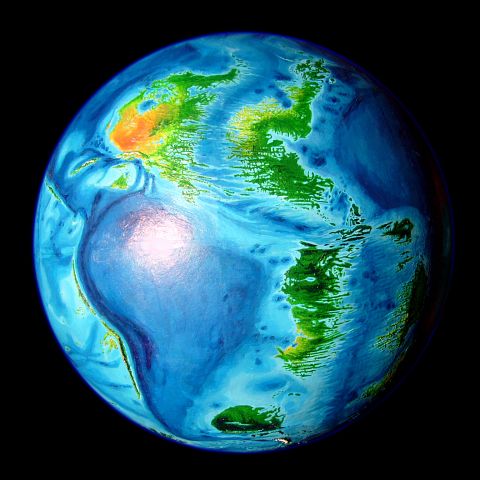
Abyssia: Amazon Ocean, lower left; African Ocean, upper right; down the middle, the Atlantis Strip. |
I've generally gone with the principle that where there's smoke there's fire: if even one reputable map recorded a reef or trench others lacked, I included it. Where they disagreed (i.e., everywhere!) I made judgment calls. I can't claim great accuracy or even consistency--but then, the whole project is insane, of course.
For comparison, I just finished a variant Inversia: remove all water, invert, ending with the exact same "dry" topography as Inversia... but then pouring all our Earth's water back onto it. The result? Utterly alien coastlines. The only land is the deepest bits of our oceans--the abysses and trenches. Call it Abyssia. It's hard to calculate the volume of those inverted sea basins, but they're deep. Shocked me just how much high the flood went. Less than half the land area of Earth! Brings home just how much water Earth has. A bit more, or a bit less vigorous tectonics, and we'd have a landless world-sea. Well, we wouldn't. I'm not even sure intelligent sea life would evolve without dust and sediment from land fertilizing the seas .
I just finished Abyssia, but then it had so little land it was quick to map. Paddling in the baby pool until I learn to swim.
In contrast, Inversia has over twice as much land as Earth, and a good five times as much as Abyssia. Skeletal tours of Arctica, Medimarea and the Canadian Ocean are skeletal but online; by 2026 I plan to have half a dozen. But this planet will be a long, long haul. I'm still not sure how much of the Antarctic highlands around 40-50° south will glaciate. A lot, but like Ice Age Earth? Not so sure. It's cold, and high up, but dry. I'm guessing Inversia's surface is about 56% land, 4% ice, and 40% water (35% salt, 5% huge high-altitude freshwater lakes). But details will surely change.
AIR PRESSURE
Once we're sure what's land and water, the next step is climate. This gets complicated, for the new, radically different topography changes the air pressure. Nearly all of Earth is near sea level; Tibets are rare and there are no big holes like Hellas on Mars (air pressure twice Mars-normal). But Inversia has small, deep lowlands and huge highlands--many Hellases. Now, you humanities majors will just have to trust me, but this odd topography means air pools and gets dense down in the new basins: air pressure at the new "sea level" is 1.7 times ours! That traps a lot more heat. Our worst-case, apocalyptic predictions of global warming are trivial next to the conditions in these basins--at least 10°C (18°F) hotter than comparable latitudes on Earth. Steamy tropics, tropical mid-latitudes, temperate poles..
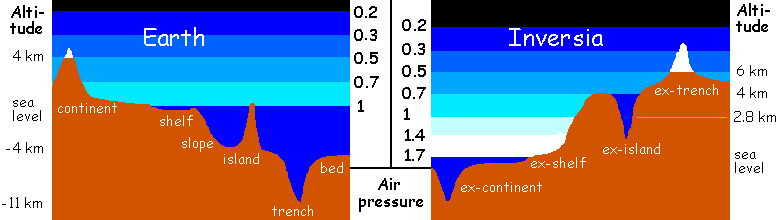
In contrast, the dense-air regions are huge--indeed, continental (by definition--they are our continental platforms). You may suspect I awarded Inversia some extra air as a consolation prize for all that stolen water, just to keep life going--artificial life support! No. I promise. Those lowlands rich in air and warmth are an entirely natural result of the peculiar shape of Earth inverted. Planetology: the game of unexpected consequences!
Ecologically, too, Inversia's not an easy riddle. The deep basins are unlike any ecology on Earth today--hotter and wetter than our densest rainforests. That dense air traps heat and transports more moisture. A cloud factory! All that cloudcover shades the basins, keeping temperatures tolerable for life. Most places. I think.
But how far can the rain from these steamy, alien basins climb up the huge new continental shelves? Our nearest analogy, the altiplano above the Amazon basin, is dry; but Inversia's air is much denser, both in the basins and on the plateaus--most of them. This question of rain-transport is vital, for it decides how much of the vast uplands will be desert. How much Carboniferous, how much prairie, how much Tibet?
How much Mars?
My own projections are undoubtedly wrong. Climatology at this point's an infant science; it's all still educated guessing. But how wrong, where, in what directions? Hot wet basins and cooler drier uplands, these I'm sure about--but the devil's in the details.
ECOLOGY
Is Inversia more or less fertile than Earth? Smaller seas means less rain. Wide inland deserts! But then, much of our deep sea is desert now, judging by its biomass. Sediment and upwelling currents, the two greatest sources of nutrients, are rare in the open sea. Inversia's biological deserts may just be more visible.
And even if Inversia's dry, there's a lot of it. The huge new swiss-cheese world-continent has relatively fertile coasts, and a lot more of them: where our oceans have mid-sea ridges reaching only halfway to the surface, Inversia has a dozen mile-high freshwater seas bigger than the Mediterranean. Even a modest island in our world is just the tip of a much broader platform; on Inversia, this often translates into a huge, deep high-altitude lake. Millions of square kilometers of surface water from these inland seas generate rains that moderate the climate of these wide Inversian uplands. This isn't Pangea, that ancient supercontinent with green coasts but a super-Sahara at its heart. This is something new. Land and water mingle bewilderingly--deserts exist, but they're patchy.
One reason so much of the new land is dry: lots of the new coasts have tall mountains--wherever offshore trenches lay in our world. Such ranges cut off rain to the interior plateaus. Pacifica will especially suffer. Expect wide steppes at best, deserts at worst.
Shallow waters are generally more fertile than deep ones; minerals are more accessible, and most of the biological action's in the sunlit part. Inversia's seas are warm and shallow; they average just 600 m (2000') deep, vast stretches are 100 m or less, and the water's mostly warm, insulated by denser air. Ideal for coral reefs! Even in deeper regions, our river valleys invert into sinuous ridges, forcing currents to wash over them--and as they do, great rolling plumes of sludge are forced to the surface, feeding plankton. Such ridges are also excellent seedbeds for coral reefs. Even the deeps mostly aren't THAT deep, and are largely coastal--often, on Earth, more fertile than mid-sea deeps. Inversia's land may be heaven or hell, but the seas are unambiguously rich.
BIOLOGY
This little stub will eventually expand a lot as I work out what the natives of the sea-basins are like. The most important thing is: they'll probably fly. The dense air makes it easier for climbers to glide and gliders to evolve to true flight. Way less wing surface is needed to lift you. On Earth, our thin air makes it difficult for large, big-brained creatures to get off the ground, though pterodactyls did manage; but my guess is that in the Inversian lowlands a dozen or more broad lineages will find ways to fly, and the maximum practical flight weight may be as much as 25-30 kg (55-65 lbs). Unquestionably big enough for intelligent life.
The other unearthly characteristic that's likely to develop comes from my laziness desire for consistency. Abyssia is identical geologically and geographically to Inversia (they're both just Earth turned inside out)--but unlike Inversia's relative drought to preserve oceanic coastlines, Abyssia has all of Earth's water. Since they're twins, I may give them similar evolutionary quirks. On Abyssia, insects developed with four limbs, and vertebrate life with six, often in a centauroid pattern. This is handy--literally handy--for large, intelligent creatures. Abyssian land animals have forepaws used to groom, and gather food, and potentially to make and carry tools. It's especially helpful for fliers--Earth birds must hold tools in either a beak, awkward for fine manipulation, or a foot, interfering with balance. An awkward dance. On Abyssia, birds have small but dedicated hands; as a result many have advanced to various degrees of civilization, where none of their Earth relatives have. It's certainly not lack of smarts; ravens and parrots are as bright as chimps. Hands matter.
Will I duplicate Abyssia exactly? No, for two reasons. Abyssia's air is Earthlike, so big-brained creatures are mostly too heavy to fly. And since it's a sea-world full of islands not continents, there are few large land-predators; many birds became flightless. In contrast, Inversia's dense air in the basins encourages the evolution of fliers, and its continuous land (allowing large land-predators to spread) gives them a need to fly.
So my best guess is that in Inversia's deep, dense-aired basins, the dominant life form will be winged, not pterodactyl-huge but considerably heavier than our condors; possibly mammalian, more likely avian; in either case, with small but cunning hands.
Outside the basins, in the thin-aired uplands, we may encounter nonflying centauroids running on four feet just as most Terran mammals do, but with small forelimbs sporting dedicated hands. No knuckle-walking in their past! The ubiquity of functional hands means I anticipate multiple lineages developing sophisticated tools, and possibly civilizations; not one as on Earth.
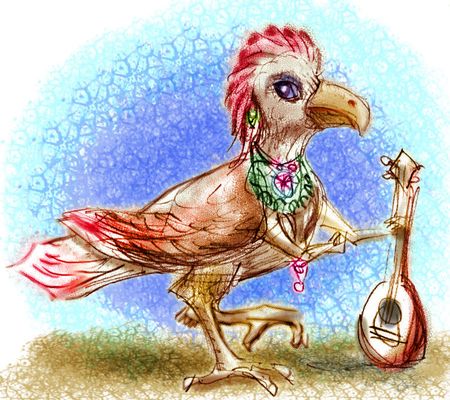
Avian lutist |
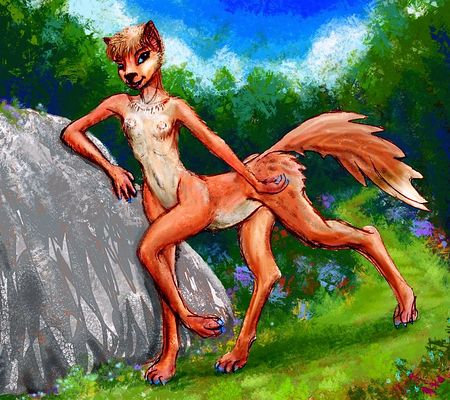
Foxtaur, stray glacial boulder, Arctica |
As I said, part of this is for consistency with Abyssia, but part's laziness. I have a hundred lovely dioramas featuring half a dozen sculptures of three six-limbed species--dogsized foxtaurs, deersize cattaurs, and equi, gracile horse-faced centaurs. I never used them to illustrate Abyssia because the land area was modest; they just weren't needed. Inversia, on the other hand, has nearly EIGHT TIMES as much land--2.2 times Earth's land area. Two or three worlds in one! That's why I've put it off so long; gonna be grueling.
So I'll need a LOT of Inversian illustrations--scenery, people, cultures--over the next few years. Waste not, want not...
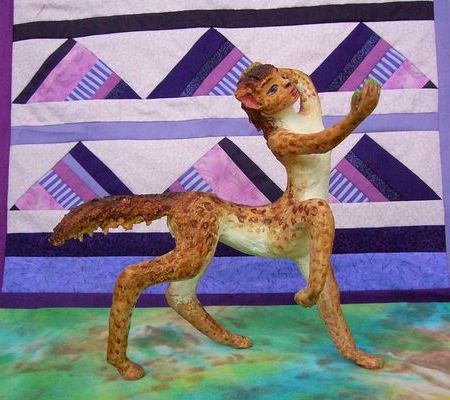
Leptaur; backdrop signifying the Mariana Mts. |
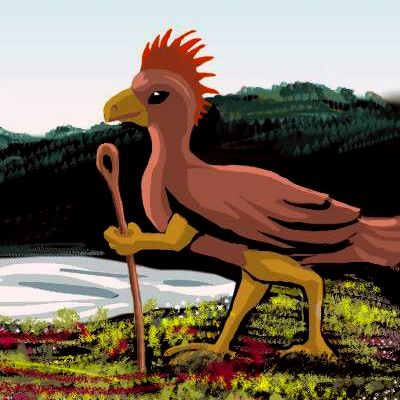
Large avian at sunset |
INTELLIGENCE
Will intelligent life evolve? If so, where, and what kind? Even in our world, with its extinctions and migration barriers, big-brained primates are scattered over a hemisphere--orangutans live in Indonesia. On Inversia, where you can walk around the world, primate niches may actually expand. And not only primates. It's worth remembering that (even restricting ourselves to land animals) elephant brains are as complex as ours, while Arctic wolves have chimp-sized brains, and bears aren't far behind. Parrots and ravens have recently proven to rival apes in intelligence. Inversia, like our present world, will have a rich pool of intelligent creatures, the right environment to shape them, and plenty of time.
Are there any generalizations we can make about the Inversians? Just that they won't be us. And not just superficially so: not just physically and genetically different, but in basic temperament. Aggression, territoriality, sociability, gender differentiation? And subtler traits: the social finesse of bonobos, or the political opportunism of chimps, or the shy tool-cleverness of orangutans? And these are just differences in our immediate family! Postulate super-parrots, mini-elephants or amphibious cetaceans and the dominant sense may be not be sight, but smell, touch or hearing. Is the sense of self different in sonar-using species, where soundfields sweep through you all the time, where the state of your stomach is a public affair? Do folks like that even have a word for lying? Or in smell-centered species, where everyone knows whether you're in estrus, will sex be public? Such species differences will shape nonhuman cultures profoundly. Look how we take our tool-dexterity, our intraspecies aggression, our constant sexuality, and our smell-blindness (and consequent ease of lying) for granted! Civilization is not one-size-fits-all.
CULTURE
My picture of Inversian culture is still hazy. One certainty: the low coasts around the ex-lands will be very different from the raised seafloors. The high air pressure in these low basins (nearly twice what we're used to; thrice if you're Tibetan) will let much larger animals fly. Indeed I'd expect most life in these basins to be winged one way or another--including intelligent life. Parrots or corvids twice the size of ours will be way smarter than our apes; less dexterous maybe, but with better reasoning, better hearing, better color vision, longer lifespans, and better linguistic abilities. It's hard to see them not developing a civilization.
A winged culture will be very different from a ground-based one. Politically and culturally unified, with fast communication but limited trade (because who wants to poke along with cargo on the ground or on the water at one-tenth speed?). Production will tend to be local, but news, ideas, culture and inventions anywhere in the world's basins will spread at half a mile a minute. This single factor may guarantee that the sea-basins dominate world culture and technology. A winged Web.
The uplands? Hard to say. In general, Atlantis and Indiana will be like mile-high plateaus on Earth, but Pacifica is higher--much of it, in terms of air pressure and temperature, like Earth uplands 2-3 km above sea level. So even Pacifica won't be utterly barren and will only ice over at high latitudes. But these huge, thin-aired plateaus will be unfriendly for giant parrots or ravens from the sea-basins; they may even be grounded. Who'd settle land that takes away your chief joy? Settlers can plant trees, irrigate crops, build railroads... but you can't reform the air. Would you renounce flight?

So I think wingless people of some form will dominate the uplands, as on Earth. Here, transport will by slow, and easiest by ship. In the uplands, great oases like the Hawaiian Ocean will become giant Mediterraneans where sea-trade fosters local civilizations ("local" as in Europe-sized). There are half a dozen of these super-Mediterraneans; they alone could support a population and cultural diversity comparable to all Earth. Around these diverse but civilized oases will be huge hinterlands: steppe and desert where (before the invention of railroads, at least) goods and ideas must spread slowly and painfully by caravan.
To sum up: Inversia is two worlds in one. So it's less likely a single people will dominate, as on Earth. Even if technology has some inherent tendency to become the monopoly of the first critter to invent it--and I'm skeptical that we can generalize from our single example--Inversia's lowlands encourage flight and the uplands discourage it. There may be more than two intelligent species, but there certainly won't be less.
Will they cooperate? Yes. That's the one thing I can assert flatly. Why? If they didn't, if one (probably the basin people, with their faster communication) tried to dominate the uplands the way Europe tried to colonize the whole world... well, Europeans overseas might die of tropical diseases, but they weren't instantly and universally crippled simply by leaving Europe! In contrast, Inversian lowlanders will be relatively helpless in the uplands. The locals have overwhelming advantages in transport and communication. A Conquistadorean techno-edge might win you a battle or two, but you couldn't settle the territory. And wouldn't really want to.
The Conquest does suggest an exception: the silver mines of Potosí, where generations of Andeans mined for European rulers who could barely breathe at that altitude. So yes, Inversia's lowlanders might be able to hold a few key, lucrative points--mines or vital passes. But wholesale conquest or colonization is biologically impractical. Inversia discourages empire; trade makes more sense.
Of course I'd say that's true on Earth too. And look at us.
AN INVERSIAN PARALLEL
In 2009 I got a complimentary copy of Frank Jacob's Strange Maps (because I contributed maps of Dubia). It's a very funny book of... oh, take a guess! To my surprise and amusement, the cover of Strange Maps is a elegant, simplified world map by Vladislav Gerasimov (vladstudio.com) of Inverted Earth--yes, it's even called that. Parallels all over, right down to the Great Islands and Baikal Island.
Just wanted you to know my Inversia wasn't inspired by Vlad's work (I started it long before) but the inevitable result of applying the same logic. I can't aspire to his stylishness; my focus will be on working out the details of this vast world that inversion exposes.
THE RANDOMIAN FACTOR
So. A vast world full of intelligent life, not a super-Pangean desert one might, on first glance, expect. Does Inversia look too damn nice? Unrealistic? Beware--there's a hidden factor making well-informed readers expect the worst from any radically altered world--not just Inversia.
"The grass always looks greener on the other side of the fence." That old proverb isn't about jealousy, as most people think. It's subtler than that. You see, it's literally true. When you look at grass you stand on, you're looking down--you see the leaves end-on, so a lot of bare earth is visible too. When you look over the fence at your neighbor's grass, you see it full-length, at a low angle, so the grass-blades overlap and hide the ground. Even if your lawns are identical, your neighbor's grass really does look greener.
And this effect crops up in other places. Ever notice, on a large busy road, how you always get stuck in the slowest lane? Lady Luck isn't out to get you--by definition the most crowded lane will have the most people in it! Clear, fast-moving lanes have fewer drivers. More often than not, you really ARE in a worse-than-average lane. The grass is greener in the other lanes--till you move over, and slow them up!
This principle applies to alternate earths--but in reverse.
Let's contemplate Randomia, an Earth no better or worse than ours, with roughly the same biomass, same amount of arable land, about the same population... just re-distributed. Now, what regions will you notice the most? First, your home, of course, and then, other well-known regions--and well-known means inhabited.
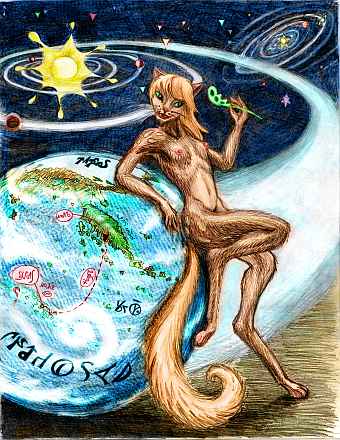
Randomia will always look inferior! For, by definition, most readers will be from our world's high-population zones. Random changes will, on average, degrade them. And the lands that improve, that become the heartlands of Randomia's civilizations, are likely to be barren obscure lands in our world, mere names (if that) to non-Randomian readers. The great European cities are all flooded on Inversia (millions of European readers groan), while the green Sahara nurtures great civilizations (a handful of Saharan readers cheer). If you love civilization, Randomia will probably kill or cripple the ones you love, and plant its greatest civilizations in places you associate with backwardness.
So the grass always looks browner in a parallel world--because what you value most, what you KNOW to value, is generally lost. This principle makes it hard to see alternate worlds fairly.
So, if I seem foolishly optimistic about the alternate Earths I build, postulating island leagues and tropical civilizations and oases in Martian deserts and islands in the Great Flood and seal-holes in the Global Icecube, if I postulate intelligent lemurs or elephants or mega-ravens... just remember I'm fighting the Randomian factor. Your view is colored by the degradation of what you know and love; so my predictions of new growth in unlikely regions and species, will seem fatuous. Yet they grow from the same changes as the doom and gloom--your perceptions are naturally tilted toward seeing the losses.
Factor Randomia in, before you mock.
STATE OF THE PROJECT
For years, Inversia's languished; I didn't have seafloor maps good enough to proceed beyond this overview. But as of December 2015, I've pretty much finished Kakalea, and thanks to GEBCO (the General Bathymetric Chart of the Oceans) Inversia's on the front burner again! It'll be slow--even at a million square km a day, it'll take many months, for Inversia has more land to map than my other worlds. But soon you should start seeing the first pages with regional maps. I hope to finish Inversia by the end of 2017.
[Of course, I said that years ago, and I've covered at a quarter or at most a third of the surface. It's true I'm going slow partly because my dreams have warned me not to push it.]
NEXT!
I've finished the basics for Inversia's companion-world, Siphonia. Its premise is simpler but equally drastic: drop a hose 5 km down (16,000') in the northern Pacific, and suck the oceans up til the hose runs dry. Nine-tenths of our water, gone. Now wait 100,000 years and see how life's adjusted! The new sea level varies around the world--the Sea of Japan, being nearly landlocked, dropped very little, while the Mediterranean and Caribbean dropped 1-2 km (3-7000'), the Atlantic and Indian Oceans are now a chain of seas 4 km (13,000') down, and the North and South Pacific (now two separate seas) are 5 km down (16,000'). The old continents are generally alpine or Tibetan; most of the livable land is now in the abyss. And those lands are rugged, spectacular, and bizarre--the secret face of Earth. Siphonia's regions all have maps now, but ground-level sketches and descriptions of scenes, critters and cultures are still thin.
Abyssia looks done. Lush but small and simple, minimizing calculation, letting me just enjoy touring, sketching the scenery and the people.
Basic tours of Capsica are done too. Hard work to design tours for regions that want to bake or steam you to death. Illustrations are still scant--both the scenery and the natives.
I need to rethink Libratia in light of the last few years of fuss about its fundamentals. Probably I should enlarge the whole system, move the planet farther out, halve the tidal effects. Still, that won't satisy some readers sure it'll be a volcanic hellhole (I dunno; people overestimate the effect, very strong on Earth because it spins relative to its primary, maximizing tidal warming; tidelocked, merely nodding worlds get massaged much less). Other readers swear by the new atmospheric studies suggesting not all close-in worlds will be tidelocked at all--hot dayside air is less dense, and it works out that the atmosphere actually protects a planet's spin. So would Libratia slowly spin like Venus or Mercury, not nod? Other readers complain Libratia's orbital eccentricity would decay to circularity--killing libration. That'd take the fun out of it! But the moon has equally big tidal stresses on it, yet it nods every which way (and isn't erupting this week). We'll see.
Maybe all those helpful critics will be distracted by the discovery of our (hold your breath) NINTH PLANET! I think the odds look decent by 2026. Can we name it Planet Ix? What a great retro sound! Not just for the Roman numeral, plus the pun on X... it's already a place name! L. Frank Baum wrote "Queen Zixi of Ix" a century ago. If we can use Shakespearean names on Uranian moons and Tolkien placenames on Pluto (and the Atlantic seafloor), why not Oz out in the Kuiper Belt?
CLICK A REGION for local maps & illustrated tours. Many areas still lack tours, though. These are done:
Arctica -
Canadian Ocean -
Amazon Ocean -
Medimarea -
African Islands -
More worlds: see Planetocopia
World Dream Bank homepage - Art gallery - New stuff - Introductory sampler, best dreams, best art - On dreamwork - Books
Indexes: Subject - Author - Date - Names - Places - Art media/styles
Titles: A - B - C - D - E - F - G - H - IJ - KL - M - NO - PQ - R - Sa-Sk - Sl-Sz - T - UV - WXYZ
Email: wdreamb@yahoo.com - Catalog of art, books, CDs - Behind the Curtain: FAQs, bio, site map - Kindred sites