World Dream Bank
home-
add a dream-
newest-
art
gallery-
sampler-
dreams by
title,
subject,
author,
date,
places,
names
ABYSSIA
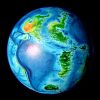
by Chris Wayan, 2004-2011
for William Beebe and Otis
Barton, first voyagers into the abyss
Abyssia-
map-
building Abyssia-
geology & geography -
critters & cultures -
the clash
of names -
-
more worlds? Planetocopia!
RECIPE FOR A SOGGY PLANET
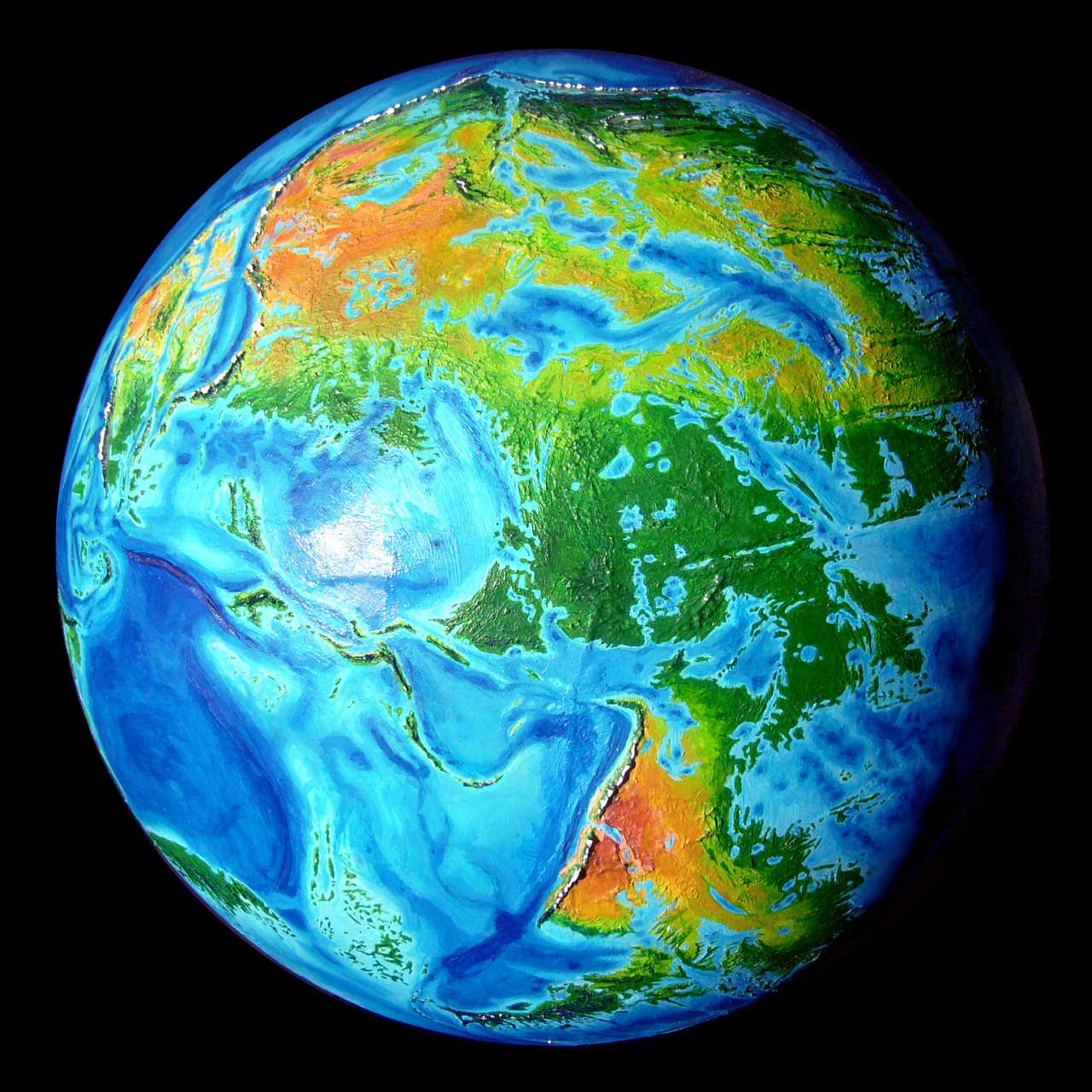
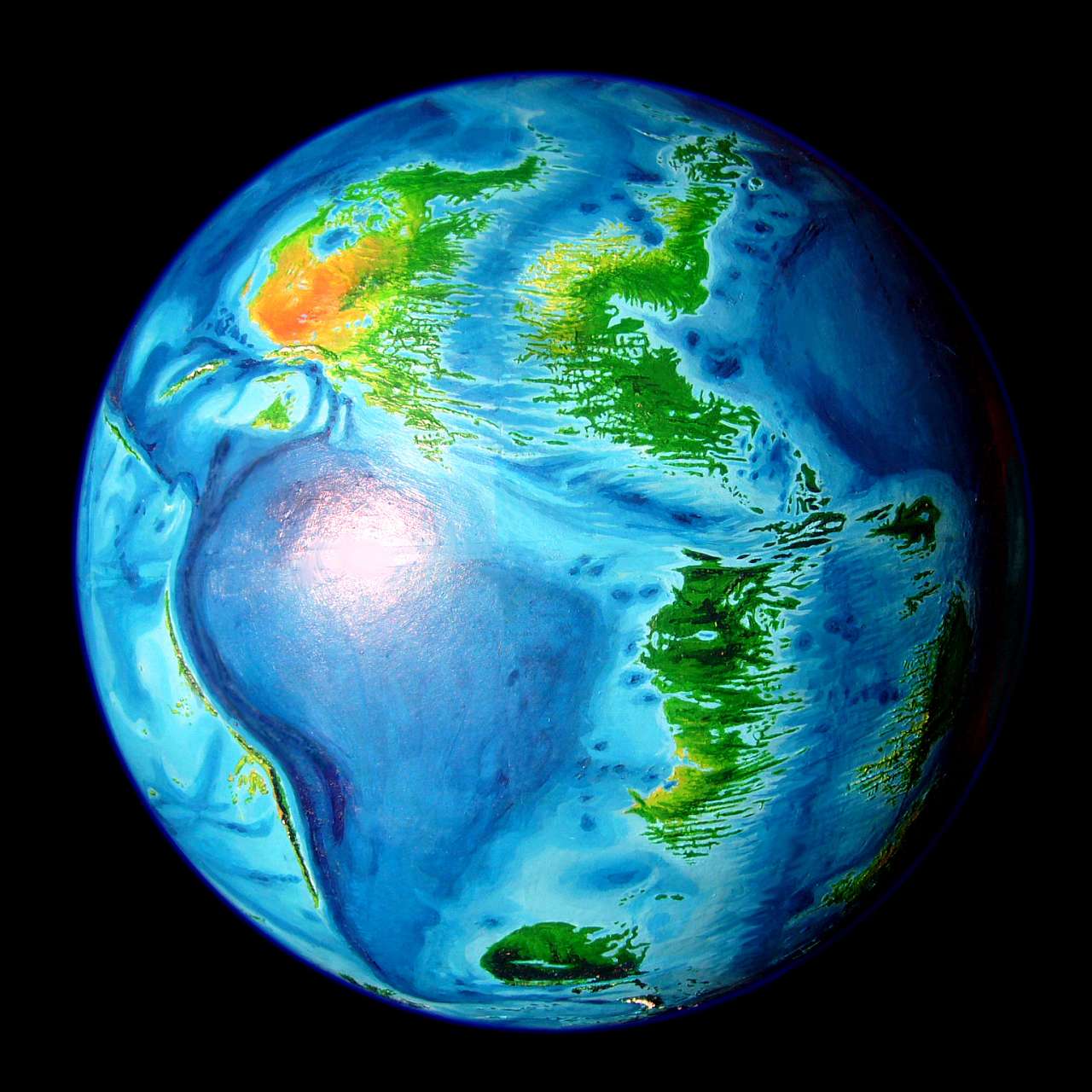
Abyssia demonstrates just how much water Earth has--dangerously much. We're lucky to have any land at all! The recipe for Abyssia is simple:
- Remove the world's oceans (keep them handy. You'll need them soon.)
- Now mark the altitude of every point on Earth, and make every depth a height, and every height a depth. Our ocean trenches are now huge mountain ranges; our ranges, trenches. Rugged, isn't it? It's as if you'd turned Earth inside out like a glove...
- Now pour your stored seawater back into the new seabeds--the Eurasian Sea, the African Sea, the American Seas. But they'll fill up fast. You'll reach the old coastlines with water to spare. Lots to spare. Keep pouring. Soon you'll be refilling the seabeds, and wondering how much land there'll be. Soon you'll be adding "if any." Keep pouring! Don't hold any back.
- Look for land. Good luck. Most of our abyssal plains, which you'd think would form new continents, are
just shallower seas; the bits that do rise above water are low and broken.
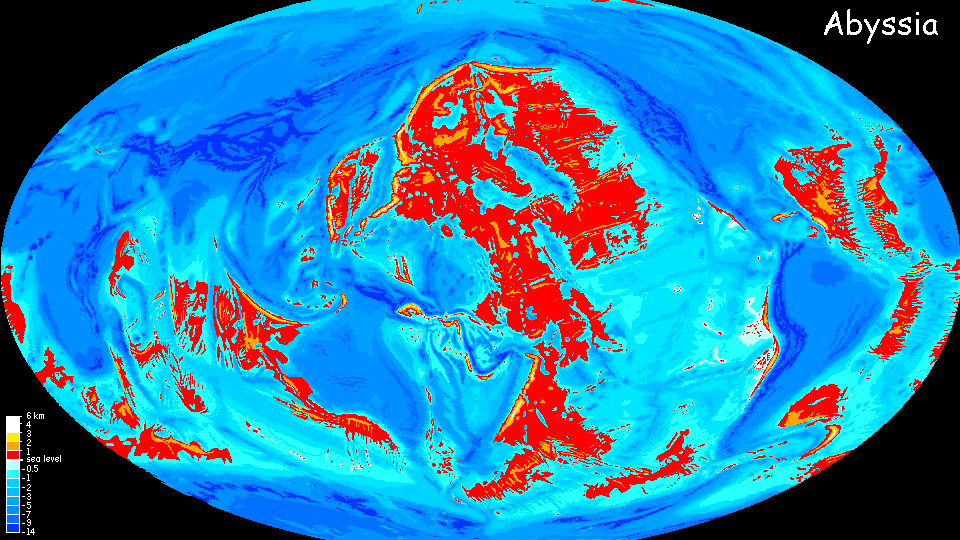
Only 12% of Earth's surface is land! That's all.
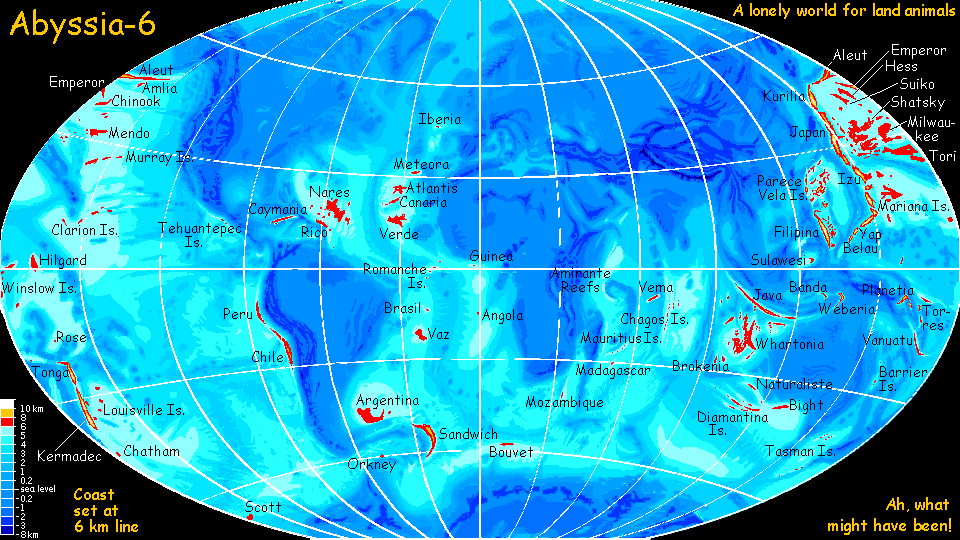
As you look at the map below, are you starting to realize how drenched our world is? And how lucky we are that continental rock is so light! We're living on rafts, and don't know it.
Earth, what a name! Don't make me laugh. Oceana, Drownia, Uptoyournosia! That's what we live on. Float on.
WHY ABYSSIA?
Oh, partly for fun--all the deepest, secretest parts of Earth are suddenly center stage, and all the geography you know is just an oceanographic footnote! Just a little bias-correction for all my land-animal readers (you know who you are).
It was partly a dare, too--my friend Dan saw a sister-planet I was building, Inversia, where up is down and down is up, and he noticed that to preserve the distinctive outlines of the continents, I'd put a lot less water over the inverted land. Dan asked "What if you put ALL our water back, so the only land is our deepest abysses?" It was an interesting challenge. I thought we'd still end up with fair-sized continents--basically, all the abyssal plains would become land. Wrong!
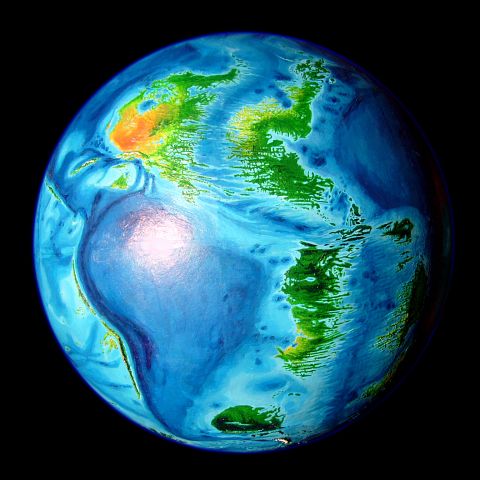
It was harder to calculate than I expected--and no, I couldn't run my handy-dandy super-accurate 3-D dataset of Earth with a minus sign to turn it inside out. Done by hand, folks--and that means a margin of error of at LEAST 100 meters! Worse yet, when I estimated the volume of my new, alien sea basins they implied a coastline near the six-kilometer mark. I even did a quick map of this world: call it Abyssia Six. Catastrophic! Islands dot the sea, but their total area's less than Australia--not much over 1% of the surface. Then I found a glaring math error; the real contour was around 4900 meters, not 5900! Better, but still mighty blue. Vast reefs and low scattered lands--except Pacifica.
I was surprised. Such a familiar planet; so modest an alteration; so alien a result. How could an artist resist?
But Abyssia's also serious. It's my way of highlighting a problem exobiologists don't emphasize enough. After centuries of highly visible Martian deserts, and decades of Venus-as-Hell propaganda, we tend to think space is dry and other worlds all have drought problems; wonderful Earth has the optimal amount of water for a biosphere. Gaia, gem of the cosmos, life-cradle, Mother Earth. Well, I'm dissing your mama! It's quite possible to be too wet, and frankly, Earth is. 10-20% more water would have changed our geography profoundly; continents would erode into tall, narrow platforms only half as big. Or if our tectonics had been just a bit less active, the relief a bit lower, like Venus... well, if Venus had oceans even two-thirds as deep as Earth's, only 8-10% of the surface would be land! Earthlike oceans? Make that 1% land! Earth is drenched. Half our water--a tenth our water--would have been plenty, thanks.
I don't go as far as Peter Ward Douglas in Rare Earth, who argues that planets with world-seas and little land won't develop complex life (my world-model Lyr is 95% sea but still sustains a complex land-civilization); but still, experiments like Abyssia show how dangerously close Earth came to lacking land entirely. Only ruggedness saved us: and it arose from very active tectonics, courtesy of the tidal drag of our huge moon. How common is that?
THE LESSONS OF ABYSSIA
In some ways, drier is safer. Even 1% of our water would be enough for very extensive seas, after all. Water does spread out! For three examples of drier biospheres, see Serrana(8%), Mars
Reborn(1.5%?), or Tharn (0.2%!). Sealife concentrates in the surface layers, and the rain that landlife needs evaporates off the surface, too. Our seas are unnecessarily deep--so deep they're a liability. But hey, I'm grateful! They could easily have been fatal.
So as we look for life elsewhere, remember: we may love Earth, like Mom, for sentimental reasons, but she's not unique--not even optimal. Just a good-enough
mom--and yet we're proof that's all life needs. We don't need to look for other Earths; our search can be much broader than that.
STATE OF THE PROJECT
For years, Abyssia felt like an empty stage--or a theater just starting rehearsals.
- GEOGRAPHY: solid--I've mapped the planet in detail now, including (at last!) the bizarre pitlakes of western Pacifica and Agassiz, the most problematic.
- CLIMATE: clear.
- TOURS: now exist for all regions, though some need fleshing out.
- BIOLOGY: I've extrapolated from a fairly Terran life-tree, except that most large vertebrates have six limbs not four (insects have four). Centauroids and avians with small forehands are common.
- PEOPLE: Notes and tentative sketches of three potential groups of intelligent species (a dozen birds, mostly flightless, but a couple from the pitlakes may be flightworthy; three centauroid mammals; and possibly a reef-dwelling cephalopod) are now on the creatures and peoples page.
- RANGES for these species are mapped, though these will be adjusted as I flesh out the tours.
- CULTURES are just beginning to come clear as I flesh out the tours.
- PORTRAITS: I'm adding these now. Some are pencil, ink and paint, but as with Kakalea, my most recently finished world, for the three centauroids there will be quite a few DIORAMAS with sculptures. First examples: see the Greek Islands and East Pacifica.
- SCENERY: An experiment. I study a woodblock print by Hokusai or Tom Killion (I admire their compositional boldness), sketch it freehand onscreen, and alter it to fit Abyssia as I draw. My versions are looser and simpler than the originals--Killion writes he spends hundreds of hours per print run, and I suspect Hokusai spent no less; I allow myself one hour per faux print. Quite a challenge to catch just the essence! Building Abyssia has a table showing the 'prints'.
THE NUMBERS
- Land = 12%; about 58 M sq km of low plains (ex-abyssal plains) and 2 million sq km of rugged mountains (ex-trenches). Less than half Earth's land, but more of it's fertile.
- Shallow seas = 13%; rich coral reefs cover fully 7% of Abyssia (Earth has just 2%).
- Deep seas: (1-4 km deep) = 40%: former seabeds. Surprise! They still are.
- Abyssal plains (5-6 km) = 32% of surface area: former continents and continental shelves.
- Trenches and Deeps (6+ km) = 3% of surface: former mountain ranges plus Tibet and the Altiplano
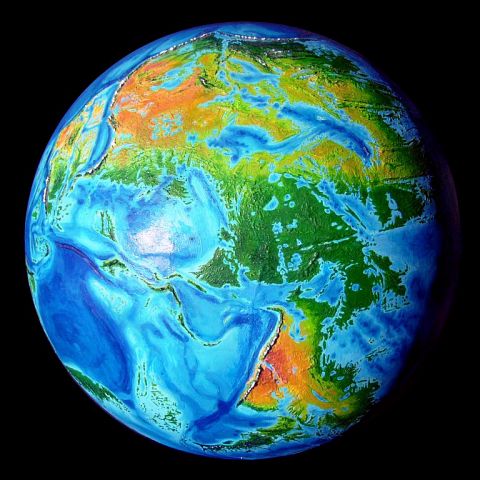
- Relief above water = mostly low, under 2 km (6600'), but with startling exceptions. The highest peak is Mt Challenger in the Mariana Mountains, over 6 km above sea level (about 20,000'). Greatest depth is the Everest Deep, nearly 14 km. Major features of Abyssia:
- Low, broken lands; the sea is always near, and most climates are maritime
- Tropical or temperate lands; very little beyond 50 north or 65 south
- Narrow, tall, straight or arcuate coastal ranges, mostly around the Pacific Rim
- Low plains dotted with deep lakes--deep conical pits equivalent to our many abyssal volcanoes. In deserts these can lie miles below sea level.
- Cloud cover = Denser. Smaller continents mean more surface water; and Abyssia's equator is unobstructed ocean, allowing a ring-current of warm water generating hurricanes all through the tropics; and without icecaps the poles are warmer. All three factors increase evaporation and generate clouds.
- Albedo (reflectivity) = quite Earthlike. Increased clouds make up for less land (deserts and grasslands reflect a lot of sun).
- Air pressure = 0.98 atmospheres at sea level, but up to 1.7 atm in the deepest desert pits of Pacifica and Agassiz. Earth sea-level pressure is a trace higher because the volume of continental rock above sea level acts like a funnel, deepening the air column by 1-200 m at sea level; Abyssia's tiny, low continents displace next to no air. Modern Earth has nothing like Abyssian pits, but just a few million years ago our Mediterranean Sea dried up; its basin was quite Abyssian.
- Oxygen = 23%; within Earth's lifetime range, but richer than Earth today. Why? There are fewer exposed rocks to oxidize, and Abyssia's biomass is 25% bigger. Note that in the deepest desert pits, the dense air raises available oxygen to 191% of sea-level Earth's! Supercharged metabolisms may result, boosting maximum flight-weight to two or three times Earth's. Look for big birds. And fruit-bats. And...
- CO2 = 300 ppm?; the many mountains and trenches suggest active plate tectonics, including vulcanism, a splendid source of CO2.
- Tectonics = active, but don't look too close! While Abyssia's ranges and trenches look superficially plausible, the mid-oceanic ridges and their rift zones are a puzzle. Marine geologists would go crazy trying to figure out if the rifts are spreading zones or slurpingzones, and why Abyssia lacks volcanic cones, and what all those conical pits are instead. Though some of Venus's coronas pucker inwards; in fact much of Abyssian geography looks rather Venusian.
- Temperature = about 3°C (5°F) warmer than Earth. CO2's not the reason, though. The equator's about the same; but the poles are much warmer. The average is deceptive in another way: Abyssian land climates are maritime, lacking the savage heat and cold of our continental interiors. Only 12% may be land, but on much of that, a human dropped down naked would be just fine. Try that on Earth!
- Icecaps = 0.002% of surface area! (Earth: over 3%). With no polar lands to speak of--not even a Greenland--ice can't build up. That keeps the poles so much milder that even sea ice retreats to the few polar islands each summer.
- Habitats = less diverse than Earth's, on land. The largest on land are tropical forest and temperate forest, mixed savanna (scattered trees, groves, or riverine strips in dry grassland), veldt, alpine vegetation, desert, and pit ecologies. The shallow seas have larger coral reefs than Earth, but the deep seas are relatively barren; with few deserts, there's less airborne dust, and great sediment-bearing rivers are rare; open sea is nutrient-starved.
- Biomass = 125% of Earth's!
- Land = 250% of Earth's land biodensity, due to all those lush forests and lack of deserts... but the area is small, so the total land biomass is around the same as Earth's.
- Sea = 120% of our oceanic biodensity; wide barren deeps offset by triple-size coral reefs. About half the oceans' species, individuals, and biomass live in these reefs!
- Intelligent species= on land, three centauroid mammals, at least a dozen flightless birds (and probably a couple of fliers); the seas are home to several intelligent marine mammals and at least one tool-using cephalopod. See Peoples of Abyssia.
- Technology = low? Much of Abyssia's intelligent life will be marine; it's hard to progress technologically without fire or metallurgy, both impractical on coral reefs. Even on land, is there a big enough base for it? Savanna and deserts are ideal places to learn of fire: lightning-set fires are common, yet thin vegetation limits their size and heat. Was our taming of fire opportunistic? If so, will fire ever be tamed on such a moist world as Abyssia, with little savanna or desert? Rainforests haven't generally been dynamos of innovation, and much of Abyssia is. On the other hand, the people are more diverse than Earth's, physically, mentally, and culturally. They may surprise us.
- Data sources: I used a very wide variety of atlases and maps, once I realized how much they clashed. The most reliable online sea-map is GEBCO, the General Bathymetric Chart of the Oceans--but even that's derived largely from satellite gravitometry (inherently low-resolution) and oversimplifies deep contours. For me, a single sounding by an old ship that was actually there carries more weight than gravitometric estimates. So Abyssia isn't just GEBCO upside down; I did my research in (ahem) depth.
- Nomenclature: I've used real names for my islands and coral reef zones, with commonsense inversions ("trench" to "range", "seamount" to "lake", etc). One caution: atlases disagree more on seafloor nomenclature than land names. Well, they disagree on features and contours, too. Whole mountain ranges appear and disappear with each edition as if by cartographic whim. And why not? They're free to get it wrong--the locals won't complain.
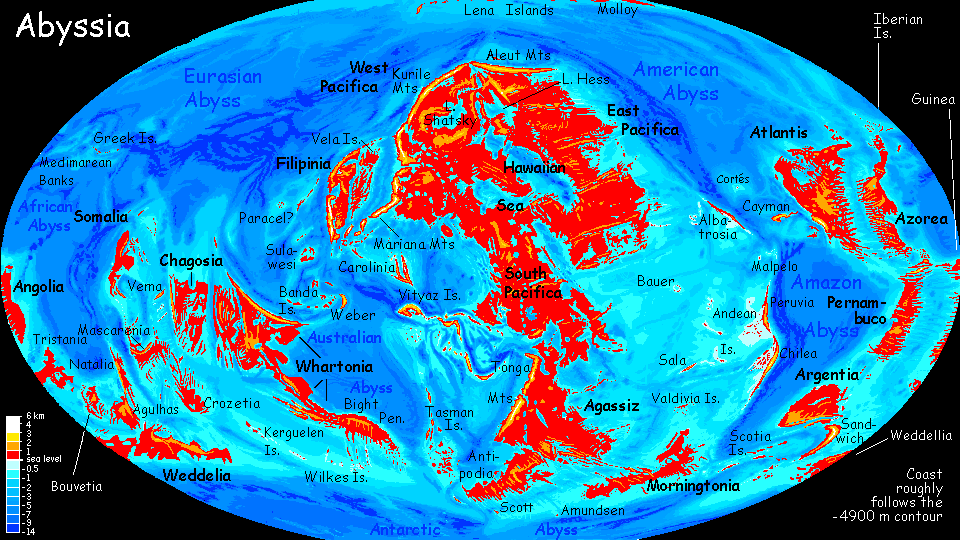 TOURS: this route snakes around Abyssia's major lands -
Lena Is. (brr!) -
Greek Is. -
Atlantis -
Azorea -
Cayman and Albatrosia -
Andean Is. -
Scotia Is. -
Morningtonia -
Agassiz -
South Pacifica -
East Pacifica -
Hawaiian Sea -
Pacifica Desert -
Filipinia -
Banda Is. -
Vityaz Archipelago -
Tasman Is. -
The Bight -
Whartonia -
Chagosia -
Somalia -
Mascarenia and Crozetia -
Weddellia -
Argentia -
Pernambuco -
Angolia -
Tristania -
Agulhas group
TOURS: this route snakes around Abyssia's major lands -
Lena Is. (brr!) -
Greek Is. -
Atlantis -
Azorea -
Cayman and Albatrosia -
Andean Is. -
Scotia Is. -
Morningtonia -
Agassiz -
South Pacifica -
East Pacifica -
Hawaiian Sea -
Pacifica Desert -
Filipinia -
Banda Is. -
Vityaz Archipelago -
Tasman Is. -
The Bight -
Whartonia -
Chagosia -
Somalia -
Mascarenia and Crozetia -
Weddellia -
Argentia -
Pernambuco -
Angolia -
Tristania -
Agulhas group
Abyssia's homepage - map - peoples - regional tours - names
LISTS AND LINKS: More worlds? Planetocopia! - dreams of other
worlds- ecology- climate change- evolution- natural disasters- terraforming- sculptures and 3D art -
World Dream Bank homepage- Art
gallery- New stuff- Introductory sampler, best
dreams, best art- On dreamwork- Books
Indexes: Subject- Author- Date- Names- Places- Art
media/styles
Titles: A- B- C- D- E- F- G- H- IJ- KL- M- NO- PQ- R- Sa-Sk- Sl-Sz- T- UV- WXYZ
Email: wdreamb@yahoo.com- Catalogof art, books, CDs - Behind the Curtain:FAQs, bio, site map - Kindred sites