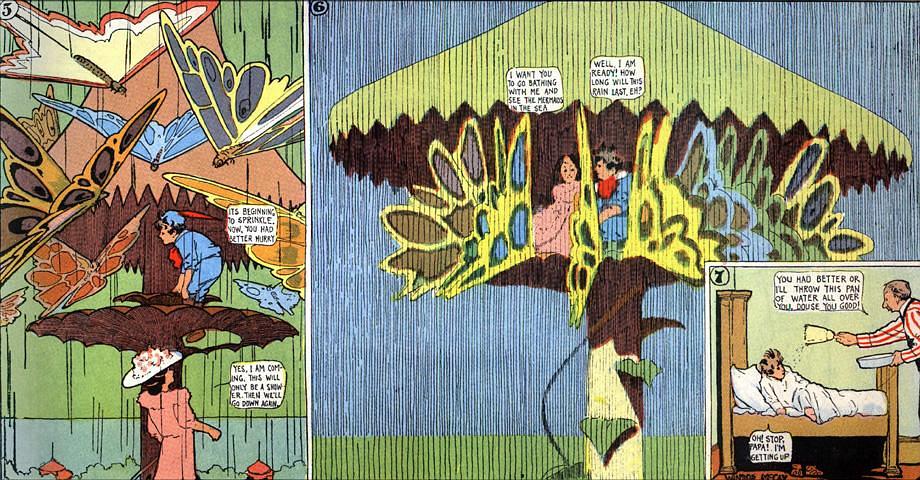
The sheer beauty of Nemo's dream (1906/8/12) versus the shabby waking world. Anti-meaning? No. Subversive? Oh, yes. Always.
Little Nemo
by Chris Wayan, 2005/2/6; sample comic from 1906/8/12
I've been reading a book of essays: "Give Our Regards to the Atom-Smashers: Writers on Comics." That subtitle should be "Guys on Superhero Comics." Nearly all the writers are male. No surprise, I guess. But I AM surprised that they mostly read the wham-bam comic books I ignored as a kid--and still do. If I wanted violent conflict involving oversized males, all I had to do was go to school and get beat up again. Superheroes were just those jerks grown up; nothing new. As a kid I read comic strips creating their own worlds (Krazy Kat, Pogo, King Aroo, Little Nemo in Slumberland, Barnaby) and later independent/underground comix doing the same (Odd Bodkins, Crumb and Harvey Pekar, Women's Comix, Omaha, Elfquest). Yet nearly all these essayists, as boys, read the caped two-fisted hero-stuff.
Not all. Lydia Millet writes on "Little Nemo in Slumberland", the very first dream-comic, and one I always liked. Its creator Winsor McCay drew a vast world of dream-splendors, full of creatures (and feelings) that don't fit any nice neat plot. More like ukiyo-e than comics--and not that far from my own dreamworld.
Millet argues Slumberland is passive and anti-meaning--that's its subversion. McCay as Surrealist! I agree Nemo is deeply odd, but is that quite it?
Little Nemo has a plot--its arc is just too big to see in single episodes. But over time, Nemo grows more active and less fearful--progressing from nightmares and frustration dreams, to trickster and fuck-up dreams, then delegates the trickster role to Flip his resentful lower-class shadow, and then when he's befriended/integrated Flip, to Imp, a jungle boy. Imp's a racist caricature, but quite unlike the colonial racism of, say, "Tintin", for Imp's clearly a dream-figure: either a side of Nemo himself, or a spirit of chaos who manifests in this form to Nemo, who is after all a white middle-class boy born in the 19th century. Imp functions just like Dorothy's dog Toto: as a familiar who communicates through action, an agent of intuition who pulls back curtains to reveal humbugs behind wizards. Like Flip before him, Imp's an active side of Nemo he consciously represses. And has to learn to value.
So Nemo's active--his deeds just aren't heroic. He's building a self. First he must lose his fearfulness and crying for Mama, then his shyness with the Princess, his anima; then he must fight and befriend uncouth Flip the underdog/Jungian shadow, and then chaotic, instinctive, intuitive Imp. In the end, Nemo wins the girl and becomes a prince of the dream realm.
Still, Millet is quite right that this happens subtly, slowly, haphazardly, with diversions and setbacks--not through any plan or Triumph of the Will (oops! I try not to quote Nazis, but after that book on superheroes, there's this testosterone whiff in the room...)
Millet rightly says McCay rejects and challenges cramped crabby Freudianism. But the sheer splendor of McCay's love-letter to the dreamworld's beauty distracts Millet from how much he anticipates Jung! Nemo's instinctive and shadow sides aren't Ids to be repressed or channeled (as Freud said) or enemies to be defeated (as superhero comics said) but spirits to accept and befriend, despite the chaos they bring. For short-term chaos builds long-term character. McCay's dream comics advocate a messy, often-failing, never-ending spiritual journey.
Without needing to punch anyone's face, either.
World Dream Bank homepage - Art gallery - New stuff - Introductory sampler, best dreams, best art - On dreamwork - Books
Indexes: Subject - Author - Date - Names - Places - Art media/styles
Titles: A - B - C - D - E - F - G - H - IJ - KL - M - NO - PQ - R - Sa-Sk - Sl-Sz - T - UV - WXYZ
Email: wdreamb@yahoo.com - Catalog of art, books, CDs - Behind the Curtain: FAQs, bio, site map - Kindred sites