Lebbirds
by Chris Wayan, 2006
Lyr (home) - map - creatures - cultures - evolution - climate - geology - gazetteer - nomenclature - definitions - building Lyr - more worlds? Planetocopia!
Lebbirds
by Chris Wayan, 2006
Lyr (home) - map - creatures - cultures - evolution - climate - geology - gazetteer - nomenclature - definitions - building Lyr - more worlds? Planetocopia!
SPECIES
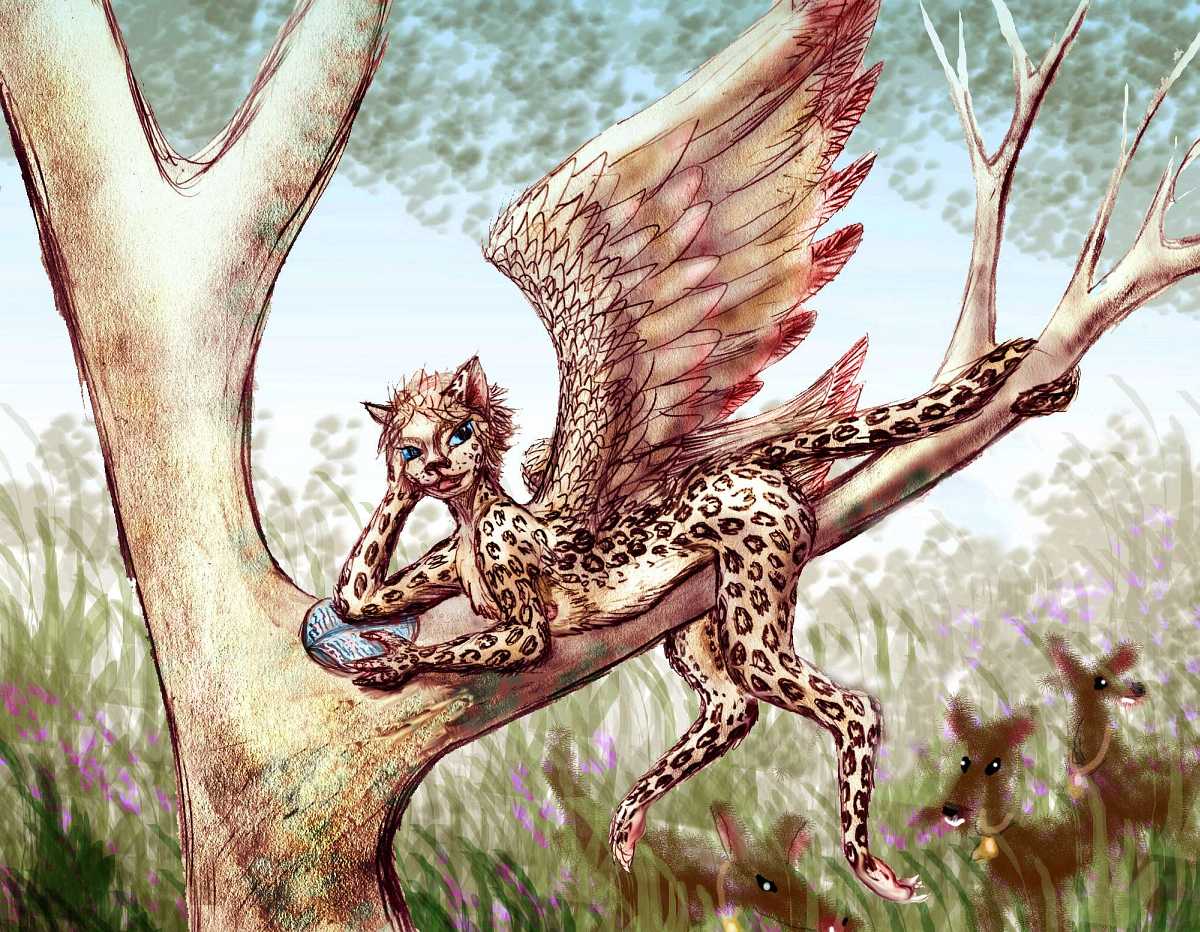
Lebbirds, as the name suggests, have a winged feline body, with handlike forepaws. Despite many similarities, they're quite unrelated to sphinxes; lebbirds are a converging design that evolved 30,000 km away. The parallel is not exact; lebbirds are far more arboreal than sphinxes. (Lyr's southern hemisphere even has a third similar-but-unrelated species, the considerably more humanoid icari).
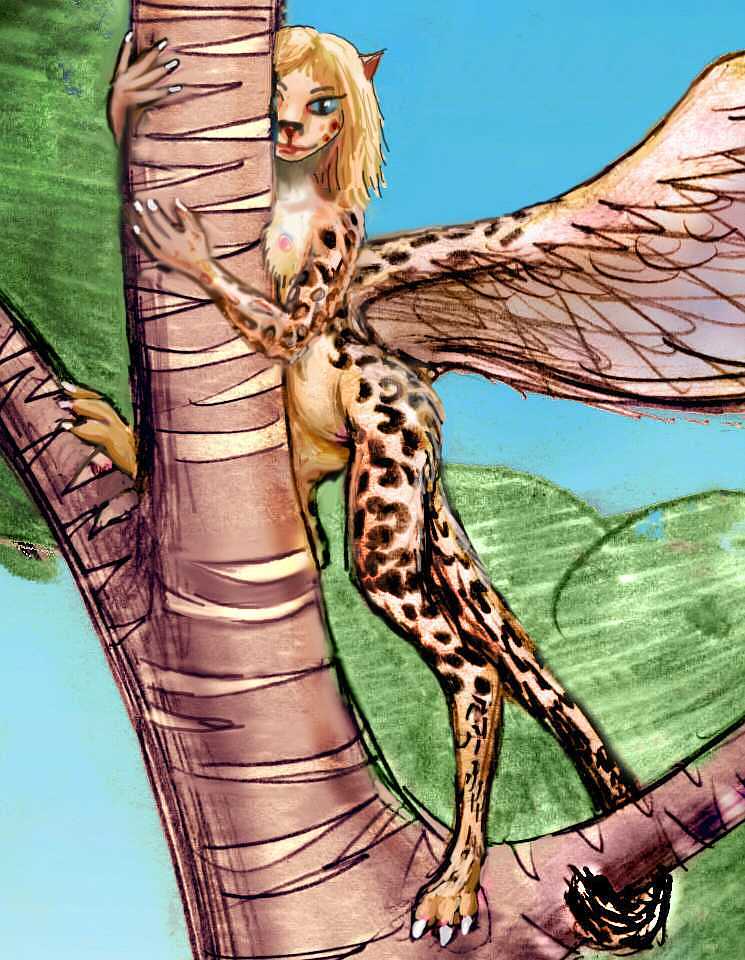
Note the long hind legs and splayed hind digits; lebbirds can stand and walk upright along branches, balancing with their long tail, or using it as a sort of third leg. Yet they can climb using all four legs, or swing by their arms and prehensile tail, as well as fly. This complex design-compromise means you can find lebbirds almost anywhere--if it's warm. Their spidery frames and short velvety fur are adaptations to heat; they don't mind warm rains, but cold storms or a freeze can quickly kill an unsheltered lebbird.
Nearly leopard-sized, lebbirds are far lighter, being hollow-boned. Their greater fragility makes them relatively gentle and cautious. Originally omnivorous hunter-gatherers of the jungle canopy, eating fruit, nuts, termites and especially river-fish, many today are ethical vegetarians (though high-protein ones, heavy on dairy products from herds of domestic milk-monkeys, plus bird- and lizard-eggs).
BEHAVIOR
Not just their appearance but their temperament parallels sphinxes. Friendly, as sensual as leopards, but gentler, due to their fragility. On Wersgorix, their homeland, many are still cliff-fishers and orchardists. But in mixed villages, lebbirds often specialize in bodywork, scents and herbs, seduction and sex (considered a respectable art by most Lyran species). In big cities and more cosmopolitan cultures, the intense curiousity of lebbirds makes them good therapists, shamans, and scientists--all fields with complex, multidimensional puzzles, much like flying or climbing through their ancestral rainforest canopy.
Their least sphinxlike feature is their love affair with trees--lebbirds feel lost without them, and never settle steppes or deserts. Nor are they as aquatic--though they do fish, they don't hug sea-coasts as sphinx villages do.
They're also less firmly four-footed than sphinxes--they often stand or walk upright, though they use their tail as a sort of third leg, so it's a stretch to call them bipedal; not to pun, but lebbirds swing both ways.
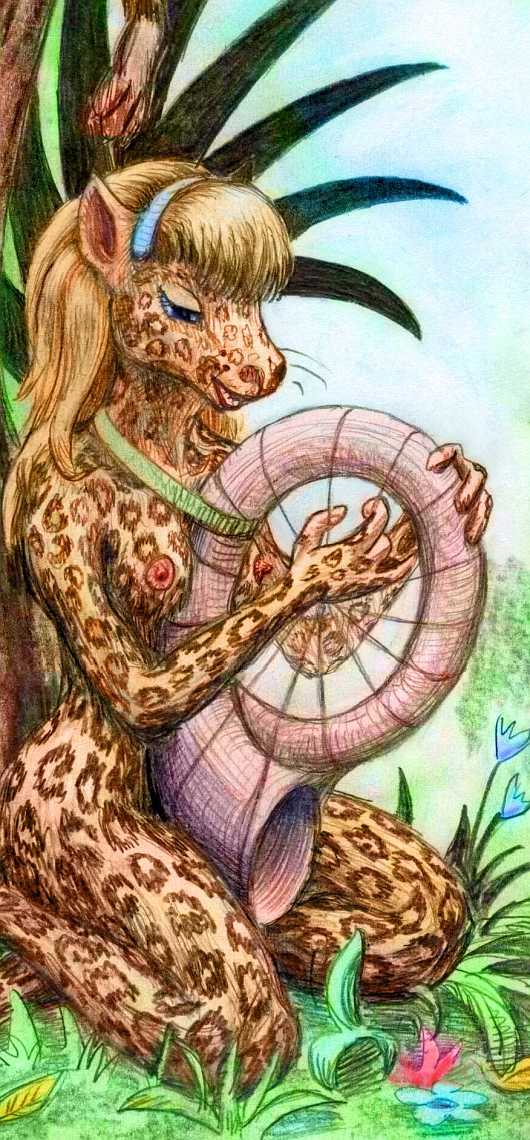
Many lebbirds also excel as performing artists--actors, dancers, and especially musicians. To left is a sketch of a bard (well, a music student, actually) playing a spiral "ammonite harp", made of a single large shell with a deep thrumming resonance. Fragile but gorgeous. The harp, I mean. Lebbirds may be gorgeous, but despite the hollow bones, don't call them fragile. At least not to their faces.
HABITAT
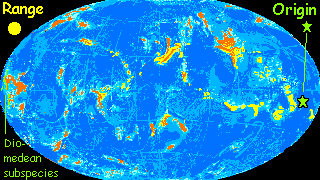
Lebbirds evolved in the hot rainforests of Wersgorix, eventually spreading north to southern Troisleons and west along the Polesotechnic Strip--Ulash, Ikrananka, Larsum, the Kraoka Islands, east Gaiila, the islands of Oronesia, and the southern Ythri region. To the east, a few lebbirds have made it to the Kyrie Islands and even the west coast of Diomedes, though their numbers are still small. They'll probably remain a rarity on the mainland, since their rainforest niche is already occupied by the native koreens.
Diomedeans now form a distinct subspecies. That harpist pictured to left is a Diomedean--you can tell by her wide, rounded, rather equine snout, where other lebbirds have a small, black catlike wedge- or button nose. Though they're only 3-4000 km from the lebbird homelands, Diomedeans are isolated by the dangerous Kyrie flyway; genetic drift quickly made this tiny group diverge. It's not just the face; wing color (not visible here) is also distinctive in this tribe--white and pale yellow underwings are common, though rare elsewhere.
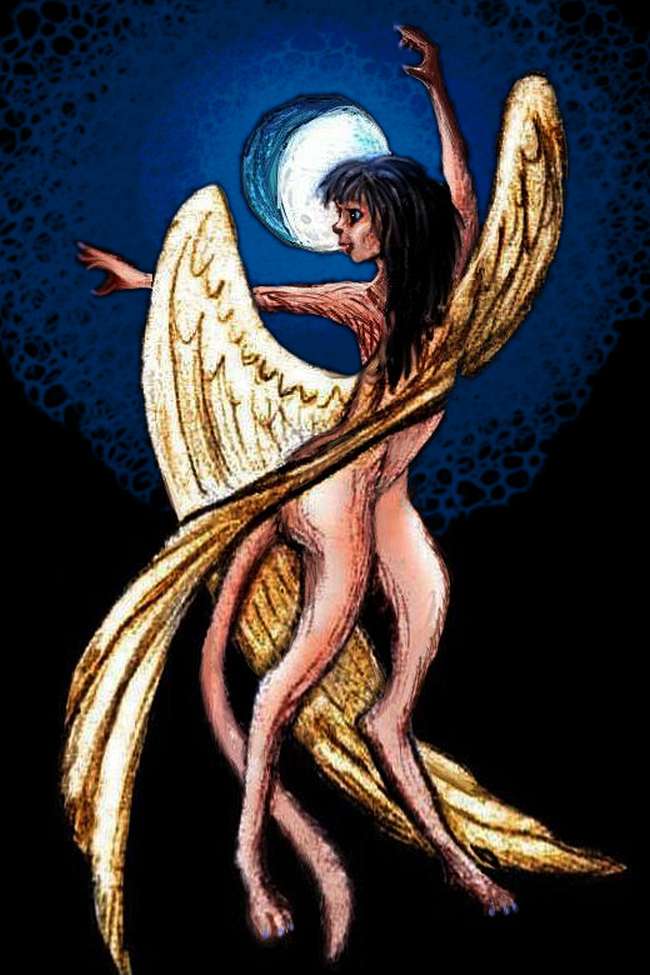
After all I've said about lebbirds only living in warm rainforests, their second preferred habitat may seem paradoxical: cities!
Many lebbirds still live in traditional treetop and clifftop villages, but they enjoy being around other species, and perhaps an equal number today live in multi-species towns. Cities all the way to southern Oronesia have enough resident lebbirds to support cafes and restaurants with their distinctive, sweet-spicy cooking (having evolved in the tropical canopy, full of fruit and flowers, lebbirds have a sweet tooth and a taste for resins, florals and aromatic spices). Quite Southeast Asian.
Hmm. I'm hungry now...
Another shadowy lebbird habitat, related to cities is... the night. Their lands are warm and humid. Lebbirds, like most fliers on Lyr, are cautious about flying at night. Just one good whack of your face into a tree will teach you caution. But unlike many Earth birds, lebbirds don't necessarily fall asleep as soon as it gets dark. Not if there's fun to be had! In treetop towns, lebbirds climb from tree to tree, drinking, dancing, watching plays, flirting, singing...
It's still warm in the moonlight, but at least not as sticky-hot. Do as the natives do. Fly at dawn and dusk, siesta all day, and go out to treetop cafes all night. Hear a bard tell a story-song. Flirt with an alien. Have a good argument over silly fruit drinks. Try lebbird drama (the character motivation may seem peculiar to humans, but the acting will grab you by the scruff of your neck!)
Most of all, see some ballet. Air-ballet for certain, and love-ballet if you're not squeamish. Yes, it often involves sex on stage, but as this breaks no taboos for lebbirds, it's somehow innocent. Rather sweet, really.
If it's too sweet for you, just act on the lebbird proverb: "There are plenty of trees in the wood." Just glide to the next tree-cafe. You'll find a new circle, snack, fruit drink, band, sculpture jam, storyteller, song-duel, play, dance marathon...
Most Lyrans believe in reincarnation, generally as a different intelligent species, until (as they say) you've "done the wheel" a few times--been every possible species and gender. They say it takes a thousand years--and those are long Lyran years. A thousand of those ago, the Greeks had yet to build the Acropolis; Buddha walked the earth.
But lebbirds disagree. Lebbirds aren't reborn. Lebbirds go to Heaven.
And Heaven, they insist, is a nice big crowded cafe.
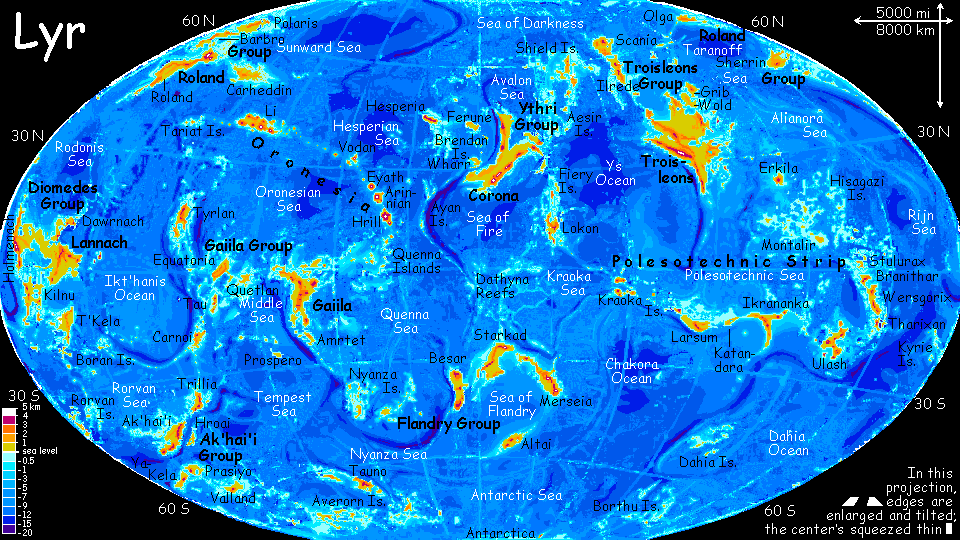
Gazetteer: index of places, with descriptions. Or...
TOUR LYR! Climb volcanoes, swim seas, meet weird creatures. First: survival tips! Then, pick a region:
Ythri -- Polesotechnic Chain -- Troisleons -- Roland -- Oronesia -- Gaiila -- Flandry -- Diomedes -- Ak'hai'i -- Averorn
Lyr's homepage - map - creatures - evolution - climate zones - geology and geography - gazetteer - nomenclature - definitions
World Dream Bank homepage - Art gallery - New stuff - Introductory sampler, best dreams, best art - On dreamwork - Books
Indexes: Subject - Author - Date - Names - Places - Art media/styles
Titles: A - B - C - D - E - F - G - H - IJ - KL - M - NO - PQ - R - Sa-Sk - Sl-Sz - T - UV - WXYZ
Email: wdreamb@yahoo.com - Catalog of art, books, CDs - Behind the Curtain: FAQs, bio, site map - Kindred sites