Le Rêve de Leonor
Dream-ballet, 1949, by Leonor Fini
1: LES DESMOISELLES DE LA NUIT
Roland Petit was a brilliant 23-year-old choreographer. In 1948 Petit was lent the Marigny Theatre on the Champs-Élysées while the resident Madeleine Renaud-Jean-Louis Barrault Company were at the Edinburgh Festival. [But he]... was desperately short of funds. Leonor took Petit to meet the very wealthy Prince Alessandro (Dado) Ruspoli, whose wife she had painted in Rome. A few days later, she arrived at Petit's office with an enourmous cone of newspaper full of banknotes, which she emptied onto his desk, telling him to get on with it. He remembered Leonor as "a fantastic woman, a sort of magician capable of performing miracles."
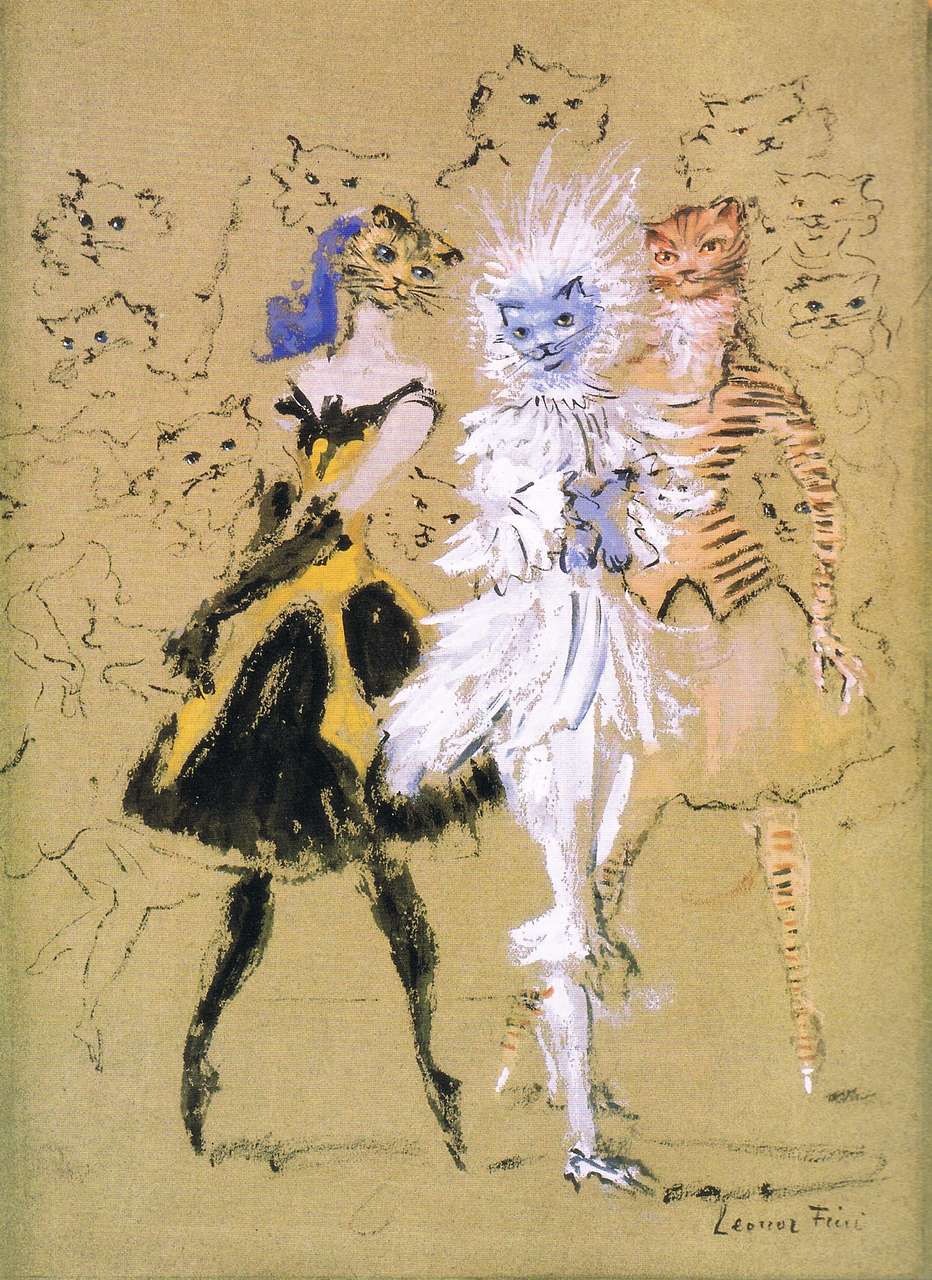
Petit decided that the centrepiece of his season would be a ballet entitled Les Demoiselles de la nuit (The Young Ladies of the Night). The book, by Jean Anouilh [one of France's premier poets and playwrights (The Madwoman of Chaillot) ], tells of a young musician who falls in love with the beautiful Agatha, only to learn that she becomes a white cat at midnight. His love breaks the spell, but one dawn she responds to the call of her animal friends on the roof and becomes a cat once more. The musician tries to follow her and falls to his death, whereupon Agatha lies down beside him and dies.
Leonor was the obvious choice to design the costumes and sets for the new ballet. She was enthusiastic from the start, and put a great deal of time and energy into the task. First she made numerous gouache and watercolour studies of dancers dressed as cats, and then produced careful costume designs for each character, bearing in mind their need to be able to move fluently as well as to look feline. There were costumes for orange, grey, black, and tabby cats, as well as for Agatha, the white cat. Each female costume included a mask, a short tutu, and little gloves, and for the males there were masks and elegant spotted outfits. Agatha alone had two costumes: a short white sleeveless tutu with mask followed by a soft organza tutu with long sleeves and no mask.
In the creation of the numerous masks, Leonor was helped by Sforzino [Count Sforzino Sforza], and in the programme he was credited with the conception and execution of the masks. Roland Petit himself danced the male lead with Colette Marchand as one of the secondary cats, and he persuaded Margot Fonteyn, star of Sadler's Wells Ballet (later the Royal Ballet) in London, to dance the leading role of Agatha in this new work.
To everyone's horror Margot refused to wear her mask, saying that it was not only cumbersome and inhibited her head movements physically but it also hid the expressiveness of her facial reactions, while Leonor absolutely insisted. A full-scale row broke out amid rumours that Leonor had threatened to burn down the theatre if Margot did not have an operation to enable the mask to fit over her nose. Margot wrote in her autobiography:
We were at fever pitch as Demoiselles came to the orchestra and costume rehearsals. Leonor Fini the costume designer had an obsession about cats and had made perfect cat masks complete with pink noses, whiskers and all. The trouble was that I could not conceive of expressing anything with my head shut in a kind of cat box. A love duet was out of the question, I felt grotesque. L. F. was unwilling to change the design and I suddenly found myself shouting hysterically in French that I refused absolutely to wear it. I was horrified at myself! Never could I imagine doing such a thing at Covent Garden!Leonor created very imaginative sets: for act one, an attic room in which the walls were papered with newspaper, and fish and birds and similar delicacies for cats stood on pedestals; for act two, a bedroom with a large bed on which the principals could dance a pas de deux, and a view of the roofs outside; for act three, a sloping roof with chimneys, dormer windows, and scaffolding. The latter proved to be a little too imaginative, for it was very difficult for the dancers to negotiate. On the night of the dress rehearsal, May 21, with le tout Paris in attendance, led by Prince Ruspoli, part of the roof scenery collapsed as Petit chased Margot across the rooftops. Roland Petit remembered:But it worked and the mask was cut down to an attractive size covering the eyes and a bit of the nose, with the whiskers remaining. Altogether my two costumes for the ballet were ravishing.
Margot disappeared in a pile of bits of wood, cardboard, screws, and nails. The orchestra stopped. The audience held its breath. I was terrified. From the middle of the debris came the little voice of Margot saying in her delicious accent 'continuez, continuez.' The music started up again. Margot climbed out of the rubble and we finished the ballet as best we could. The roof was strengthened and it did not collapse again. In fact it was such a good idea that it played a large role in the success of the ballet.Les Demoiselles de la nuit was one of the theatrical events of the year, with sold-out houses and standing ovations. People commented that they had never seen Margot dance so well before, and Leonor's contribution was widely praised: "The costumes and the famous delicious cat masks, the sensitive and strange choreography and the evocative music together with Fonteyn's uncanny realisation of the cat Agatha, endowed this ballet with an intense atmosphere of feline sensuality."
Irene Lidova, who worked with Petit on the production and later became his biographer, retained wonderful memories of Leonor:
In post-war Paris, Leonor Fini was one of the lionesses of fashionable society. She created a sensation at theatre premières and elegant receptions. Dressed in voluminous and extravagant capes and with spectacular coiffure and make-up, she fascinated me! She was a great worker, a perfectionist who took care of every detail in the making of the costumes (for Demoiselles). Her creations of the cats were superb.
Petit later took his production to London and to La Scala in Milan. The London production at the Prince's Theatre was a great success: "Les Demoiselles de la Nuit is a moving and direct narrative of metamorphosis by the playwright and poet Jean Anouilh. The perfect team that translated it into ballet were Leonor Fini at her most inspired as decorator, Jean Frangaix with the finest score he has written, and Roland Petit as choreographer. Once again we have the greatest artistic resources of the day at the service of ballet."
2: LE RÊVE DE LEONOR
In 1948, following the success of Les Demoiselles de la Nuit, Roland Petit had invited Leonor to design a ballet on a theme of her own choice. Leonor offered him a story about her dreams, featuring an enormous reclining effigy of herself. When Leonor arrived in London, she was unhappy with Petit's choreography and his use of Wagner's music. But a new production had been announced, so Petit's ballet was performed at the Prince's Theatre in February 1949 without scenery and in practice costumes, with no mention of Leonor's scenario, as an abstract ballet called Pas d'Action.
The night before the premiere the leading dancer, Nina Vyroubova, hurt her back and Renée (later known as Zizi) Jeanmaire had to learn the part in a matter of hours. Disaster was averted, but the ballet was not a great success.
After some acrimonious discussions, Leonor persuaded Frederick Ashton (whose filmed version of the ballet The Tales of Beatrix Potter she later found sublime and magnificent) to do the choreography, and he decided to use Variations on a Theme of Frank Bridge by Benjamin Britten instead of the Wagner music, with Zizi Jeanmaire and John Gilpin as the leading dancers.
Leonor explained the ballet, Le Rêve de Leonor, in the theatre programme:
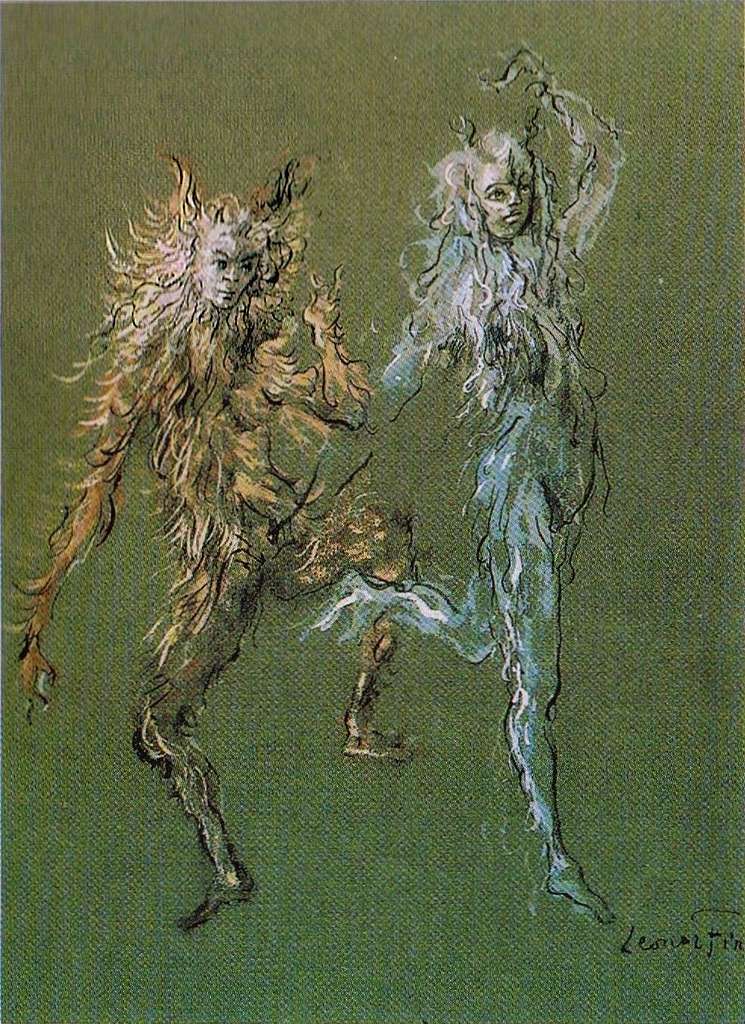
Leonor is asleep in a nocturnal landscape surrounded by her monsters, mandragors, and favourite animals.
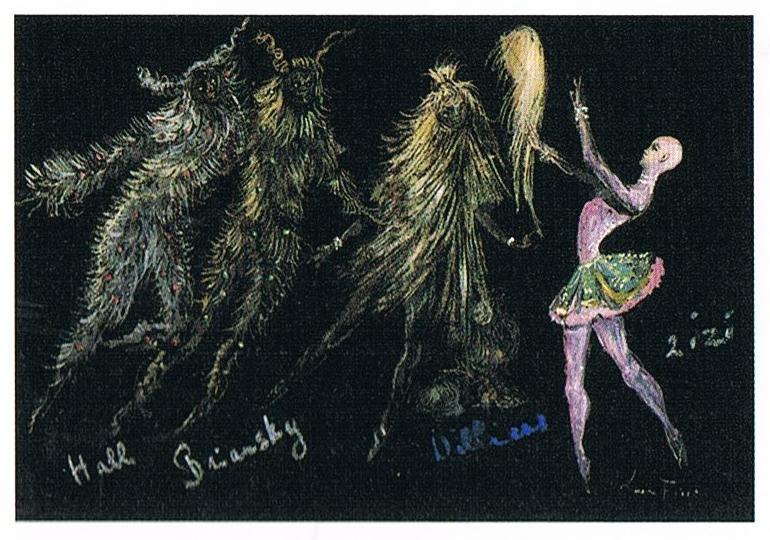
She dreams about a bald young girl--perhaps herself--who chases a beautiful blond wig.
She allows herself to be captured by voluptuous and mocking figures covered with long hair.
She remembers having been Proserpine one evening at a costume ball. A pomegranate sends her back to the Underworld, where she is tempted by gluttony in the form of the King Nougat and his whipped creams.
She dreams she has become a white owl and plays games with beautiful feathered beings who help her to escape from a black seducing bird and to kill him.
Then dawn arrives and she awakes.
Joy Williams Brown danced the role of a sphinx and remembered: "The stage was filled with this immense mannequin representing Leonor, and cats and owls emerged from her clothing. I wore a strapless gown with flowers billowing out of the bosom (influenced I think by Pierre Balmain). It was great fun to dance."
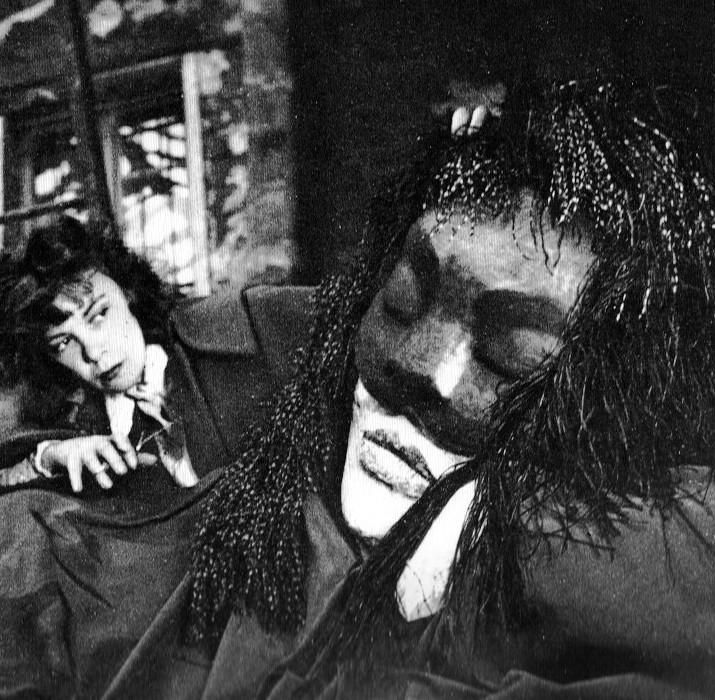
Margot Fonteyn was at opening night and wrote: "Zizi Jeanmaire was bald and chased after a wig that flew about the stage on a wire while girls dressed as whipped cream meringues did fouette turns in unison to dignify Leonor's gluttonous dreams." John Gilpin had to dance the role of King Nougat wearing a heavy curled wig surmounted by a crown of leaves, and Zizi Jeanmaire's costume was a brief concoction of feathers.
The critic of Ballet and Opera thought that the ballet fell between two stools:
The Scenario called for the creation of a mysterious dream-like atmosphere to render acceptable the heroine's irrational metamorphoses: but Britten's elegant music, being divided into variations, necessitated a series of entries rather than a slow unfolding. We were halfway between Dali and the third act of Casse Noisette [The Nutcracker].
EDITOR'S COMMENTS
That critic may be right. Neat little separate acts? Yet I think I know why. Reading Leonor's program summary, I don't see a dream, but a whole night of intense dreams--three or four separate ones. There's a thematic unity--all address appetites. But different desires, different angles. To an audience skimming the surface, it might look scattered. Fini's plot problems may be simple candor: she presents her real experience as a high dream-recaller, and the critic doesn't buy it. I have Fini's problem: half a dozen dreams in a night, some from different REM periods. They resemble her plot summary--thematically unified, but it takes some dreamwork to recognize that.
How I wish I could have seen her Rêve, danced in it... compared notes!
Rêve failed to win over the critics, but after the hit of Les Desmoiselles, was it judged fairly? Even a writer more experienced than Fini might find Jean Anouilh a hard act to follow. He made up his story; it has a waking shape. Under the fur, Desmoiselles is a deeply traditional ballet or opera fable with an easily grasped plot and message: "Stick to your own kind! Those who stray out of their proper realm--human or other--even for love--always end tragically." They must die and then we can cry over them. They don't start a multispecies pansexual commune and scandalize everyone (pretty much what Fini did in real life.)
I'm not dissing Anouilh for his structural traditionalism. It's fiendishly hard to coax a Western audience to follow you into dreaming's own logic and perspective. I've struggled with that for decades, trying different structures, different mixes of day, dream, and explanation. When I have any.
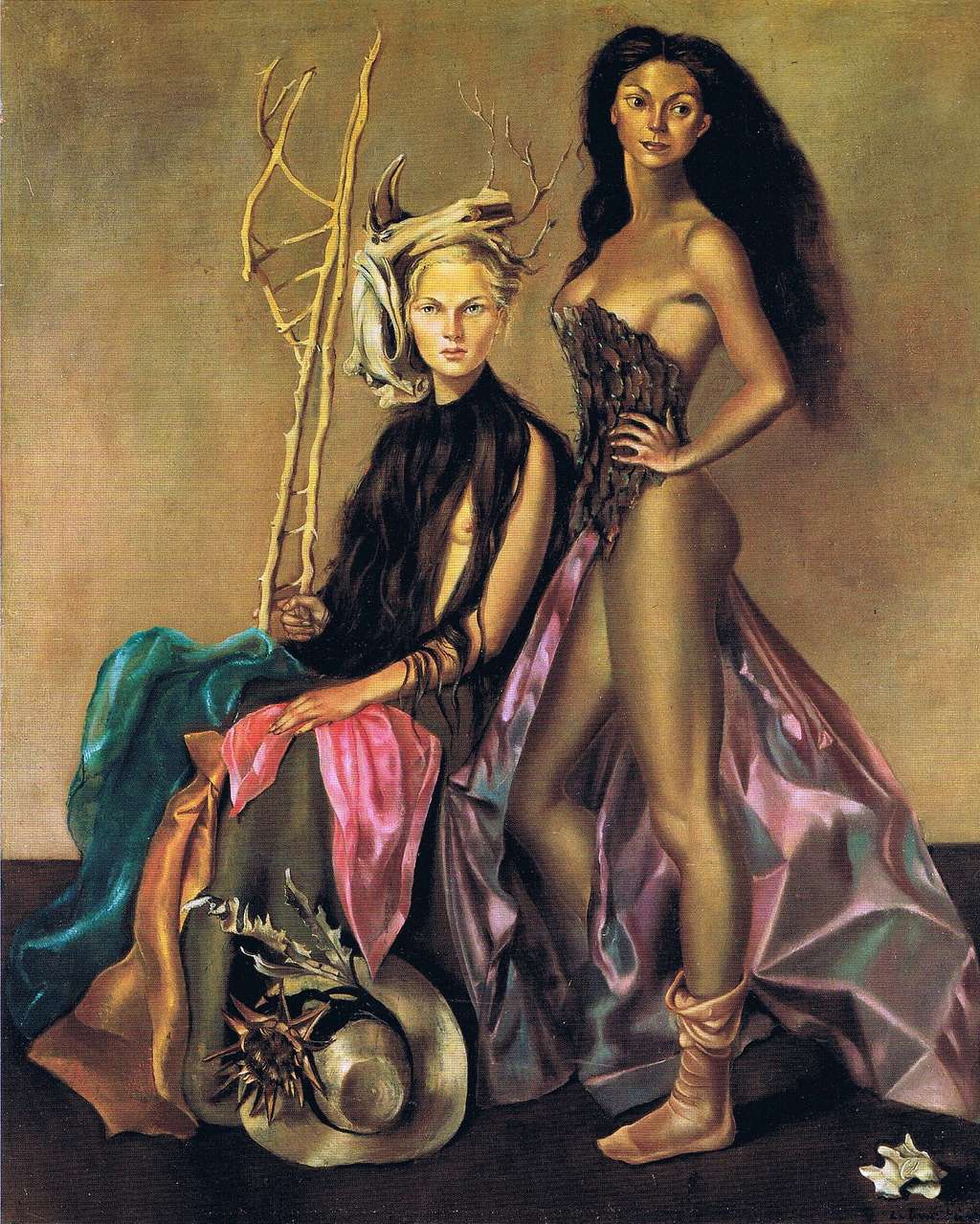
A last thought. What impresses me is partly that they managed this in the late 1940s--the impoverished aftermath of the worst war in history. Rubble and food shortages. And these weren't off-off-Broadway experimental productions and wannabe stars--Fini managed to get her shamanic dreams world-class staging. Her dancer friends, Joy Williams Brown, Zizi Jeanmaire and Margot Fonteyn, were ballet stars with charisma to burn. Here's a 1948 portrait Fini painted of Joy (left) and Margot (right), 'Elles aiment se déguiser' (They Love to Dress Up):
SOURCE: Sphinx: the Life and Art of Leonor Fini by Peter Webb (2009), p.136-8 & 145-7. His primary sources include personal interviews; Gerard Mannoni's Roland Petit, un choregraph et ses peintres, p.58 & 71; Margot Fonteyn's Autobiography p.102, 109-10, 242; Maillard, Cohen & Gadean's Dictionary of Modern Ballet p.115; Irene Lidova's "Leonor Fini in Ballet 2000, #32, summer 1996, p.47; and "Leonor! Leonor!" in Ballet and Opera, June 1949, p.10.
World Dream Bank homepage - Art gallery - New stuff - Introductory sampler, best dreams, best art - On dreamwork - Books
Indexes: Subject - Author - Date - Names - Places - Art media/styles
Titles: A - B - C - D - E - F - G - H - IJ - KL - M - NO - PQ - R - Sa-Sk - Sl-Sz - T - UV - WXYZ
Email: wdreamb@yahoo.com - Catalog of art, books, CDs - Behind the Curtain: FAQs, bio, site map - Kindred sites