World Dream Bank
home -
add a dream -
newest -
art gallery -
sampler -
dreams by
title,
subject,
author,
date,
places,
names
SIPHONIA
by Chris Wayan, 2004-2009
for you who know life sucks
map - regional tours - Peoples of Siphonia - Evolution - (don't click yet: Gazetteer - Glossary) - more worlds? Planetocopia!
INTRODUCTION
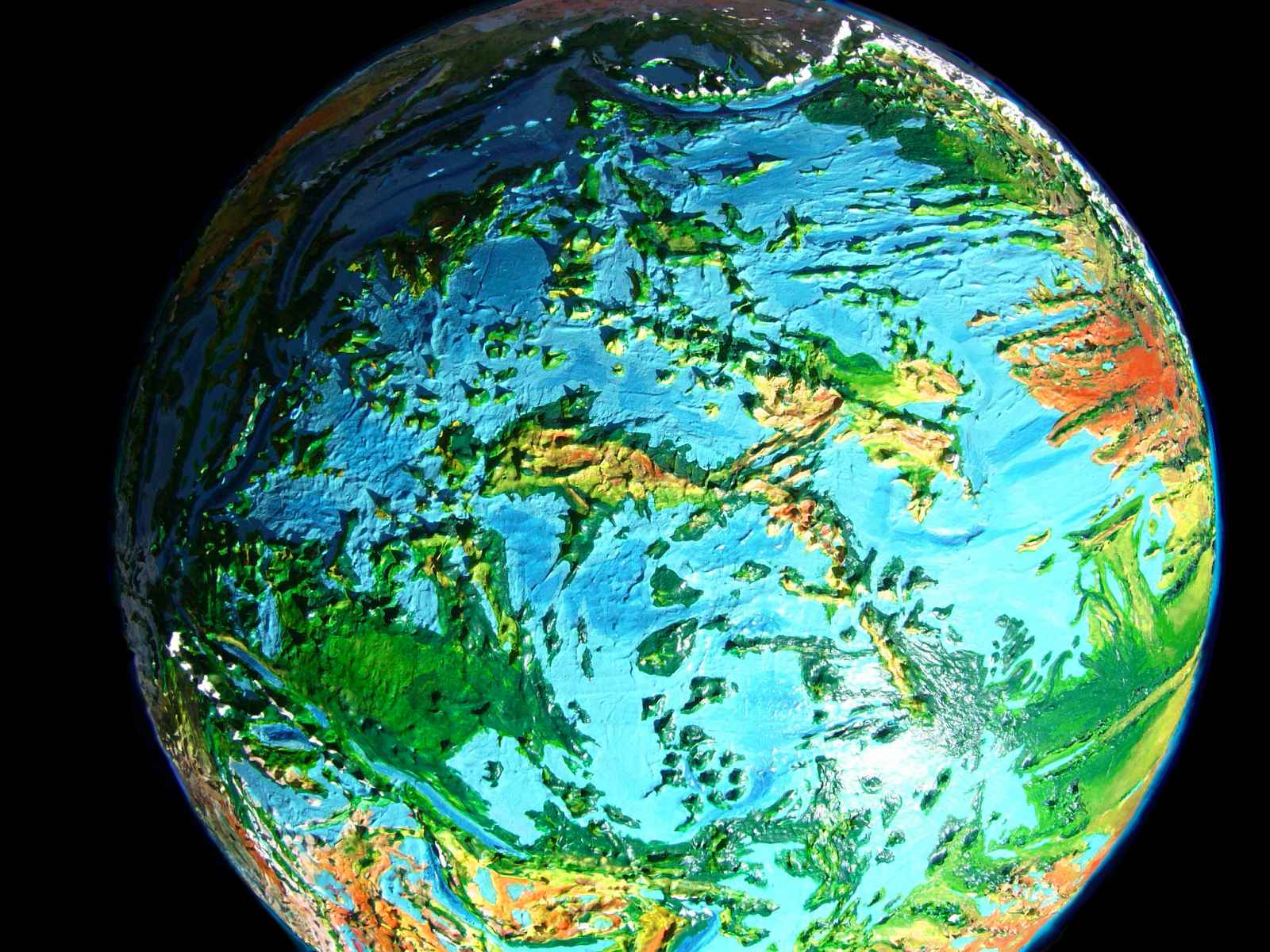
Siphonia's real. You're standing on it. We call it Earth--a peculiar name for a world half-drowned in seas. But not for much longer.
You see, far out in space is a French restaurant a million miles wide. To the customers, who are all the size of Neptune, it's an intimate little place. It's famous for its soups. The chef thinks the day's special is about ready, and pours most of it from the pot where it's been simmering a few billion years. He leaves a bit in the bottom as starter for the next soup.
Sadly for us, Earth is the soup pot. A huge energy-funnel, like a shining space tornado, touches down in the Pacific and sucks up our seas. Salty, fishy, tasty seas! A monster's gourmet delight! In a single day, 90% of our water's gone.
Now fast-forward about ninety thousand years. Tell me: what's Earth like now, after the Big Slurp?
Welcome to...
 SIPHONIA'S FEATURES
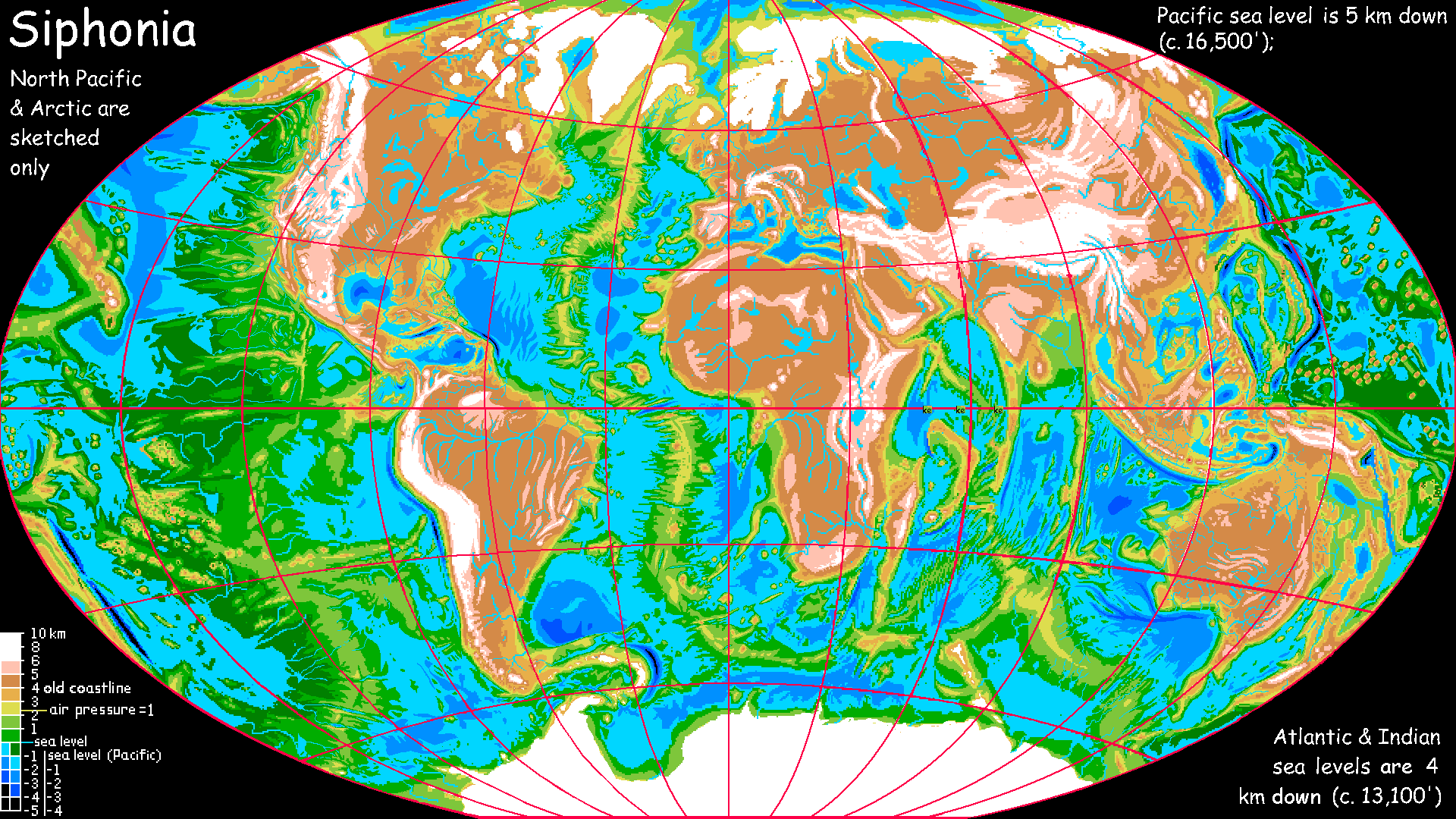
- Water = 10% of Earth's, and much of that's locked up as ice. You'll see why.
- Seas = 35% of surface area, in a dozen shallow, separate seas.
- Land area = 65% of the surface: 125 million sq mi / 312 million sq km.
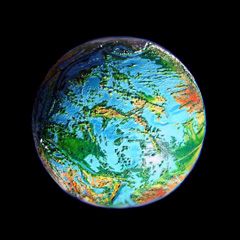
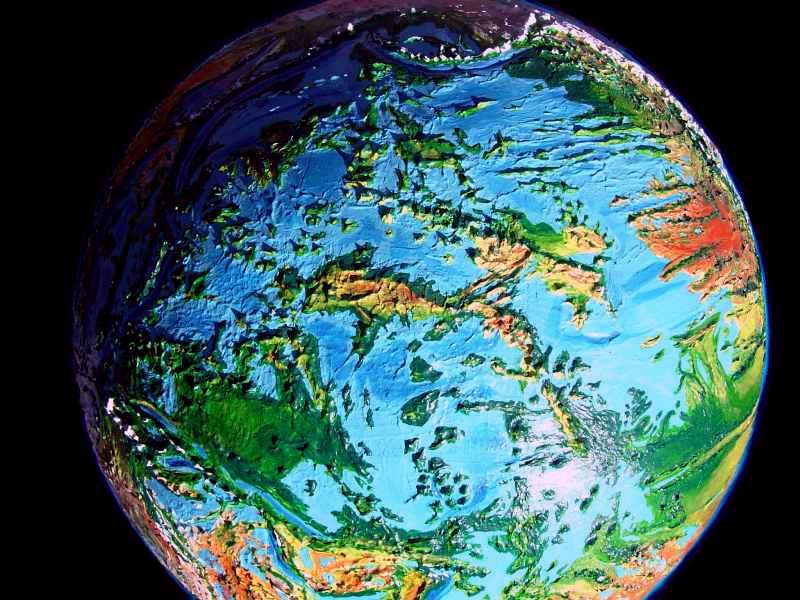
- Relief = high. The highest peak is still Mt Everest, but it's now nearly 13 km above sea level (around 43,000'). The deepest ocean trench is still 6.5 km deep (about 21,000'). Major features of Siphonia:
- many shallow, irregular seas a few million square mi/km in area
- most ocean basins are now lowlands studded almost randomly with solitary mountains 3-5 km high: ex-atolls
- winding ridges with an African Rift creasing the summit: our mid-oceanic ridges left high and dry.
- high, volcano-studded Andean ranges where plates collide or subduct.
- huge, near-Martian shield volcanoes over hot spots.
- Oh, and last, and to the natives, certainly least: huge Tibetan highlands! Plateaus with thin air and little life: our old continents, now barren--and as ignored as the Sahara or Antarctica. (I'm generalizing, of course--some uplands are still quite fertile, especially near the tropics.)
- Continents = none in our sense. The land, covering 65% of the surface, is continuous. Much of it's basaltic, like sea-floors on Earth; much of our granite and limestone are high up and snow-covered.
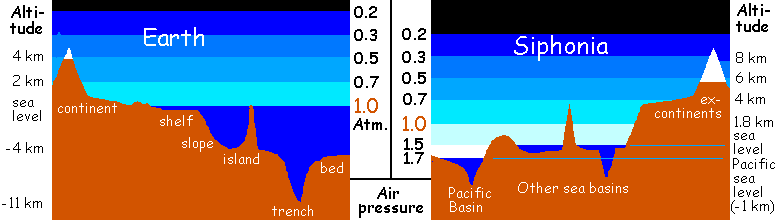
- Air pressure = varied! On the continents, the air pressure's dropped sharply, to about 60% of Earth's--almost Tibetan. Most of the atmosphere is down in the sea-basins. Now, Siphonia's basins aren't as extensive as our single huge sea-level basin below our mountaintops--if they were, the sea-level drop might have lowered continental air pressure 50%, not 40%. But these smaller sea-basins and extensive uplands have an odd effect a Terran might not anticipate: the air-column is deepened! Displaced by all that continental rock, it's squeezed in like a drink in a tall thin glass. The result: on the ocean floors, air pressure reaches 1.2 bars--50-60% denser than at our sea level. The Pacific Deep, a kilometer below the others, has even denser air. In the Deeps, ultraviolet is filtered, sunlight's milder, and heat and moisture are better retained than on our thin-aired surface. Flight is easier--flying and gliding mammals are common, and birds range much larger. In the longer run much of Siphonian life may take to the air.
- Sky color = variable too. Deep indigo on the ex-continents, turquoise to lavender (depending on dust) over most forests and seas, pale greens and whites over savannas, and gold over most deserts. Sunsets tend to be bloody extravaganzas worldwide, as dust levels are high. Thin haze often shrouds the horizon, and at night, only the moon and brightest stars shine through.
- Cloud cover = Dense regionally, but less on average. So much of Siphonia is desert!
- Albedo (reflectivity) = unexpectedly Earthlike. The altiplano, ice and deserts reflect more sun than Earth's more extensive forests and seas. But the cloud cover is generally less. These factors partly cancel out, cooling Siphonia a few degrees more than you'd expect for its CO2 levels. The result: the deeps are livable, but anything 8000' or more above the old sea level glaciates even at the equator, and the ice creeps much lower in temperate and polar latitudes.
- CO2 = 350 ppm. Life's patchier than Earth's, and absorbs less CO2; the seas are smaller, so their CO2 sponge is limited too. The main feedback loop on land: Eruptions belch CO2, the climate warms, rain increases, rocks weather faster, forests and prairies flourish further inland, locking up carbon, and melting ice swells the shallow seas... all sucking up CO2 again. Low CO2 chills uplands and builds ice caps; seas shrink and inland basins dry and die back. With less living vegetation to absorb CO2, levels rise again. On Earth, the loop's a bit different: during ice ages, forests do die and deserts increase, but dust and glacial silt fertilizes seas that are nutrient-starved in warmer eras. Basically, while land plants die back, releasing CO2, the seas bloom, sucking up CO2. Life's net effect is small, so on Earth inanimate factors dominate the CO2 feedback loop: shifting currents, volcanoes, the weathering of fresh rock in new mountain ranges, and of course fossil fuel. But on Siphonia, the seas are always dusty and fertile, so ice-age dust doesn't change much. No plankton boom, no CO2 sponge! The die-back on land is unopposed, releasing CO2--and the ice melts.
- Temperature = Earthlike; global average is 16 C, about two degrees above ours. High CO2 and low cloud cover would make it hotter still, but the wide glaciated highlands--multiple Tibets, Greenlands, Antarcticas--cool the climate. This global average means very little, though: the old sea basins are mostly torrid; away from the seas, summers are hot and winters cold.
- Polar caps = 8% of surface, compared to 3% on Earth (as I write; soon to be far less!) Both poles look nearly icy as our Antarctica. Why so much ice, if Siphonia's warmer and drier than Earth? Simple: there's more land near both poles where thick icecaps can grow. Antarctica and Greenland are fenced in by deep sea. Paradoxical though it sounds, much of Siphonia's far warmer than Earth, yet the planet's in a permanent ice age caused by its own geography. Still, there's a secret under all that blinding white: the caps are thin. Earth's icecaps heap up two miles high, up where the air's too thin to carry enough precipitation to feed them further; in the thin air of Siphonia's uplands, icecaps average less than a kilometer thick--they contain less ice than Earth's polar caps! It's just spread out more.
- Habitats = more diverse than Earth's. The largest on land are ice, desert, steamforest, and tundra/Tibetan barrens; then veldt, rainforest and mixed savanna (scattered trees, groves, or riverine strips in dry grassland), mountain and temperate forests. The shallow seas have far more extensive coral reefs than Earth; all the seas teem with life, fertilized by dust blown off the deserts.
- Biomass = around 25% more than Earth's!
- Land = about 75% as dense as Earth's land biomass (so many deserts and altiplanos!), but there's twice as much land, so total land biomass is 50% more than Earth's. Some rainforests in the Deep are denser than anything on Earth.
- Sea = twice as dense as our seas, but only 75% as much total biomass. Rich but tiny...
- Intelligent species = numerous. See Peoples of Siphonia.
- Civilization = one! Rather than rival nations/races, Siphonia's species have evolved one cooperative society.
- Nomenclature: I've borrowed terms from many different atlases for my sea-floor regions, with common-sense alterations ("rise" becomes "hills", "abyssal plain" becomes "sea", etc).
 WHY BUILD SIPHONIA?
Why waste time on a silly fantasy like Siphonia, you ask? Oh, several reasons:
- Cartographic nosiness. I've always looked at world maps and idly wondered what all those huge bland blue sea-basins really hide. Haven't you? But also...
- Siphonia's my way of thinking about the deep future. Over the next few billion years, Earth will more likely overheat from our slowly brightening sun than dry out quietly, but I still like to imagine Earth as old and dried as Mars. (What will you look like when you're old?) But any projection of Earth's far future would have so much continental drift nothing would be recognizable. So bring on the Big Slurp!
- Siphonia's hideously educational. All these lands are real--huge mountains and basins and trenches, all named and known to a few researchers, but ignored by humanity as a whole--less known, really, than Mars.
- But really, something else motivated me. Not just fun, speculation, education. Something spiritual that's hard to explain to non-artists. The joy of showing you a huge, miraculous world you don't see any more, numbed by habit and familiarity. You take Gaia for granted. But let her do a strip-tease, and you suddenly look again.
And she's a bigger, craggier, wilder, more fascinating goddess than you ever dreamed. Ooh, those volcanic cheekbones!
STATE OF THE PROJECT
As of early 2017, I just finished a larger-scale world map, and all regions have local maps and short tours, but ground-level sketches and descriptions of scenes, critters and cultures are still thin.
I feel spread thin myself. So many worlds, so little time, so slow my coding! In 2016 I focused on fleshing out Kakalea, and did; now I'm making regional maps for Inversia, a sister world to Siphonia in which land is sea and sea, land. I hoped to finish those in 2016 but while I've got beta versions of many northern regions on my hard drive the orbital photos need cleanup and laying in; and many southern and especially Pacific regions require serious cartographic work. And then there's Capsica--with a master map, but lacking many local maps and tours. Once these are at least mapped properly, I'll return to Siphonia and flesh it out more. There is an order inherent to all things. Calculation and contemplation, then creation, then survey, then cartography, then ecology, then culture, then dioramas of goofy aliens.
Anyway: Siphonia's still thin on the ground, I know. I shall return.
TOUR SIPHONIA! Click a region above, or choose from:
- Arctic Valleys, sea level to 3 km high
- Atlantic Ocean (our N. & S.E. Atlantic), sea level
- African Ocean (S. Atlantic & W. Indian Ocean), sea level
- Bengal Sea (N. Indian Ocean), sea level
- Australian Ocean (E. Indian Ocean, Tasman Sea), sea level
- Davis Sea (S. Indian Ocean), sea level
- Anzac Basins (N.Z. to Australia), 0.5-2.5 km high
- Mornington Sea (S.E. Pacific) sea level
- Nazca Seas (E. Pacific), sea level to 1 km high
- Agassiz Basin (S. Pacific), 1 km down
|
|
- Pacific Ocean (N. Pacific), 1 km down
- East Asian Seas, 1-3.5 km high
- Javan Seas, 0.5-2.5 km high
- Australia, 4-5 km high
- Amazon Highlands and Andean Cap, 4-8 km high
- African Highlands, 5-6 km high
- Antarctic Cap, 4-5 km high (no, not 7-8!)
- European and Siberian Highlands, 4-6 km high
- Caribbean Lakes, 2-5 km high
- Canadian Highlands, 4-6 km high
|
top - peoples of Siphonia - Siphonia's evolution - Gazetteer
LISTS AND LINKS: More worlds? Planetocopia! - dreams of other worlds - ecology - climate change - evolution - natural disasters - terraforming - sculptures and 3D art -
World Dream Bank homepage - Art gallery - New stuff - Introductory sampler, best dreams, best art - On dreamwork - Books
Indexes: Subject - Author - Date - Names - Places - Art media/styles
Titles: A - B - C - D - E - F - G - H - IJ - KL - M - NO - PQ - R - Sa-Sk - Sl-Sz - T - UV - WXYZ
Email: wdreamb@yahoo.com - Catalog of art, books, CDs - Behind the Curtain: FAQs, bio, site map - Kindred sites