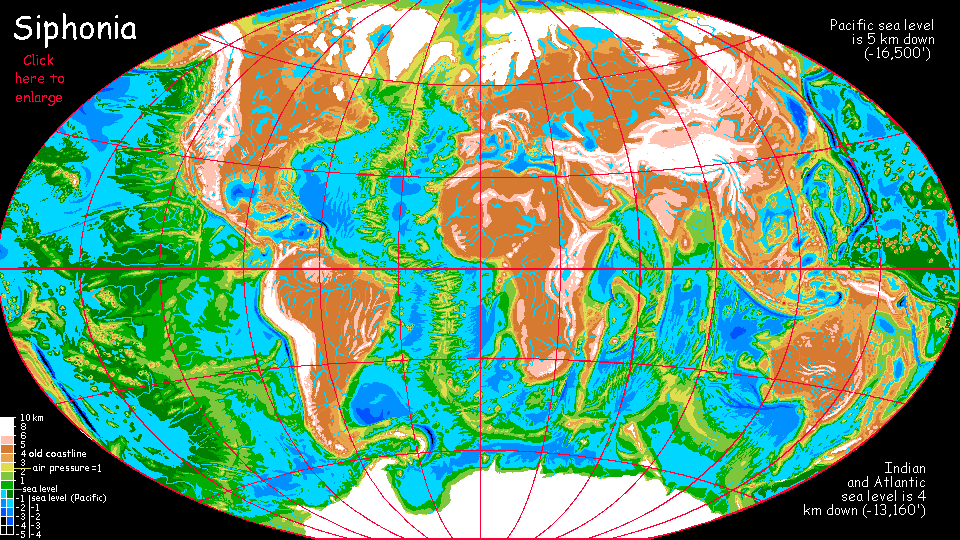
Siphonia:
Europe and Siberia... Brrr!
by Chris Wayan, 2006-9
Siphonia - map - regional tours - People, Creatures - Evolution - (don't click yet: Gazetteer - Glossary) - more worlds? Planetocopia!
Are you an optimist or a pessimist? Do you wince at all the icefields on this map? Not me! I notice how much is not ice!
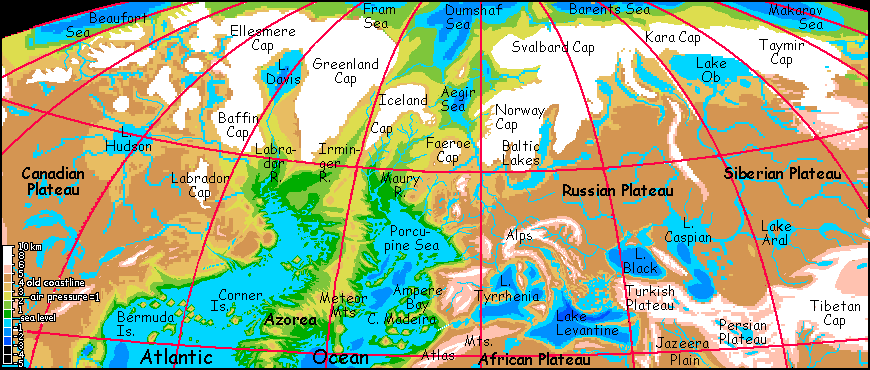
Pessimists will argue that these separate caps should merge into great icefields, as they do in our Ice Ages. I've kept them smaller and separate for a couple of reasons: our polar caps only build up until the top of the ice is in thin air, around half the pressure at sea level; precipitation at that altitude is small and is offset by the flow of the ice outward. On Siphonia's continental platforms, the air is much thinner; the limit is reached much sooner, so individual caps aren't under nearly as much pressure and don't spread as much. They grow mostly from precipitation not creep. But nearly all the precipitation is near the coasts, which have receded; inland Siberia (and Canada) may be cold enough to sustain icecaps, but a bit too dry to build them.
The result is tundra and Arctic barrens over much of Siberia and a surprising amount of Europe. Cool dense conifer forests line the chilly Mediterranean, now a sort of super-Baltic Sea, never freezing in winter but getting snow all round its shores, even in Egypt. Few trees survive north of the Alps.
Optimists have some regions to cheer up about. The North Atlantic valleys from Labrador to Britain are warmer: cool-temperate? These five valleys, Labrador, Irminger, Gardar, Maury and Rockall, together form perhaps the largest region on Siphonia that's midway between the new sea level and the old. Judging purely by air pressure, their climate should be much like France. It won't be, though; Greenland and the new secondary caps of Scandinavia, Iceland and the Faeroes will give it colder weather. The question is: England, or Norway?
I suspect England; the dense air in these valleys can carry a lot of moisture, further moderating the climate. Cool, misty, and damp is my guess. Trees will love it; people won't. At least the people we know. Perhaps, in a milllion years, something better-adapted will evolve. Brown arctic bears already have brains nearly as big as chimps'; might they be on the cusp of a brain-expansion like ours?
Or maybe the British will just go on cursing the weather and carrying umbrellas, in the streets of New London on the Maury or Rockall River, a thousand km west and over two km below the poor old Thames, where caribou wade (in the few months when it's not iced over). Either way, bears or barristers (or bears who are barristers, let's not be specist), these valleys will be an interesting land--mild, green and fertile, yet right below the ice. And not the only place of this sort: consider the new cooler India below the Tibetan icecap, or Amazonia below the great ice wall of the Andes! It's a juxtaposition inconceivable on Earth today--though twenty thousand years ago there were rich grassy steppes right up to the edges of the ice in many places.
But the most paradoxical and fascinating places up here are still further north--polar, in fact. Though this region as a whole has grown much colder, extraordinary things have happened to parts of the Arctic Sea basin.
|
|
Siphonia's homepage - map - peoples of Siphonia - Siphonia's evolution - Gazetteer
LISTS AND LINKS: More worlds? Planetocopia! - dreams of other worlds - ecology - climate change - evolution - natural disasters - terraforming - sculptures and 3D art -
World Dream Bank homepage - Art gallery - New stuff - Introductory sampler, best dreams, best art - On dreamwork - Books
Indexes: Subject - Author - Date - Names - Places - Art media/styles
Titles: A - B - C - D - E - F - G - H - IJ - KL - M - NO - PQ - R - Sa-Sk - Sl-Sz - T - UV - WXYZ
Email: wdreamb@yahoo.com - Catalog of art, books, CDs - Behind the Curtain: FAQs, bio, site map - Kindred sites