| S E N T I A R Y | |||||||||||||||||||||||||||||||||||||||||||||||||||||||||||||||||||||||||||||||||||||||||||||||||||||||||||||||
|---|---|---|---|---|---|---|---|---|---|---|---|---|---|---|---|---|---|---|---|---|---|---|---|---|---|---|---|---|---|---|---|---|---|---|---|---|---|---|---|---|---|---|---|---|---|---|---|---|---|---|---|---|---|---|---|---|---|---|---|---|---|---|---|---|---|---|---|---|---|---|---|---|---|---|---|---|---|---|---|---|---|---|---|---|---|---|---|---|---|---|---|---|---|---|---|---|---|---|---|---|---|---|---|---|---|---|---|---|---|---|---|
| SPECIES | WHAT? | WHERE? | BEHAVIOR
|
ARTIFICIAL INTELLIGENCES
|
AIs are more a phase of life than as a species--you may start out as pure AI and careen through incarnations as a robot, chip-enhanced animal, cyborg or pure organic... Your path varies by locale and preference, but alternating silicon and carbon (breathe in, breathe out!) is wise. |
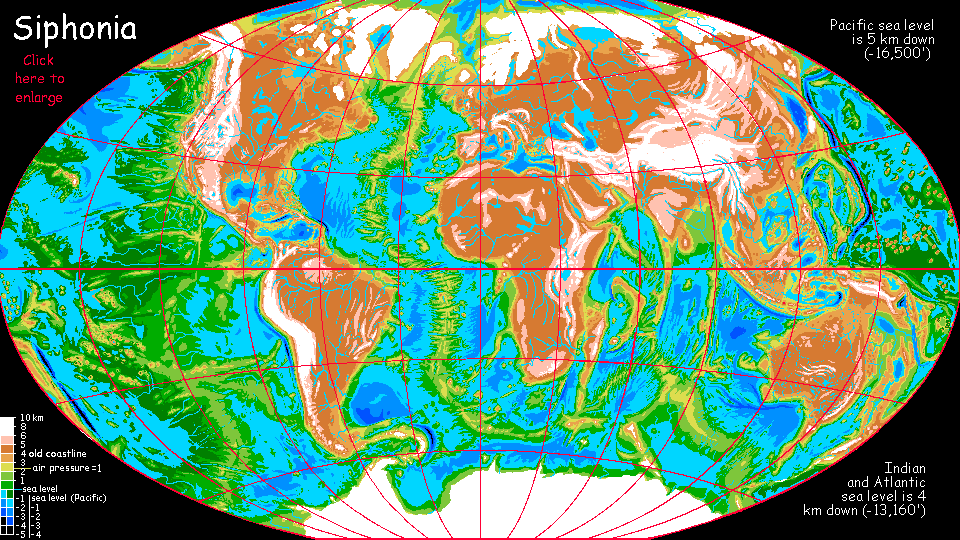
If the technology exists to support them at all on Siphonia, they'll be most visible in extreme environments like deserts, ice, orbital cities... but quietly ubiquitous. |
Pure AIs shouldn't have a species-character, but they do: newborn and old AIs (lacking animal drives) are often sweet geeky idealists, while cyborgian AIs may feel like angsty teens. They'll say their impatience with all-meat people is a joke--but it isn't.
|
BONOBO
|
Chimplike, but leggier and more upright, gracile (lightly built). A gentle, sensual, intuitive and psychologically perceptive people. Omnivorous, but today mostly ethical vegetarians. |
Native to the rainforests of the eastern Atlantic Basin, they're now found around the world in tropical and subtropical lowlands. |
Bonobo communes and sex hostels are famous--people of every species seek healing there. Bonobos living among other species often become doctors, counselors and psychologists--or actors, dancers and standup comics.
|
CETACEAN |
see DOLPHIN, ORCA, WHALE
|
CHIM
|
Omnivorous arboreal apes, small but stocky and strong; descended (literally: three miles down) from chimpanzees. |
Hot rainforests like those in the equatorial waist of the Atlantic Basin, the Penrhyn Sea in Pacifica, and the Bengal Valley. |
Often found in politics and other competitive sports.
|
COCKATOO |
see MEGATOO below
|
CYBORG |
see AI above
|
DOLPHIN | 
These small fish-eating whales are little changed, other than the fingers at their fin tips. Natural selection? Hardly. Blatant gene-tweaking. |
Rocky coasts, especially with offshore deeps where nutrients upwell, like the Atlantic Ocean's Romanche Gap or the Amirante Strait in the African Ocean. |
Jokes, jokes, always with the jokes...
|
ELEPHANT
| (see also MAMMOTH) 
About the size of the Indian elephant. Two races, one much skinner and leggier; a heat-adaptation. Tip of the trunk is more differentiated; most individuals now have three large "fingers," all opposable. Mammoths (see below) are a separate species. |
Worldwide, from the uplands (where they look if not behave quite Earthlike) to the cooler basins (where anorexics reign). |
Clannish? It's hard to coexist with folks you may absently squash! Elephants dominate construction, infrasonic music, storytelling. They invented body murals. And talk like they invented dreamwork, too, but they're just very good at it.
|
GLIDERWOLF
| (related species: WOLF) 
Coyote-sized canines descended from the big-brained wolves common in Siphonia's uplands. Their broad skin flaps let them glide long distances in the dense air of the Deeps, even soar on thermals. |
Mountain, cliff and mesa country of the Deeps that's warm, not too wet, and has air pressure over 1.4 atmospheres. Typical: Clippertonia on the east shore of the Pacific. |
Wolves may be classed as Carnivora, but they were always omnivores; today they're farmers and herders--mostly (high-protein) vegetarians. Their cliff dwellings look like Mesa Verde. Wolf cuisine is famous, expecially wolf cheese, wolf tofu.
|
GORILLA
|
Big, shy, arboreal herbivores, descendants of our lowland gorillas, but with bigger brains and smaller, leaner bodies (to cope with the heat of the sea-basins). |
These evolved gorillas inhabit the hill-jungles of the Atlantic Basin. Highland gorillas, less advanced, live mostly in the equatoriaal forests of the Congo and Amazon Plateaus. |
Lowland gorillas are mostly silvicultural Buddhists. Highland-gorilla brains, lacking the extra oxygen of the Deeps, haven't enlarged nearly as much. Are they even people?
|
HUMAN
| (related species: see BONOBO, CHIM, GORILLA, UTAN) 
Balding, non-arboreal, quasi-amphibious apes. Though rather inept in the water, they cluster along coasts and congregate in great mating rookeries on sunny beaches. |
Worldwide, but rare in the rainforested parts of the Deeps; also rare in inland deserts. |
Obsessed with exploring niches they don't naturally fit in, humans are big customers for strap-on wings, scuba gear, space suits, chip implants, etc.
|
LEMUR
| 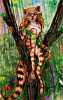
Graceful arboreal primates, Still big-tailed and big-voiced; now add big ideas. That's what a huge new range rich in food and even richer in oxygen will do to a brain... |
Exiled from Madacascar when it iced over, the lemurs settled the far bigger forests of the African Deep; they're spreading into the South Atlantic and Bengal Seas. |
Singers and announcers, of course; lemur rival parrots for the Stentorian Award. Slip-time music, tree-ballet. Their instinct to groom others and sharp sense of smell make them outstanding bodyworkers and healers.
|
LLAMA
| 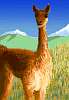
Brainy hybrids of Andean cameloids, including llamas, alpacas, guanacos, and vicuñas. Long forked leathery prehensile tongues serve as a (messy) hand. |
These people graze and farm cool grassy uplands and tundra from Arkansas to China, though they're extinct in the Andes. But then who isn't? |
Extremely curious. Talkative--some might say disputatious--but loyal and responsible friends. Though they do spit.
|
MAMMOTH
| 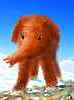
Huge, shaggy, red-haired elephants. Tip of the trunk is more differentiated than in modern elephants; most individuals now have three large "fingers," all opposable. |
Two races, Arctic (Canada, Europe and Siberia) and Antarctic (all round the south polar shores, the alps and icefields of the Andes), and isolated Tibets like Roraima, Kenya, Lesotho, Zealand... |
Arctic mammoths are nomadic. Their oral culture emphasizes storytelling, infrasonic music and of course dreamwork, like all elephants. Southerners are more settled, often living with wolves & ravens in stone crofts with hydropowered arc lights.
|
MEGATOO
| 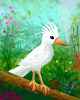
Properly "megacockatoo," but who has the time? These elegant white crested birds have wingspans of 3 meters and weigh 15-20 kilos--including a compact, efficient 700-gram brain; up those numbers 20% more in the lowlands of the Pacific Abyss. |
Common in warmer lowlands. Rare above 3000 m (10,000') in the Pacific or Agassiz Deeps, or 2000 m (6600') in the Atlafric or Australian Deeps. |
If you think of megatoos as giant crested bleach-blonde parrots with sweeter voices, you won't be far off. Social, a bit temperamental. Masters of 3D visualization, with an ear for music to intimidate a whale.
|
OCTOPUS
|
A molluscan people, mostly nocturnal, communicating via signs, pictures projected on the skin, and typed text. |
Rocky shallows and coral reefs. In the Deeps, they're increasingly seen in mangrove forests, climbing out of the water into the trees. |
A shy species, wary of vertebrates and little seen. Dexterous. Good sculptors. Octopus decor beats Rococo for sheer feverish invention.
|
ORANGUTAN: see UTAN |
|
ORCA
|
Giant black and white dolphins, essentially. Often "killer whales" in older texts. |
Coasts where cooler nutrient-laden water upwells and fish abound: the Aleutian and Kurile Trenches in the northern Pacific or the Kermadec/Tonga Trench in the Agassiz. |
Orcas, both individuals and tribes, vary too much to summarize easily. A quirky people.
|
OTTER
| 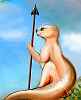
A lake and river people, up to two meters long, based mostly on the giant Amazonian otter. Omnivores partial to fish--and everything else. |
Ubiquitous on rivers, lakes and seashores all over Siphonia, though most common in the warmer Deeps. |
All the cliches are true. Otters really are as playful and good-natured as you think. But their dexterity and cunning rival their social skill--as many otters are civic engineers than sushi chefs, sculptors, or clowns. Most, of course, have more mundane work: fishers, sailors, traders, and dockworkers.
|
PARROT
|
Properly "megaparrots", these red and green omnivorous nut-loving birds have wingspans of 3 meters and weigh 20 kilos (up to 4 m, 25 kg in the Pacific Deep), with a superefficient 700-gram brain. |
Ubiquitous in the warmer Deeps: north Agassiz, the southern Pacific, the Bengal Delta, the Wharton Sea, northern African Ocean and the central Atlantic. |
Often fruit and nut farmers, but parrots are in every field--except solitary work. They're smart, quirky, loud, individualistic... but deeply social.
|
RAVEN
| 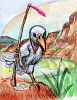
These long-billed omnivorous birds of variable color (black, grey, blue, white and mixed) have wingspans over 3 meters and weigh up to 20 kilos (up to 4 m / 25 kg in the Pacific Deep)--including a compact, efficient 700-gram brain. |
Ubiquitous in temperate (i.e. near-polar) Deeps. Colonies can be found even in the torrid mid-latitudes, at higher elevations. Rare in the tropics. |
Curious, playful, acrobatic. Careers: anything but opera (though raven raps are unsurpassed). Sociable, outspoken, but low-maintenance friends, bearing solitude better than parrots. Ravens turn any task into play.
|
SQUID, GIANT | 
A huge carnivorous mollusc of the deep sea, surfacing only on dark nights. Able to project complex images on their skin, and navigate in three dimensions with unsurpassed skill. More sociable than their ancestors, but still loners by nature. |
Trenches and deeps all over Siphonia, but little seen by other peoples. |
The squid of Kurile Trench in the western Pacific, wrestling whales before huge audiences, qualify as hams--lowbrow perhaps, but the most social of squid. The squid of Meteor Trench (southwest Atlantic) have loftier ambitions--as starship pilots.
|
TREE: | ENTS AND HUORNS
Tree-minds sensing and directing the growth of whole groves, not single trees. Ent isn't a species name; a number of tree-species link like this. |
dense rainforests of the Deeps |
Not an easy group to know, as Ents and especially Huorns (antisocial Ents, though the name may be a joke) mostly ignore animal life, though they may have AI friends and seem to like baleen whales as webpals.
|
TREE: | INN-TREE 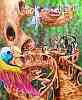
Large sentient trees growing warm, podlike rooms (windows and all). Inn trees bud off food (and social drugs like hot coffee or cold beer) as naturally as a cow gives milk. |
Rainforests like the Philippine Deep, Carolinea in the south Pacific, or the Bengal Delta. |
Tree-inns shelter other species in exchange for gossip, entertainment and nutrients (a euphemism for garbage and shit, OK?)
|
TREE: | MOTHERTREE, TREEMOM, FRUITBEARER
Tree-minds whose bodies are living genetic factories, bearing strange fruit: new organisms, from naturalistic to utilitarian to fanciful... even intelligent. |
Rainforests in the Deeps. Widely distributed but not common anywhere. |
The art of playing God. Species creation. Planetary ikebana, if you prefer.
|
UTAN |
Large arboreal apes with red-brown fur and flattish faces. Vegetarians, still rather solitary by nature like their smaller-brained ancestors, communicating mostly by email. |
Dense rainforests of the new sea-basins. The ex-continents are too cold for them. |
Solitary eco-monitoring, which for utans is a form of worship. Less mystical utans are often engineers, as the species has an extraordinary feel for tools and mechanical processes.
|
WHALE, BALEEN |
Large filter-feeding cetaceans. Several species: gray, finback, blue, etc. |
Dolphins are coastal; sperm whales hunt the deeps; but baleens graze most of Siphonia's seas. Typical calving lagoon: Agassiz Sound, the eastern tip of Agassiz Sea. Largest music festival: Conrad Sound in the southern African Ocean |
It's as singers that the big whales are famed, though their contributions to philosophy can't be ignored. Living centuries without hands, unable to affect the world directly, makes you think.
|
WHALE, SPERM |
Big, squarish-browed toothed whales. The biggest brains in the solar system, bar none (up to 7 kg--yours is 1.5 if you're lucky). |
Deep seas, especially around trenches where small, non-intelligent squid abound. |
The biggest brains in the solar system--and what do they do with them? Championship squid wrestling! More proof God (or Darwin) is asleep at the wheel...
|
WOLF | (related: see GLIDERWOLVES) 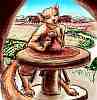
A bit larger than our Arctic wolves, with still bigger brains, and opposable thumbs on their forepaws. Wolves are classed as Carnivora, but they were always omnivores, and today they're farmers and herders. |
Uplands and mountain ranges--wherever the air's too thin for their descendants the gliderwolves. Typical: the Clipperton Range on the east shore of the Pacific. |
Small farms and dairies, Mesa Verde style cliff dwellings. Wolf cuisine is famous, expecially wolf cheese, wolf salsa, and wolf tofu.
| |