CENTAHS
by Chris Wayan, 2004
Map, Tharn's homepage, Peoples of Tharn, Regional tours, Geology and Evolution, gazetteer, terms explained. More worlds? Planetocopia!
SPECIES
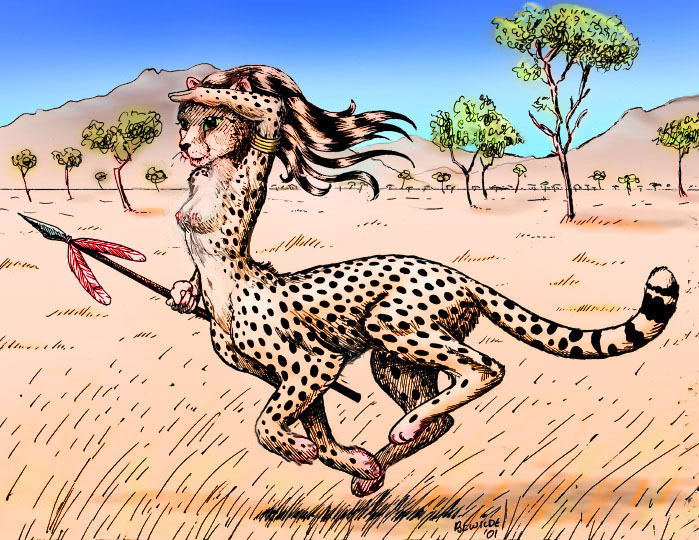
Centahs are gracile, long-legged, rather cheetah-like centauroids, with feline faces, pelts and tails. Not so feline are their high foreheads, huge brains, and stubby but clever forehands--three fingers and an opposable thumb. Coats vary greatly, from spots to stripes to plain, by region and tribe.
The resemblance between centahs and lebbirds is entirely due to evolutionary convergence; they're only very distant relatives, descending from a six-limbed trench-dweller that likely had no feline features at all.
Common on Tharn's high veldts, centahs were successful hunters of small game by virtue of sheer speed, and, later, accuracy in throwing. But centahs were never as strictly carnivorous as Terran cats--as opportunistic as wolves and coyotes, eating fruit, insects, and nuts when available. In recent eons, tool use and trade has broadened their diet greatly. Soon after they discovered zero (centahs like math), they also adopted the alien concept of... salad.
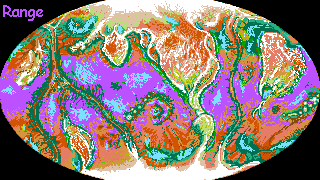
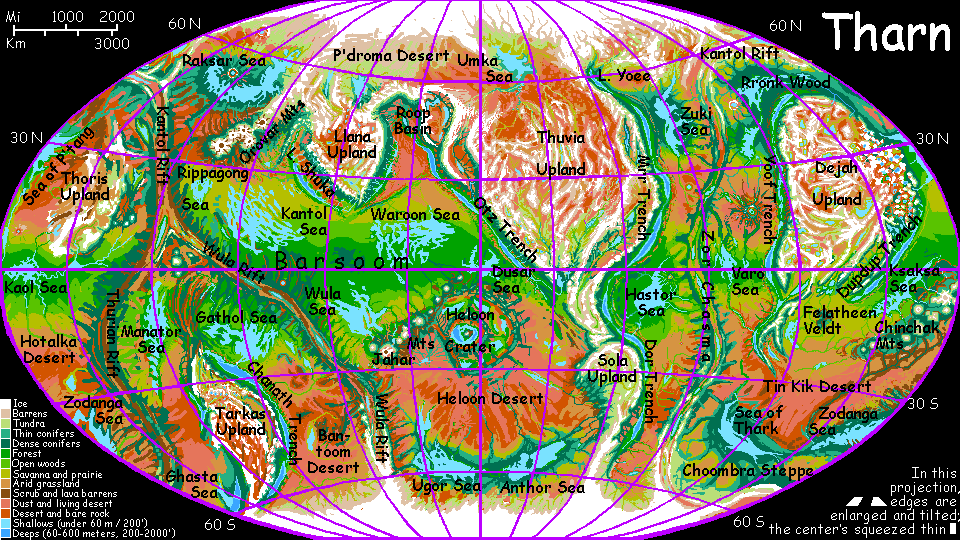
Centahs probably evolved on the huge Felatheen Veldt south of Dejah Upland; they slowly spread around the tropical belt. Curious even for cats, they're great explorers, and discovered and linked many upland and high-latitude peoples far from their native tropics. Runners with strong cardiovascular systems, they can endure the uplands' thin air and the heat of many trenches (though few centahs live in the very hottest lowlands). Like camaroos, they went everywhere, trading, spreading news. Amiable and ubiquitous, centahs were in many ways the catalyst in founding Tharn's worldwide community.
Those familiar with herbivorous veltaurs will see startling parallels--ironic, since veltaurs traditionally mistrusted carnivorous centahs (though there's no evidence centahs ever hunted veltaurs, wingboks or other intelligent species. With a veldt full of game, why attack someone else with weapons? Ethics aside, it's just asking for trouble, and centahs like life easy.)
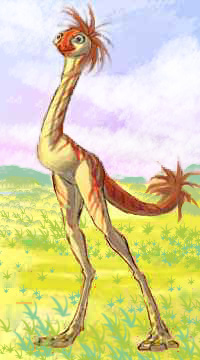
Today many centahs are herders, tending flocks of losha (flightless egglaying ostrich-dino-roos with exactly three moods: panic, the munchies, and utter bewilderment. Guess which one's pictured here) for milk, eggs and meat. Indeed this is how both species spread around Tharn; today several other species herd losha too. And most modern centahs aren't nomadic losha herders--or even rural. Great numbers live in mixed-species villages and towns, in warmer grasslands and open woods around Tharn.
Surprisingly, perhaps, they get along well with other species. Territorial among their own kind, feeling crowded in more than small groups, they seem to find other species unthreatening--perhaps unconsciously seeing them as flocks they're herding, not as rival predators. Losha need a lot of herding; while those identical mops of feathers on head and tail are undoubtedly meant to confuse predators, they mostly confuse other losha. Sometimes the same losha.
Centah families and individuals vary greatly in color and markings, but these aren't very analogous to human races. There is a geographical gradient, though it's the reverse of human dark-equator, pale-polar coloration. Here's a sketch of a girl from the hot Tor Kvas Valley in Heloon; you'll notice she's much paler than the runner shown above; her mane's positively Nordic. The better to reflect the heat!
On the other paw, her elfin look's not racial but adolescent. At nine Earth years (16 local) she's not yet full-grown, as her proportionately huge ears, eyes and paws reveal; as an adult she'll be as tall as the woman shown above. But there is a real difference: this girl will be far lighter in build as well as pelt: lanky, with long spindly greyhound-legs and large ears; "the better to dissipate heat, my dear."
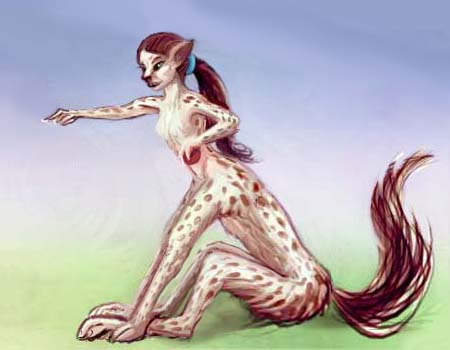
Human slenderness or obesity is largely genetic and dietary; but a single factor determines centah build: the average temperature experienced in childhood. Raise centah twins on the same diet, one in cool hill country and one in a hot trench, and the former will be stocky, the latter delicate and long-limbed. Thus, looking past the fur can tell you a lot about a centah's place of origin, yet next to nothing about ancestry.
Whatever genes control this thermal plasticity, they're not unique--wingbok have at least two analogous genes (or clusters), one regulating overall size (unfortunately including brain-weight) triggered by air pressure or oxygen level, the other regulating sex and fertility, probably triggered by day-length (as in Terran bird migration).
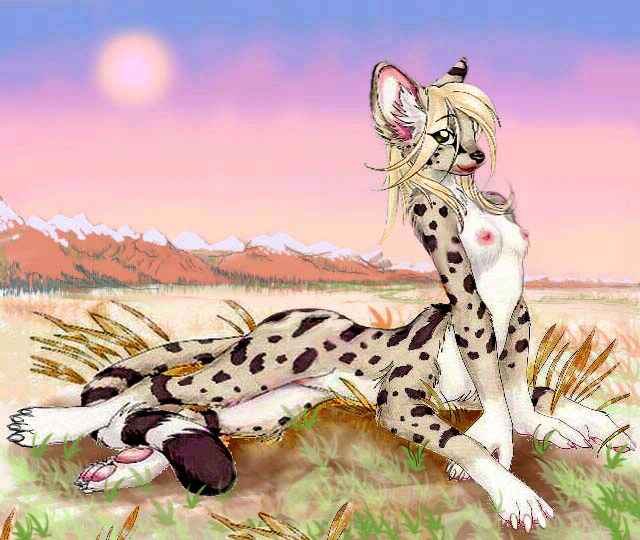
The sketch at right shows a girl from equatorial Felatheen Veldt one evening as she told a story in competition. Note the story-ball showing it's her turn to speak. Just wanted to show how skinny and leggy a hot-weather centah can get...
BEHAVIOR
Centahs are playful, vain (all too aware they're cute) and lazy--or rather, they work in short bursts, just as they once hunted in sprints. They're prone to mystical visions and ecstasy--indeed centahs have a general air of bliss. Some Terran cats (like ocelots) are loners prone to dark bloody moods, but centahs are quite social, for they evolved in small bands of omnivorous hunter-gatherers. They have tempers, but rarely initiate fights. It takes a herd of good solid insults to make a centah claw.
Centahs, like Terran tigers, enjoy swimming and fishing. Few live as fishers, since they can't compete with semiaquatic thotters; but then, who can? Easier to play at the beach and trade for fish--and centahs like life easy.
They're fond of poetry, song, stories, music, dancing, sex--better yet, all of them at once. Feline stretching has developed into a sort of yoga said to promote longevity. Restless, sensual, individualized and often involving contact, it's closer perhaps to dance than human yoga. Centahs welcome touch, and often engage in casual sex-play, both with other centahs and other species; some have been known to form dyadic and group marriages with lebbirds, and even bos and trench wingbok. Veltaurs, the species you'd assume they'd be closest to (after all, both are sensual, centauroid, wingless savanna-dwellers) generally avoid centahs, calling attraction to them perverse.
 It's not the Uncanny Valley, that unease most humans feel towards critters too much like us. Centahs find veltaurs charming despite, or because of, their similarities. The mistrust is all on the veltaur side--apparently based on legends of prehistoric centah predation. (Yet no sane hunter would mess with a herd of veltaurs--they look delicate, but are smart, fast, and skilled in defensive weaponry. On the ancient savanna, before Tharn's velociraptorish equivalents of dire wolves and sabertooths went extinct, you had to be. Guess who killed most of them off?
A few individual veltaurs have overcome their mistrust, less often in dyadic, Romeo-and-Juliet love affairs than by marrying into groups or joining craft co-ops including a centah or two (common enough in multispecies Tharnian cities) and finding an unexpected soulmate. The main problem is always snotty veltaur in-laws--there are half a dozen classic plays mining this theme, from tragedy to farce.
What occupations are common for centahs? Though lightly built by Terran standards, at least they're not hollow-boned like the flying species; thus they have a reputation for strength down in the trench towns where most folks are winged; they often work there in shipping, trade and construction. On the plains and in the uplands, they don't stand out this way, of course; veltaurs and camaroos are quite as strong.
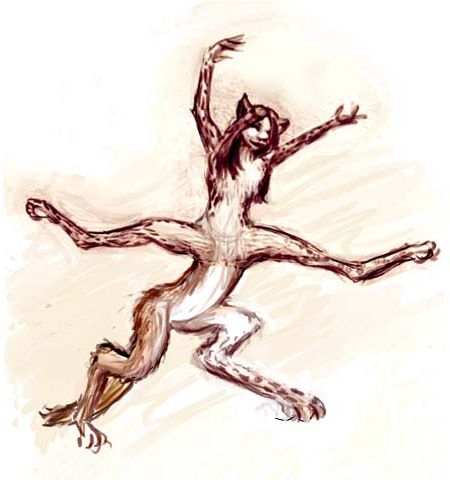
Centahs enjoy chasing creatures, looking alarming and making loud noises, as the sketch to the left attests; getting paid to do it is just a bonus. So herding animals come naturally to a centah. Sentient animals are even more entertaining--you don't need to hire them for crowd control at trade fairs and festivals, just offer them reed wine and they'll do it for free.
But primal centahs also dug earth burrows, and later built sod lodges, so they're more comfortable underground than most Tharnians; as miners, smiths and metallurgists, their only rivals are huge mamooks.
Cat-curious, centahs dominate many scientific societies as well. Solemnity is alien to centahs, but they're quite capable of deep thought.
Lacking squeamishness about blood and with an acute sense of smell, centahs make superb doctors and surgeons; even nervous, high-strung herbivores like wingbok trust them above all other species as diagnosticians.
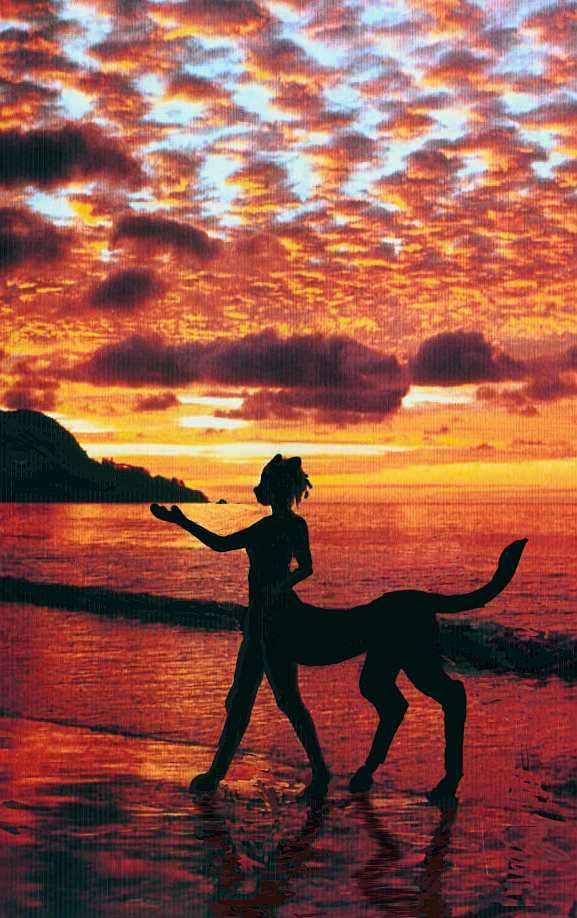
Though centahs don't walk upright, they're still runners who evolved on savanna--unlike Tharnian fliers. Maybe this is why their psychology is so familiar. Grounded? Earthy? Emotionally they resemble bos, another odd-looking but wingless species.
Has walking this vast flat earth truly shaped our minds so much?
CENTAH LANGUAGE
Since centahs are flightless, they've fragmented into tribes the way humans did. But not as severely; centahs love running, are tireless travelers, and never had seas dividing them. The Tharnian Magellan, at least the first on record, circumnavigated the northern hemisphere in a single summer, on foot... on a bar bet. Not an organized quest for treasure or empire, but a casual individual out to get free ale.
My point? Since centahs are far less sedentary or territorial than humans, constant interchange has kept their languages relatively unified. Regional accents and dialects shade from one to the next without sharp boundaries, so it's hard even to make a count of mutually unintelligible languages. Camaroos, who publish most of the dictionaries on Tharn, say about eight; centahs say none, at least for the attentive traveler; and it's true that all their languages or dialects do sound as closely related as, say, Latin tongues; the grammar's much the same and many roots and sound-clusters are the same.
What's absent is equally consistent; for example, there's not a highly tonal language in the bunch; centahs use tone to express feelings--lots of them. Nor will you find a tongue with built-in hierarchy, as in human tongues with different forms of address for superiors and inferiors. A formal centah just slips assonance and slant-rhymes in, until you suddenly find poetry's snuck up on you and out your own lips...
So we may as well accept the centahs' own evaluation, and say there's one centah ur-language with strong dialects. It does reflect their species-character: elegant, alternately soft and crisp. Fur, then claws... and a pleasure in the speaking. A child's delight in luxurious sounds; you can hear it in place names, if you travel in warm savanna regions or desert oases: the Chinchak Range, Felatheen Veldt, Chornis Ridge, Lake Hemitho, the Proom Sea, Lushanta Veldt, Shuka Trench, Tancho Crater, Rippagong Sea...
SHOLIKA'S LOPE: A CENTAH'S TALE
Late one spring, thousands of years ago (but remember, Tharnian years are short; on Earth, the Tang Dynasty was clearing bandits off the Silk Road, and the Venerable Bede was young) a traveler named Sholika was visiting Lake Yoee far to the north of her home in the Shif Shif Veldt. No verifiable portrait of her survives, and accounts disagree whether her pelt was striped or spotted (most likely a blotchy mix of both, common enough in Shif Shif). So don't take my sketch of her too strictly; though her eyes were yellow-green.
Now Sholika had the traveler's itch; she was already far beyond her people's natural range. She may not have realized how far, or what she was about to get into, for Lake Yoee is extraordinarily warm for the northlands. No surprise, as it lies two miles down in Mrr Trench.
Sholika was a bit of a boaster. That spring evening, lapping at her drink in a lebbird inn on the Yoee shore, it got her into trouble.
On a bet, she set out to circumambulate Tharn alone.
Sholika realized skirting the pole would shorten her path, and of course Yoee is already quite far north, committing her to the arctic. So she collected what maps and directions she could, put on her pack, and the next morning set out east.
In sixty-seven long Tharnian summer days, she loped around the world. Magellan on foot! And what a feat it was. Well, four feet...
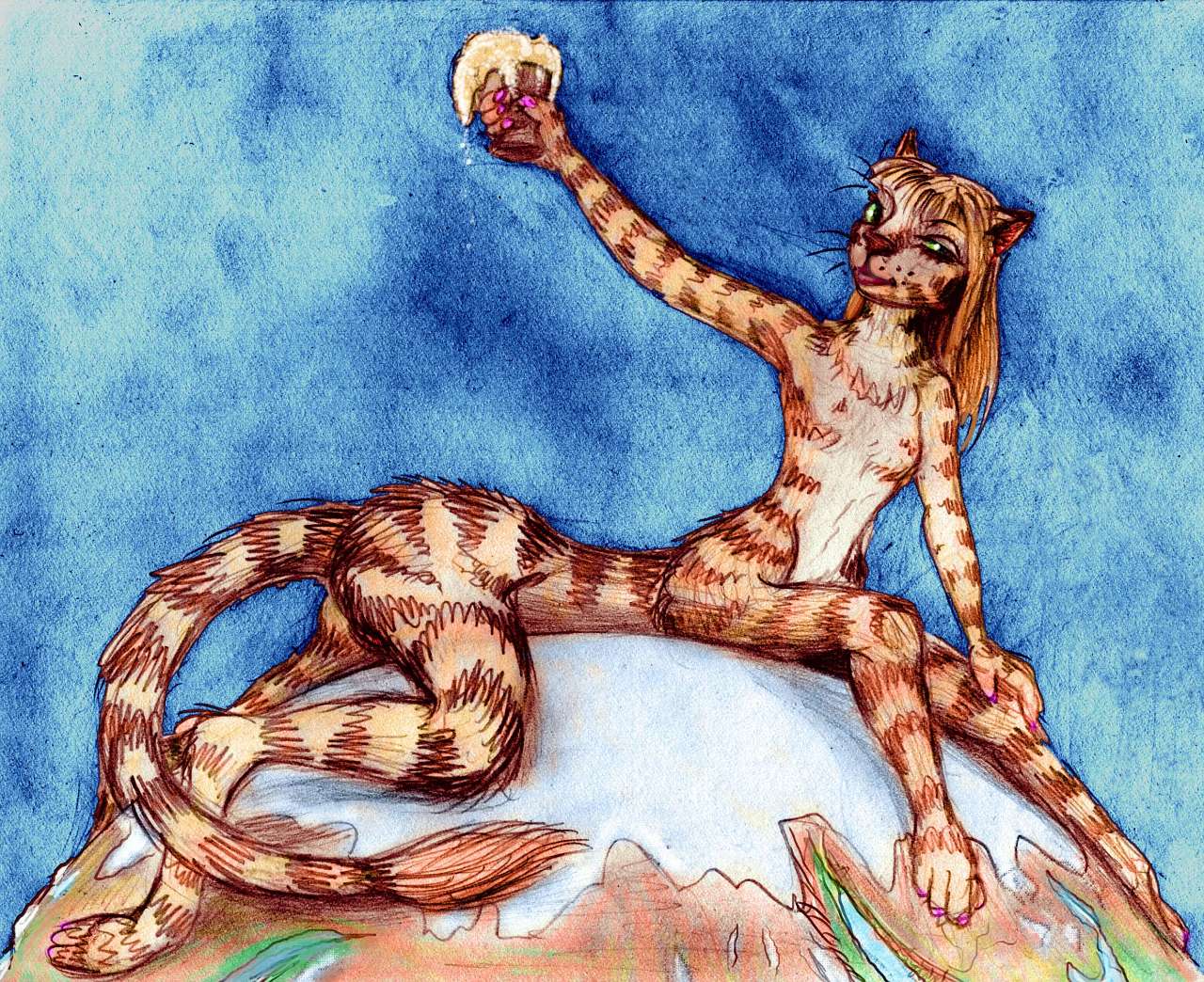
Now that her story's known, every year, a few mamooks get mystically called to walk round the world; and a few camaroo caravan leaders do it by accident, if trade calls. Sholika herself did it on a whim. Not an organized quest for treasure or empire, not a caravan or expedition, just a casual individual out for fun and free ale.
Compared with Magellan's heroic, fatal voyage, it seems so low-key, so... petty.
And yet, and yet... if you see Tharn (and Sholika's Lope) as small, remind yourself: no ships, no seas. No, Sholika's not Magellan, nor even Marco Polo or Ibn Battuta. Her quest was harder. They rode; Sholika walked. Walked around her world, on her own four sore paws.
Nor has it changed. You still travel Tharn on your own power, measured against your own body. Remember that, and suddenly little Tharn feels a lot bigger--bigger, in this deepest sense, the body sense, than Earth has been since humans learned to sail.
World Dream Bank homepage - Art gallery - New stuff - Introductory sampler, best dreams, best art - On dreamwork - Books
Indexes: Subject - Author - Date - Names - Places - Art media/styles
Titles: A - B - C - D - E - F - G - H - IJ - KL - M - NO - PQ - R - Sa-Sk - Sl-Sz - T - UV - WXYZ
Email: wdreamb@yahoo.com - Catalog of art, books, CDs - Behind the Curtain: FAQs, bio, site map - Kindred sites