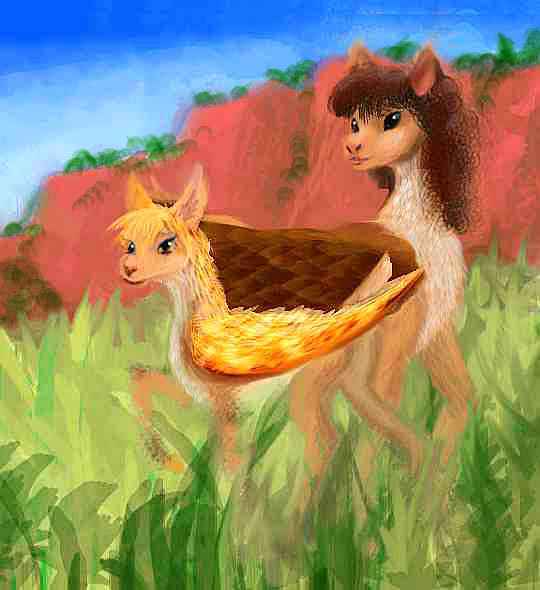
WINGBOK
by Chris Wayan, 2004
Map, Tharn's homepage, Peoples of Tharn, Regional tours, Geology and Evolution, gazetteer, terms explained. More worlds? Planetocopia!
SPECIES
Wingbok are small winged antelope who chase new growth after the rains. Hoofed herbivores--their only manipulative organ is the prehensile, tri-forked, half-meter-long tongue (when a wingbok kisses you, you remember it). The tongue is essentialy a hand with three equally opposable fingers. It originally evolved for browsing trees and picking fruit, under pressure to keep total bodyweight down (precluding neck-lengthening a la giraffe, or a large trunk a la you-know-who). Prehensile tongues aren't uniquely Tharnian; Terran giraffes have them, though unbranched. Browsing implement or not, today it's handy (if you'll pardon the word) for just about everything.
Wingbok are at the weight limit for practical flight on Tharn's surface--and that's near the minimum size for an intelligent being. Wingbok up on the plains, where the air's thin and oxygen scant, are much smaller; those in the trenches grow up to twice their weight--and brain size! Since these air oases are isolated by thin-aired plateaus, each trench holds a distinct race, with little in common... except that all trench wingbok consider the plains wingbok to be not-quite-people. And as we'll see, they may be right.
For simplicity, we'll group wingbok into three broad subspecies; the arrangement has the virtue that most wingbok would agree with it--at least those few who know of (or are) the rare southern subspecies, island wingbok.
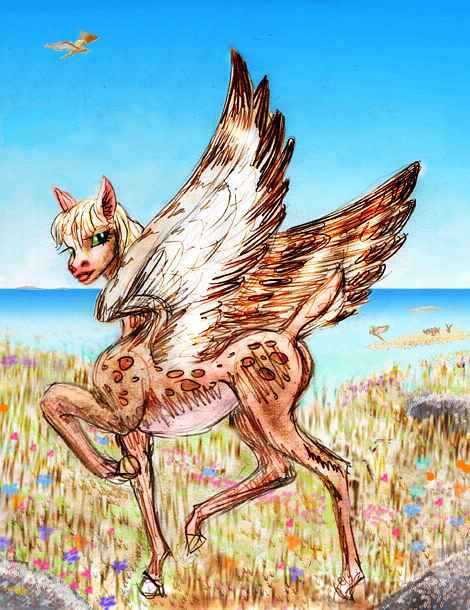
TRENCH WINGBOK
Trench wingbok are shy, sensitive people, with minimal material culture, but rich inner lives. Wingbok psychology will sound strange to readers of ape descent--unless you're painfully shy. Wingbok are constantly on alert, wary of novelty, acutely sensitive to the subtlest threats.
And yet, they don't find this troublesome, for their etiquette takes it for granted and defuses it with reassurances. And they socialize constantly--though sparingly, and always leaving room to bolt.
Emotionally perceptive, astute readers of character, wingbok are never bored, for the smallest stimulus is enough. Just as every glance is a potential threat, every bird-cry is a poem, every rock a sculpture. A touch inflames, and lovemaking overwhelms. Though they seem an austere and materially impoverished culture, they're sensorially and emotionally rich. Unable to bear large herds, let alone cities, they're a whole race of graminivorous Emily Dickinsons.
But they do have a material culture. This may surprise you, given wingboks' lack of hands. Yes, they're best known for love poetry, depth psychology, and aerial courtship dances, but those prehensile tongues (especially working together) can do more than you'd think. Mates and family groups cooperatively tongue-weave brushy roofs for lean-to shelters, though many are cave-dwellers (in low gravity, caves collapse less readily, and thus are common on Tharn). Sharp hooves dig irrigation ditches and plant fruit-tree seeds. Murals and incised bas-relief rock-carvings are common on overhanging walls. They kick stones into intricate rock-mazes and figurative patterns.
Indeed, lines of stones in wingbok trenches are never natural--they lead you to water, shelter, or art. The three basics of wingbok life.
For a comparison of the various trench societies--some of whose populations are, quite arguably, separate subspecies--see Wingbok Cultures below.
HABITAT
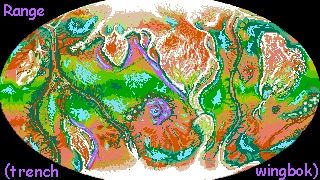
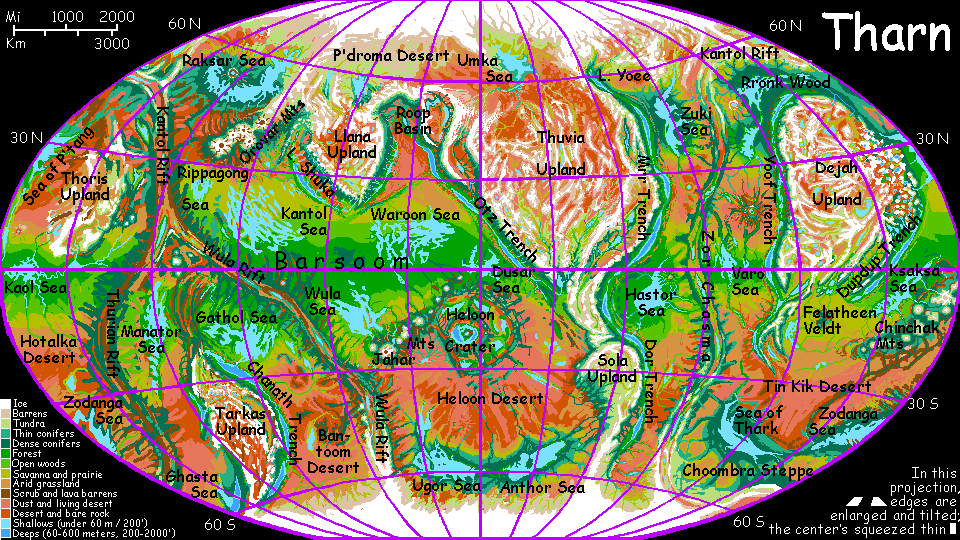
Trench wingbok are low-altitude creatures. They live only in Heloon Impact Basin and in deep subduction trenches around the Barsoom Basin and Chanath Trench to the southwest. In these trenches they may spread up ordinary water-carved side-canyons, as long as they cut well below bedlevel. They prefer veldt and open woods to deep forest or chaparral; with their nervous temperament, they prefer the clear lines of sight on open ground.
Trench and plains wingbok seem at first glance to be two distinct species, but though they rarely crossbreed, they still can; thus, they're listed here separately but on a single long page--though the trench people would resent being lumped in with their elfin, simple cousins. Not that the line is that sharp. In shallower canyons and trenches, where the air is thinner, wingbok are smaller, rangier, with proportionately larger wings and, sadly, smaller brains--grading into the second subspecies, plains wingbok.
PLAINS WINGBOK
Plains wingbok are dwarfed and gracile (slender, light-framed)--as large as they can be and still fly in the thinner plains air. Their culture and language are far simpler; they occupy a hazy border zone between animals and people. Delicate, big-eyed, childlike even when mature, they make trench wingbok feel uneasy--they seem like sexually precocious children. And under the confusion, dread--dread that their vulnerability, simplicity, stupidity is contagious.
 Most trench tribes see crossbreeding as perverse--it seems almost like child abuse, as the plains wingbok are big-eyed and delicate, like trench fawns. Yet it does happen; and hybrids are fertile. The two "species" are in fact just phenotypes! Hard proof exists--orphaned plains wingbok raised in a trench valley grow up full-sized... and smart.
The exact genetic mechanism is unknown, but a growing wingbok's appetite-thermostat or growth-gland must monitor the effort it takes to fly, determines the maximum practical flight-weight for local conditions, and enforces it at all costs--sacrificing even brains for flight--for what it sees as survival. Apparently it isn't just the weight of the brain and skull, but the huge oxygen and sugar consumption of a large brain. In humans the brain burns a good 25% of caloric intake. In a small plains wingbok it approaches 35%! If flight's difficult too, the two fuel-hungry activities are in direct competition--and abstract thinking loses.
The plight of the wingbok is the saddest example on Tharn of environmentally triggered plasticity, but not the only one. Among centahs, a single factor determines adult build: the average temperature experienced in childhood. Raise centah twins on the same diet, one on a cool steppe and one in a steamy trench, and the former will be stocky with big lungs (a grayhound crossed with a leopard?), the latter delicate and long-limbed (a cheetah look). Their brains, however, will be similar, for overall weight doesn't have to be regulated: they don't have to fly!
The case of flyotes may be more analogous to wingbok. Growing up in higher oxygen levels may encourage overall flyote growth--affecting brains as much as wingspan. The flyotes who settled Dupdup Trench grew steadily for twelve generations, doubling in weight (and brain-size) until they rather resembled the largest flying trench-people, lebbirds--about as big as a Tharnian flier can be--then stabilized near that maximum flight-weight. Surely that's too fast for natural selection alone! Still, flyote plasticity is subtle; some still argue the Dupdup explosion was as much nutritional (far better crops in the lowlands) as the removal of a flight-weight restriction. But whatever the cause, it did take twelve generations.
In contrast, the poor plains wingbok who settled Shuka Trench had fawns that might as well have been a different species, who treated their own parents almost as pets. Clever, beloved, talking pets, but not people, not full participants in the new culture. Their bodies had entered the Promised Land, but their minds couldn't; the thin air and sparse food of their own childhoods barred them from their fawns' Utopia. A single generation, and the gap was uncrossable.
There's Tharnian plasticity, and wingbok plasticity.
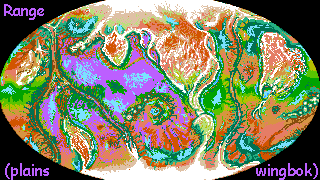
But "even wingbok only shrink so far" as the (non-wingbok) saying goes. You'll notice on the distribution map (left) that plains wingbok are common on all the savannas in one hemisphere--fertile Barsoom and nearby basins--but not the other. Wingbok have so far failed to make it over the high barriers of Thurian Rift and Trunzip Pass to the far hemisphere. The air's too thin (and cold) for them to fly long distances, though they might sign up with a caravan. Still, it'd be grueling. And the likeliest candidates, tiny hill wingbok nearest to the passes, are (due to the altitude) precisely the smallest-brained wingbok in the world, and the most skittish--those least able to face immediate suffering for the longterm good of their fawns. Someday, perhaps. Lebbirds and arthom and elaffs all eventually managed similar crossings into new air oases.
Why not wingbok? Their deerlike shyness of course--worst among the dwarf populations. I know first-hand how shyness can blight one's personal life; but it's startling to see it as a geographic, mappable curse!
ISLAND WINGBOK
In the northern shallows of the Ugor Sea is an archipelago, the Kayakai Islands, where a small herd of plains wingbok got stranded eons ago. They altered so profoundly that we must treat them as a third subspecies, neither plains nor trench wingbok. I'll dub them island wingbok, for what their neighbors around the Ugor Sea call them is quite misleading: "flightless" wingbok. Untrue! Most can fly short distances--but it's not easy. For they're as big as the largest of trench wingbok, 2-3 times the average weight of their plains ancestors, with brains to match.
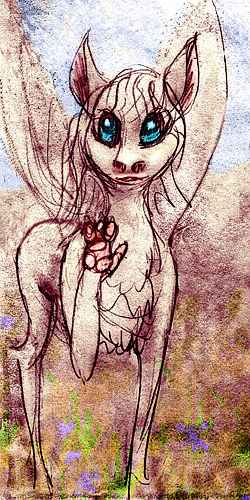
The sketch to the right does not show a mother and fawn; that's an adult plains wingbuck beside an island wingdoe (and not a tall woman at that). Note her higher forehead and proportionately larger skull, as well as a second mutation that may be related to the size-change: dark whiteless eyes like hers are common in trenches as well as the islands, but rare in plains wingbok.
Presumably, a tiny group of plains wingbok flew here during the last Dry Age, when the islands were larger but drier: grass and scattered groves. One mutant individual, big, smart, tool-handy but a poor flier, must have flourished, while similar mutants on the mainland got eaten. His or her descendants became island wingbok. The gene restricting growth so that flight remains practical must have mutated many times all over Tharn. Other temperate islands should have mutants too, but none have ever been found. Their uniqueness suggests suggests either:
- The mutation is rare indeed.
- The Kayakai Eve (or Adam) was lucky, or else mutants in other archipelagoes had terrible luck.
- Predation in ancient times was horrendous.
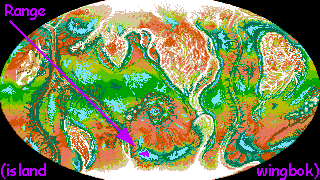
For whatever reason, here alone, they survived: as large and intelligent as trench wingbok, but poor fliers in the Himalayan air--50 meters and they're exhausted! Yet Kayakai wingbok are not unathletic; indeed, they're tireless runners and decent swimmers. The tongue-hand is large, dexterous, and usually holding something; the islanders have a richer material culture than most trench wingbok, with warm, solid, thatched huts, rafts for long lake-trips (to propel them, they just hang on and flap, or catch the winds--living sails!), and even bark hats and ponchos for winter.
Maybe it's the cool climate that's stimulated tool-use, or the lack of a need to stay light (heavy possessions and flight don't mix), or maybe it's the neighbors. Mops have a woodworking obsession, and thotters have reed-woven and sculpted for at least twenty millennia. Was it wingbok vanity--just wanting something cool to trade?
These wingbok have a second distinction: one of the few Tharnian peoples to change their environment on a large scale, deliberately. Island wingbok set controlled burns to clear brush, keep the forest open and parklike, and encourage the sweeter grasses, herbs and berry patches they prefer. Without wingbok, the Kayakais would likely be unbroken forest today with sparse wingbok grazing; they've maintained a patch of the Dry Age that created them!
Why haven't they spread? They can, after all, reproduce full-size out on the plains, unlike all the trench subspecies. I'm not sure. It may be simple: the shores around their artificially open islands are all dense forest, unappealing to a wingbok, and in any case settled by others better suited to the woods. To the islanders, the vast prairies of Tharn that could be theirs are just a distant fairytale.
So far. But all it will take is one reckless couple of newlyweds signing on to a caravan that makes it to Heloon Crater or the fertile plains of Barsoom, who send back excited letters proving to their stay-at-home kin that the wide world over the desert is real.
WINGBOK CULTURES
Sophisticated trench wingbok understand, intellectually, that it's only growing up in thin air that would dwarf them and stunt their minds, and that it's safe for full-grown wingbok to visit or cross the plains on foot, but they still dread and shun the heights.
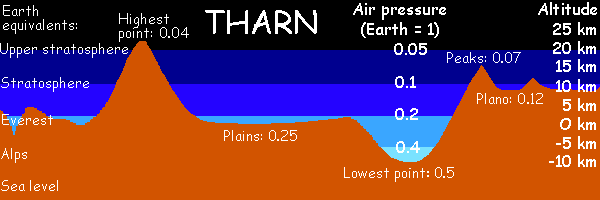
Therefore, each trench culture flowered independently, from plains wingbok bands who discovered an air-oasis, had huge brilliant fawns they couldn't understand, and ended up as immigrants who never quite learn the language, never quite enter the Promised Land. Their fawns coin new words and (re)invent tools and customs--mostly on their own, with no sense of history. Each new trench tribe assumed they were a unique, mysterious anomaly, always in danger of regression back into animality. They only learned other "mutant" wingbok existed when caravaners told them--and they were slow to listen or believe, let alone explore and verify. Trench cultures fear uplander animality too much; they tend to be insular, even xenophobic.
That's the conventional wisdom, at least; but wingbok are still changing. Along with the unusually calm, social wingbok of Okar Trench, consider those around Lake Foosh in Otz Trench, who get along increasingly well with lebbird settlers from the east; lebbirds are as affectionate as housecats, and many Fooshian wingbok will endure and even enjoy petting and tongue-grooming in public, inconceivable a few generations ago. Much the same is happening in Heloon Crater, where many species mingle in large artificial clans. And the wingbok of Roop Basin live with other species able to settle the high ground, though they rarely intermarry, and those of Chanath Trench get along well with flyotes (but then, no one finds flyotes threatening!)
Still... overall, trench wingbok live in their own world and stick to their own trench. Genetic drift has made these trench-tribes look visibly different; but it goes beyond pelts. Every trench is a different breed. While they're still fairly cross-fertile, some of these cousins have diverged in deep ways.
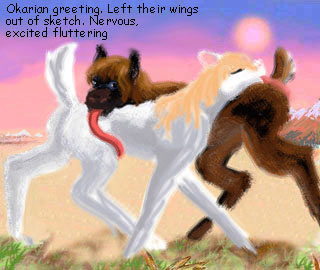
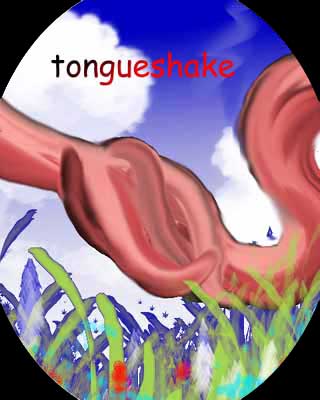
The wingbok of isolated Okar Trench found an oasis with few large predators, as I mentioned. But losing the edge of their antelope nervousness had side effects. They're relaxed, tactile, and as casually sexual as bonobos... or lions. Other wingbok, in greeting, normally tongue-shake or kiss, tasting each other to get a first impression. But an Okar wingbok of either sex will lean their head on a stranger's haunches and taste and fondle their genitals, sometimes to orgasm--and expect the same back. A friendly gesture to them, just a pleasant way to taste who you are! Other wingbok tribes react to this the way a human would, flinching in shock (though it's not moral but sensory overload). Too intimate, overwhelming--and strong feelings, even pleasure, can make a wingbok bolt. Except an Okarian! For they've lost the panic circuit.
They don't seem to miss it.
Southern Chanath Trench has strong seasons--winters here are dark and fairly cold, though nothing like the snowy Siberian steppes 4 km above. The wingbok here, around Lake Tavia, are seasonally fertile. While they still mate all year round, they're only fertile late in the year, so all fawns are born in early summer. The wildly promiscuous fall "mating festivals" outrage the shyer northern wingboks, most of whom prefer to think of Tavians as another species entirely. And yet, Tavians who venture to lower latitudes seem normally fertile and noncyclic; it's unclear if it's the fall chill or the shortening day that triggers their fertility and sterility (or that rush of equinoctial horniness). The cycle has shaped all of Tavian culture: their notion of time and progress are deeply cyclic, and a wide range of ideas from mates and pairbonding (like human marriage), to fidelity, to parenthood itself mean different things in different seasons--and some meanings shock and bewilder other trench wingbok more than they'd shock humans.
Are Tavians developing a true mating season, or have other wingbok lost it?
 SOME UNIVERSALS
Though many wingbok tribes have developed their own languages, they're all (if you'll pardon the pun) the same tongue--the same sound, at least, shaped by that forked prehensile tongue. Consider these wingbok place names from around the world: Tlikki, Hai Lek, Nainechei, Yallanin, Tintei, Liklik, Lelei... Don't they all sound like words from a single language? Yet trench wingbok alone have eight major languages, and hundreds of little plains bands each have their own. Not many words, usually, but their own.
Wingbok may be shy with strangers, but they all love to talk. And sing, and chant poetry. They spend days at it. Narrative choral singing, in which each singer adds a line in rotation, is a curious mixture of cooperation and competition--you want to come off as creative, yet not disrupt the group effort. It's a fine line requiring lots of yitlaki--intelligent sensitivity, a quality even more valued than muscianship.
Individual creativity goes all-out in dance-poems, where a wingbok dances and chants original tales, full of complex inner feelings, intuitions and dreams: a novelistic approach, we might say. But dance-poems aren't pure art: there's a practical purpose. Social standing and mate selection's largely based on impressions gained from song, dance and poetry--wingbok of both sexes want a sensitive, flirtatious, humorous, subtle, shy but articulate mate. Yitlaki again! Wingbok are too high-strung to diss others directly, but there's no question these quiet, friendly, events are subtly competitive. Still... compare them to the roaring song-duels of the mamooks!
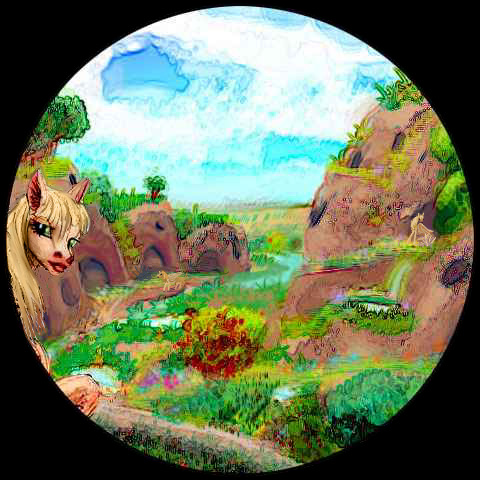
Wingbok architecture is always simple. They make a virtue of necessity; it's a minimalist, nature-loving esthetic. The best house is barely noticeable; the loveliest garden, natural (discreetly enhanced, of course--but evidence of hard work jars a wingbok, rather like a face caked in too much make-up).
There's another factor at work here: wingbok houses, even in the most sophisticated trenches, are more storage sheds than fulltime shelters, for wingbok are a bit claustrophobic and prefer to sleep outside in good weather. Days are spent browsing the land in a mystical communion. Trench folk may express it more subtly, but wingbok spirituality is the same all over Tharn. The Grass Doe, their version of Gaia, speaks to them in tongues--wingbok tongues, I mean. Both taster and hand, it's a sacred instrument. That's why, when wingbok meet, they kiss or tongue-shake. To a human, "seeing is believing"; but to a wingbok, "tasting is knowing". In most wingbok tongues, "taste" and "know" share the same root.
Shy and introverted, theirs is an elusive civilization of words and glances. Not for them the pomp and roar of mamooks--wingbok fear to scare off the Grass Doe, their mother goddess, who they (naturally) conceive of as a still larger, still smarter, still more sensitive wingbok, with lush grass for fur--a shy goddess frightened of mortals' crudity, one to treat gently as a friend, not worship as a creator.
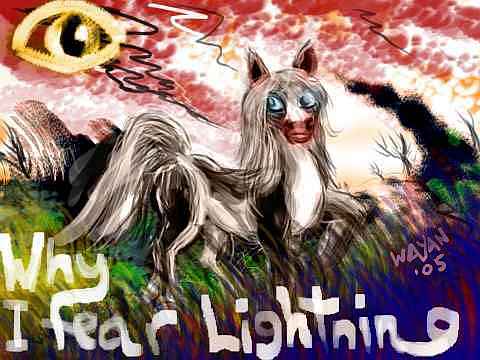
They also have a male god, the Thunderbuck, all flash and roar, bringer of fertility and rain, but also of danger: lightning out on Tharn's great plains can be deadly, for there's little shelter. Wingbok ambivalence toward their Thunderbuck should be familiar to Terrans: it's remarkably like the stormy (oops) relations between humans and their own Thunderdad--whether you call him Allah, Jehovah, Indra, Zeus or Thor.
World Dream Bank homepage - Art gallery - New stuff - Introductory sampler, best dreams, best art - On dreamwork - Books
Indexes: Subject - Author - Date - Names - Places - Art media/styles
Titles: A - B - C - D - E - F - G - H - IJ - KL - M - NO - PQ - R - Sa-Sk - Sl-Sz - T - UV - WXYZ
Email: wdreamb@yahoo.com - Catalog of art, books, CDs - Behind the Curtain: FAQs, bio, site map - Kindred sites