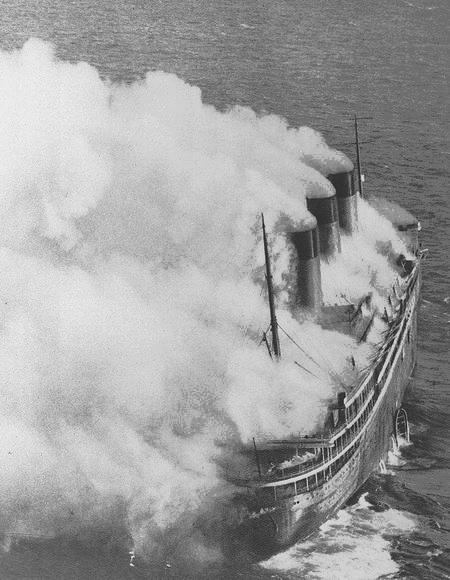
 I am a sailor, about thirty years old, on a large liner. I am afraid because there is a fire in the ship, but I do not realise I am in any real danger--until the smoke drives me back along a narrow passage and I have to climb out of a cabin window because I cannot reach the stairs. I run along the deck but am prevented from going any farther by clouds of heavy black smoke. I look down into the sea where several men are struggling in the fire-lit water. Dare I jump? No, I can't swim. I shall be drowned if I jump. Perhaps if I run towards the bows I shall be able to climb down to a lower deck. Paint is bubbling up into great blisters which burst with a small sharp noise I can hear above the noise of the fire and the sea... My feet are hurting because of the heat of the deck. I must jump. I must. It is better to drown than to be burned...
I clamber over the bulwark, stand on it for an agonisingly long time and then, when a gust of heat singes my back, throw myself forward, trying to keep my feet together as I fall. The sea knocks the breath out of me. I try to swim but I am too heavy, too heavy. The water is crushing my ribs. No, a great hand is squeezing them... Why does the giant want to kill me?
He has let go! I am buoyant as a cork. I can swim! It is very easy to swim. Swim fast, faster! Get away from the burning ship before she heels over. It is almost ridiculously easy to swim. Why did I never realise I could swim so well? I swim very well. I have swum a long way and yet I am not tired. I feel stronger with every stroke I make... A wave lifts me and I see I am very close to an island. The sun is making the water glitter but I can see the palm-trees on the island. The water is kind and smooth and warm...
Then I am no longer the sailor. I am Joan, standing on a shelving beach of white sand, watching a man splashing towards me through the shallows. He is wringing water from his clothes when he sees me. 'Good morning, Miss,' he says politely. 'Extraordinary what you can do when you're up against it! Never done more than paddle in my life, and there I was swimming like a ruddy champ, overarm and all. Not that I wasn't glad to see this island. Belongs to you, Miss?
I tell him that I am only staying here for a little while and that a yacht will come to pick us up before sunset. Where would he like the yacht to take him? 'My ship was bound for Cherbourg, but I'd rather go to Bordeaux--if it's all the same to you and no trouble.'
I ask if he was hungry. I have food, plenty of food, and wine too if he would like it. He says he would prefer a coconut. 'Very partial to green nuts I am, took a fancy to them when I was deck-hand on a cargo-boat plying to the West Indies. I'm on a liner now--very posh job she is...' He pauses, beginning to look anxious, so I quickly change the direction of his thoughts by asking him to show me how to open a coconut. Then I say casually, 'Have you noticed that you're dead?'
'Dead? Me, Miss? Don't talk so barmy! ' He picks up a pebble and throws it into the sea, where it makes a most realistic splash. Then he kicks the sand with his bare foot. 'Dead men can't wiggle their toes. I've seen corpses in my time, and their feet were as stiff as a plank.'
'Was there a fire in your ship?'
'Yes,' he reluctantly concedes. 'But don't let's talk about it. It will be a good story to tell over a bottle of wine when I get home--not yet though, it's a bit too close for comfort, if you see what I mean.'
'How fast can you swim?'
'You seen me,' he says reproachfully. 'Matter of ten knots or more I must have been doing.'
'No one can swim as fast as that--unless he is dead.'
'You been running about in the sun too long without a hat, Miss? Very odd notions sunstroke gives some people. I remember a stoker, proper raving he was, when I was in the West Indies...'
I hasten to interrupt him. I have arranged our present environment with some care and it will only confuse the issue if we find ourselves involved in the playback of a bar fight in Martinique. 'You are dead,' I say briskly, 'and now I will prove it to you. Where was your ship when the fire broke out?'
'In the English Channel.'
'And are there coral islands like this in those waters?'
That shakes him for a moment. It must be one of the Scillies. Never been to them myself, but I've heard tell they grow palm-trees there--which is true, for I can see them, ten good ones, with nuts on.'
'Can I fly? If I fly will you agree that you drowned?'
'If you can fly--no cheating, mind you--it don't count if you've got an aeroplane tucked away behind them trees--I'll give you best, honest to God I will.'
I try to levitate, but so strong is his conviction that I shall stay solidly on the ground that for a moment nothing happens. Then I make an extra effort and rise into the air, do a few fancy swoops and land neatly beside him. Then he laughs, gusts of enormous and complete enjoyment, not at me but at himself.
'All my life I've been frightened of dying, and all it was is this! Never enjoyed myself so much as I have since I drowned. What a joke on my poor auntie who always said I'd fry in hell when I died! If this is hell, give me lots more of it! Where do we go from here?'
'Tell me who you would most like to be with and I will fix your passage,' I say, efficient as a clerk in Thomas Cook's.
'Must they be dead too?'
'Not necessarily. But it would be better as a start. People who are only asleep--like me--are inclined to vanish rather abruptly.'
'Well, there was a very nice bloke who was torpedoed in the war...'
'Think of him hard,' I say quickly. I am beginning to feel misty at the edges and know I am soon going to wake up. I hear a joyous shout of recognition and dimly see two men thumping each other on the back... bottles of red wine on a table, the music of an accordion...