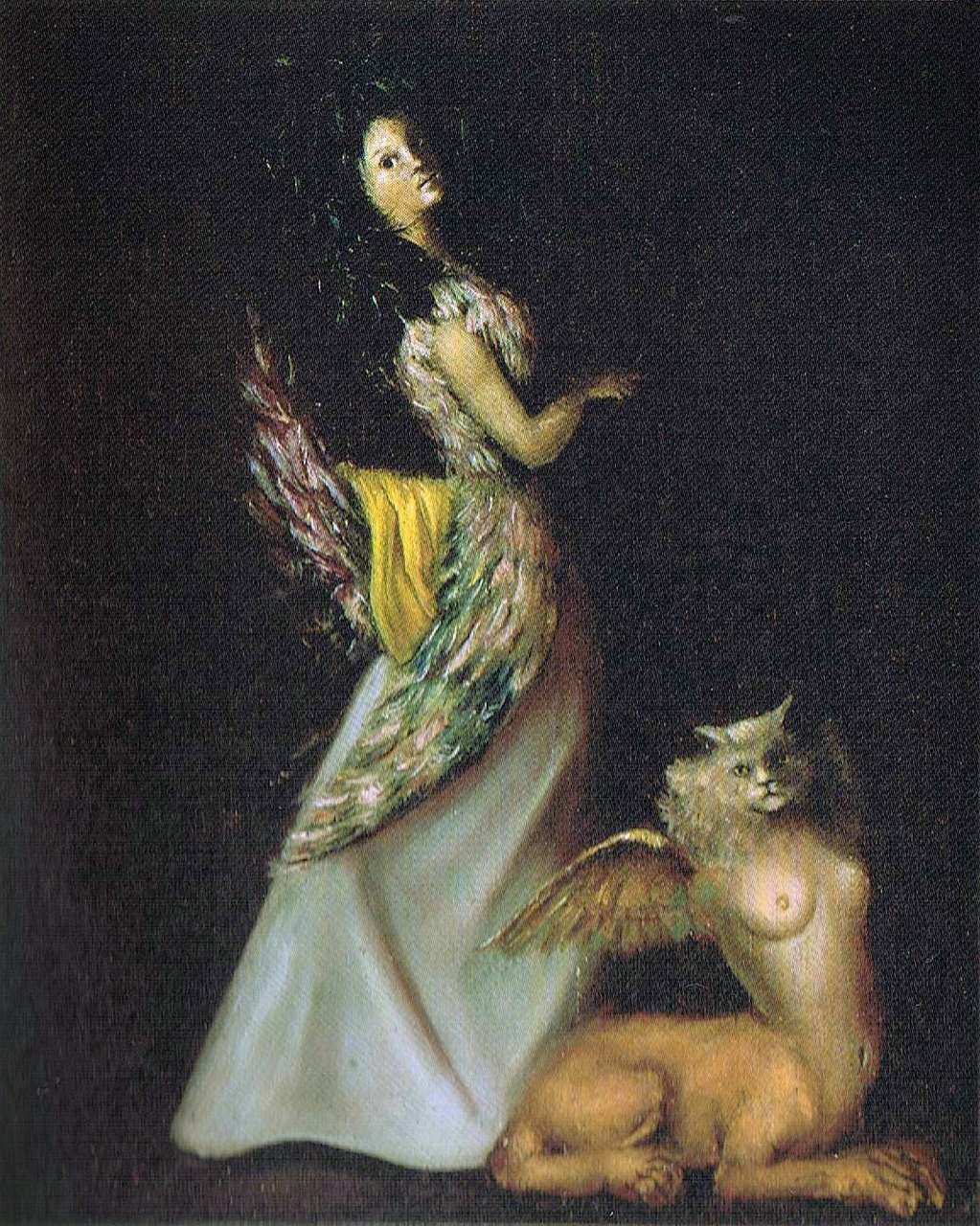
Autoritratto Con Chimera (Self-Portrait with Chimera) 1939 |
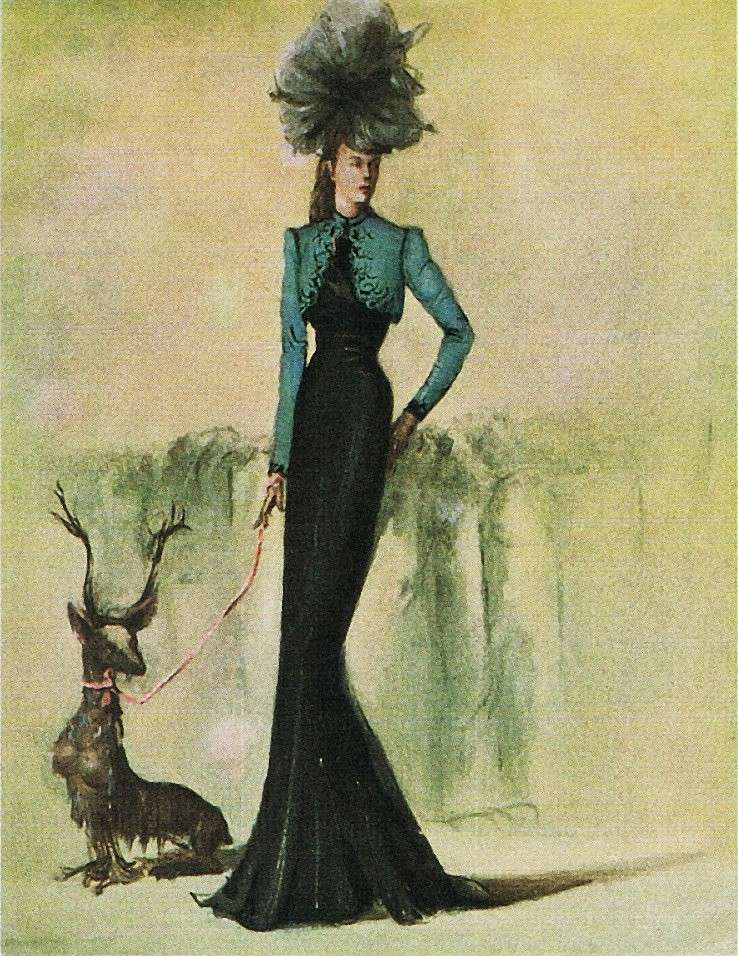
Fashion watercolor for Harper's Bazaar, 1940 |
Sphinxes
Recurring dream- and daydream-images, 1938-47 (at least) by Leonor Fini
In her thirties, surrealist Leonor Fini gradually developed an image of herself as a sphinx. She was very much a cat person (she usually had a dozen), but the sphinx meant more than that to her. It seems to have been a symbol of the balance between conscious and unconscious, human and... not.
They started out as chimeras not too different from other surrealists' strange creatures. At first they weren't selves, but adjuncts or even pets. Dream-beings kept on a leash...
|
Autoritratto Con Chimera (Self-Portrait with Chimera) 1939 |
Fashion watercolor for Harper's Bazaar, 1940 |
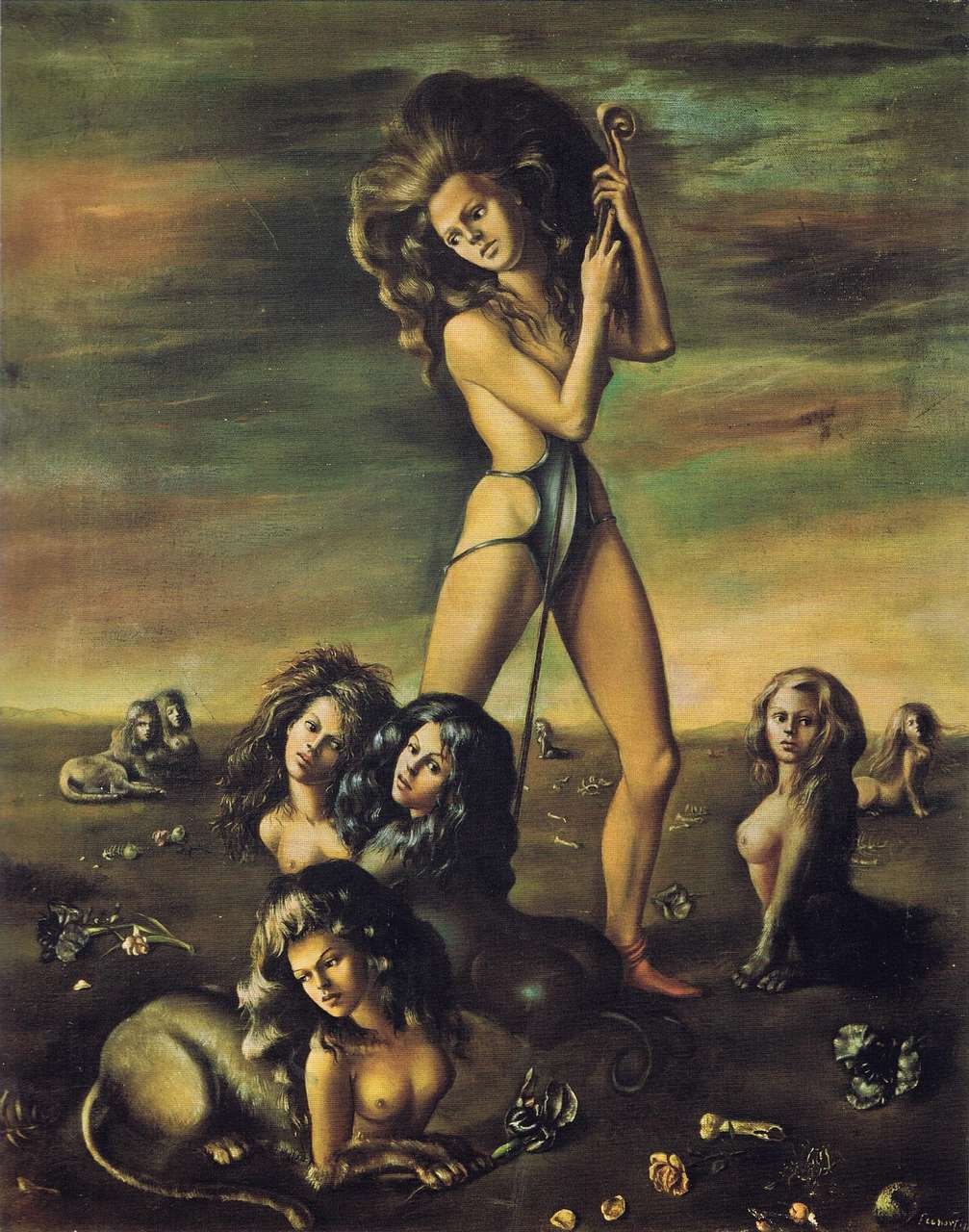
But they evolved; turned more human, more Fini-like. They became self-portraits. In Shepherdess of Sphinxes below, the resemblance between shepherd and flock is close; but the sensual, intuitive, animal half of the sphinxes are stunted, as much piglet as cat--note the bare haunches and curly tail of the dark sphinx in center. They're ambiguous in other ways. Are those bones human or animal? Is this flock predatory? Cannibal? Or are these old relics of past selves no longer relevant?
Gradually, over the decade, her sphinxes' catlike half develops and harmonizes with the human side. The next sphinx is no longer an animal, no longer an object, but a subject, a free agent--unlike nearly all female figures in male Surrealist art. Fini first titled this Sphinx Amoureaux (Loving Sphinx); she retitled it Sphinx Amalburga which she said meant "Protector Sphinx" (Amalburga was from an almanac listing Greek, Latin & Hebrew names). The herd-beast is now the shepherdess, protecting her man from the wolves of war (drafting and killing men by the millions when she painted this).

Note that though shepherds and leashes are gone, and her proportions are far more balanced, she still has a spindly, almost ratlike tail.
But a year or two later...
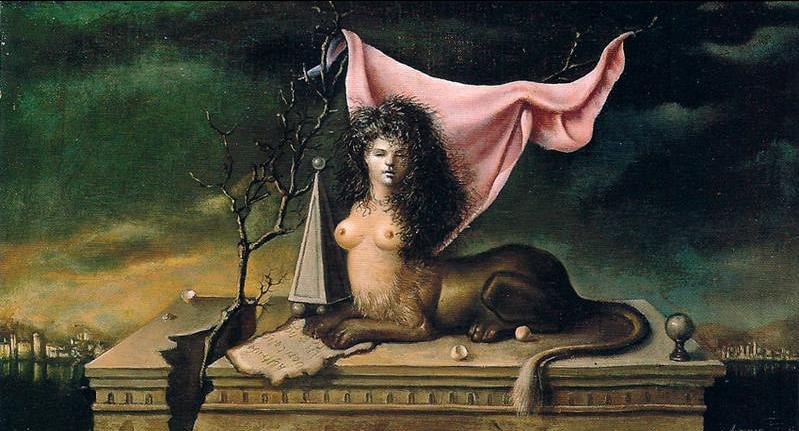
Here she's fully lioness and woman at once. More than that; those forepaws, while looking fully leonine, have apparently learned to draw and write; note she's holding a message (though I can't quite read it). Has Fini's unconscious mastered the brush, can the sphinx now paint freely through her?
The war ended. Fini kept painting...
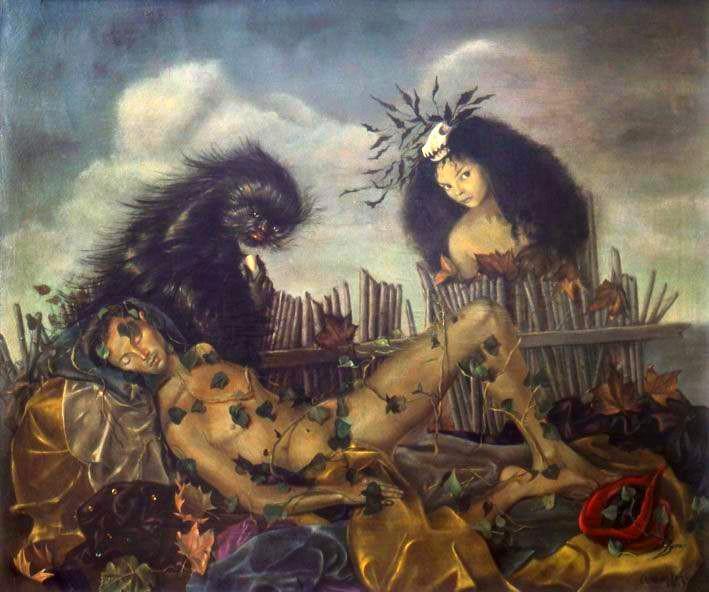
Having fully integrated the qualities of her inner sphinx, there's room now for a new creature! Stryges Amaouri (Greek for "Dark Sorceress") is a shaggy, black, depressed-looking yeti (or a melancholy ancestor of the Cookie Monster), holding, of course, the Jungian egg of wholeness and rebirth.
And after the ugliest war in history, a little sadness is understandable.
SOURCE: Sphinx: the Life and Art of Leonor Fini by Peter Webb (2009), p. 77, 93, 100, 104, 112, 119 & 130-32. (Sorry that later images are only low-resolution; poor scans.)
World Dream Bank homepage - Art gallery - New stuff - Introductory sampler, best dreams, best art - On dreamwork - Books
Indexes: Subject - Author - Date - Names - Places - Art media/styles
Titles: A - B - C - D - E - F - G - H - IJ - KL - M - NO - PQ - R - Sa-Sk - Sl-Sz - T - UV - WXYZ
Email: wdreamb@yahoo.com - Catalog of art, books, CDs - Behind the Curtain: FAQs, bio, site map - Kindred sites